Blog
Welcome to our camping blog, a resource built for anyone who has ever stood in front of a table overflowing with gear and wondered: do I really need all of this? If you are new to camping or somewhere in the middle of your journey, you are in the right place. Our goal is not to sell you equipment, but to help you understand the ideas behind a simpler, faster, and more rewarding way to sleep outdoors. Think of this page as the map of everything we cover here.
Why Simplicity Wins: The Philosophy Behind Simplified Camping Gear
Experienced campers tend to own less, not more. This is not laziness or a lack of budget — it is the result of hundreds of nights spent learning what actually matters. After enough trips, most people discover that elaborate setups create more friction than comfort.
The simplest way to picture it: camping gear is like a toolbox. A professional carpenter carries fifteen well-chosen tools, while a beginner buys a hundred-tool kit and uses ten of them. Experience does not add equipment; it removes the unnecessary.
The core benefits of a simplified setup include:
- Faster setup and teardown — less time fiddling, more time enjoying the outdoors
- Fewer failure points — every extra pole, zipper, and pump is something that can break
- Lower physical load — lighter packs mean longer, more comfortable trips
- Quicker decisions — with less gear, packing becomes automatic instead of stressful
Consider a concrete example. A family arriving at a campsite at dusk with a full tent, footprint, vestibule, and air mattresses might spend forty minutes establishing camp. A solo camper with a simple shelter and a self-inflating mat can be done in minutes and still sleep comfortably. The difference is not endurance — it is design choices made before leaving home.
Swags vs Tents: Understanding the 90-Second Camp
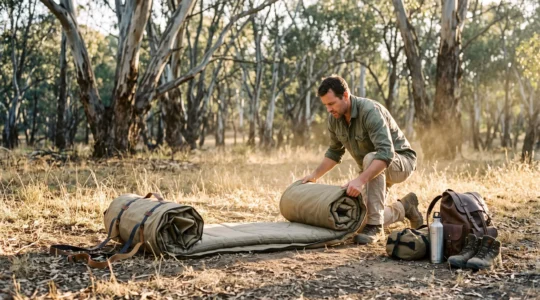
One of the most striking comparisons in outdoor sleeping systems is the speed gap between a swag and a traditional tent. A swag — a compact, rugged canvas sleeping shelter with a built-in mattress — can realistically be deployed in under two minutes. A standard tent, with poles, guylines, and a fly, often takes fifteen to twenty minutes, especially for a first-timer.
Why the gap? It comes down to structure. A swag is essentially a one-piece system: unroll, flip it open, stake the corners if you want, and climb in. A tent is an assembly of separate components that must be connected in the right order. It is the difference between opening a book and building the bookshelf first.
A swag’s typical setup looks like this:
- Unroll the swag flat on your chosen spot
- Flip or fold open the canvas and pole frame
- Adjust the head end and optionally peg the corners
- Climb in — mattress and bedding are already inside
That speed matters more than it sounds. Arriving late, facing rain, camping on a short overnight stop, or setting up with tired children — in all these situations, a two-minute camp changes the experience entirely. Speed is not a luxury; it is comfort delivered before you even rest.
Swag Bag or Ultralight Tent for Minimalist Solo Camping?
For solo travelers, the choice usually narrows to two contenders: a swag or an ultralight tent. Both serve the minimalist philosophy, but they express it differently.
A swag is heavier but more complete. It bundles shelter, mattress, and often bedding into one rugged unit. An ultralight tent is lighter on paper but demands separate sleeping gear and more careful site selection.
Here is how they compare for solo use:
- Weight: ultralight tents typically win, especially for long hiking distances
- Comfort: swags win, with built-in insulation and cushioning
- Setup speed: swags win decisively
- Durability: canvas swags handle rough ground and weather abuse better
- Versatility: tents suit bikepacking and alpine routes; swags suit vehicle-based and roadside camping
The honest answer is that alignment depends on how you travel. If every gram counts because everything is on your back, the ultralight tent wins. If you camp from a vehicle or a base camp and value instant, cozy shelter, the swag is hard to beat.
Switching From Tents to Swags Without Feeling Exposed
Many tent campers hesitate to try swag-style sleeping because of one fear: feeling exposed. A swag is a single fabric layer between you and the night, and that psychological leap is real. The good news is that the transition can be gradual.
Think of it like learning to swim. You do not start in the deep end — you start where your feet touch the bottom. The same applies here:
- Start in the backyard. Spend a night in a swag close to home so the sounds and sensations become familiar in a safe setting.
- Choose a sheltered site first. Pick a spot near other campers or with natural windbreaks for your first real outing.
- Keep a headlamp and a plan. Knowing you can get up, move, and act removes most of the anxiety.
- Adjust gradually. Once a few nights feel normal, progressively more open sites will feel natural too.
Most converts report that within a handful of nights, the opposite happens: the tent starts to feel like a barrier, and the swag’s openness becomes part of the appeal — stars above, breeze through the mesh, and a genuine sense of being outside rather than inside a small nylon room.
Building a Complete Swag Kit Under 12 Kilograms
A common misconception is that swag camping requires a heavy load. In reality, a thoughtfully assembled full kit can sit comfortably under 12 kilograms. The swag itself — typically between 5 and 8 kg depending on canvas weight and mattress thickness — leaves meaningful room for essentials.
A realistic sub-12 kg kit breakdown looks like this:
- Swag with mattress: 6–8 kg
- Sleeping bag or liner: 0.5–1.5 kg
- Compact cooking set and stove: 1–1.5 kg
- Headlamp, first aid, and small repair kit: 0.5 kg
- Water and food for one to two nights: 1–2 kg
The discipline comes from what you leave out: no chairs, no multiple lanterns, no redundant layers. A useful rule of thumb is the one-use test — every item must earn its place by serving at least one clear purpose per trip. Anything that « mightbehandy » stays home.
Take a fictional but realistic case: Sam, an intermediate camper, built a 10.8 kg kit centered on a 6.5 kg swag. The result was a camp that fit in a car trunk with room to spare, deployed in two minutes, and covered everything from cooking to sleep with zero compromises over a weekend trip.
When a Swag Is Not Enough: Knowing When to Bring a Proper Tent
Honest expertise means admitting limits. The swag philosophy is powerful, but it is not universal. There are clear situations where abandoning the minimalist approach and packing a full tent is simply the right decision.
Bring a proper tent when:
- You are camping with a partner or family — shared shelter beats individual swags in cost, warmth, and social comfort
- Weather demands it — sustained heavy rain, snow, or high winds favor a proper double-wall tent with a full fly
- You need gear storage — extended trips or bad forecasts require space to keep packs and equipment dry
- Bugs are severe — in peak insect season, a fully enclosed vestibule makes evenings livable
- The terrain requires it — alpine or exposed sites may need low-profile, guyed-out structures
The mature version of the simplified camping mindset is not « alwayslessgear » — it is the right gear, matched to the conditions. Carrying a tent when the situation calls for one is not a failure of minimalism; it is an application of judgment, which is the real skill this blog exists to develop.
Start Exploring the Blog
Each article in this category digs deeper into one of the themes above — from gear philosophy and swag setup speed, to kit building and honest limitations. Read them in any order, and let each one sharpen your own sense of what your perfect camp looks like. The outdoors rewards simplicity, and the more you camp, the more you will agree.
Why Experienced Campers Choose Simplified Gear Over Elaborate Setups?
Experienced campers often discover that adding equipment does not necessarily improve a night outdoors. More poles, storage compartments, accessories and specialized tools can create a camp that is comfortable but…
Lire la suite