Outdoor activities
Outdoor activities are the heart of any camping trip. Once the tent is pitched and the fire ring is set, the landscape around you becomes a playground: lakes and rivers for swimming and paddling, woodland trails for exploring, clifftops for photographing, and hedgerows full of birdsong waiting to be noticed. This pillar page brings all of these together in one place, giving you the mindset, the safety reflexes and the practical skills to enjoy nature confidently — whether you are a complete beginner or an intermediate adventurer looking to go further.
Think of this page as a map of the territory. Each section introduces a major theme and connects to detailed articles that go much deeper on specific questions, such as reading water currents, choosing the right lake for a first kayak outing, or photographing ancient woodland in low light.
Why Outdoor Activities Transform a Camping Trip
Camping without outdoor activities is like owning a library and never opening a book. The campsite itself provides shelter, but the surrounding natural world provides the memories. Research into family camping habits consistently shows that structured activities — a planned swim, a scavenger hunt, a dawn wildlife walk — are what children remember years later, far more than the tent or the food.
There is also a safety dimension. Most incidents in the outdoors happen when people improvise: they enter unfamiliar water without assessing it, walk too close to a cliff edge for a better photo, or wander into woodland without a plan. Preparation is not the enemy of spontaneity — it is what makes spontaneity safe. A family that has checked tide times, identified safe exit points on a lake and packed a basic kit can adapt freely once on site.
Water Activities: Swimming, Currents and Choosing Your Spot
Open-water swimming is one of the most rewarding outdoor activities, and one of the most misunderstood. Unlike a pool, a natural water body has invisible variables: temperature layers, currents, submerged obstacles and changing depth. The golden rule is simple — assess before you enter.
- Check depth gradually, entering feet first rather than diving.
- Read the surface: foam lines, debris moving steadily in one direction, or a flat channel between ripples can all signal hidden currents.
- Look at the surroundings: drainage pipes and outflow points should always be treated as no-go zones, because water quality and flow can change suddenly.
- Identify your exit point before you swim, and confirm you can climb out where you plan to.
Cold water shock deserves special mention: it is the summer swimming risk behind roughly half of open-water emergencies. Sudden immersion in cold water triggers an involuntary gasp and rapid breathing, which is dangerous even for confident swimmers. Enter gradually, stay close to shore, and never swim alone. For families with children under ten, a lifeguard-supervised beach generally beats a wild swimming spot; for details on that trade-off, see our dedicated comparison article.
If your campsite is by the coast, add one more habit: consult tide charts every day. Rising water can cut off a sandbank or cove you walked to at low tide, turning a pleasant stroll into a serious situation. A quick check each morning takes thirty seconds and removes the risk entirely.
Kayaking: From First Strokes to Reading a River
Kayaking opens up a different perspective on the landscape — entire shorelines, reed beds and wildlife that walkers never see. Beginners often worry about capsizing, but the real learning curve is in the details: grip pressure (the hand-position error that blisters most first-time paddlers), torso rotation instead of arm power, and small, continuous corrections rather than large sweep strokes.
- Start on a small, sheltered lake that stays calm in moderate winds, ideally one with several easy exit beaches.
- Learn the forward stroke and a basic sweep turn before anything else.
- Practice a controlled capsize and exit in shallow, warm water with a companion nearby — knowing you can get out calmly removes 90% of the fear.
- Only then progress to moving water, always launching from shallow beaches rather than deep docks.
When you graduate to rivers, current reading becomes the core skill. Surface patterns are a language: V-shaped channels pointing downstream indicate the fastest safe route, while upstream-pointing Vs mark rocks lurking beneath. Be especially wary of the boundary line where calm water meets fast water — crossing it abruptly capsizes more novices than actual rapids do. And remember that a fallen tree strainers the whole river: it lets water through but traps boats and swimmers, which makes it more dangerous than visible white water.
Exploring on Foot: Wilderness, Landmarks and Respecting Habitats
Exploring the wilderness around a campsite requires no equipment budget — just curiosity and a few habits. Navigating with natural landmarks instead of technology is a skill worth learning even in the GPS era: batteries fail, signal disappears under dense canopy, and map-reading builds a spatial memory of the landscape that no screen provides. Note the distinctive bent oak, the stream bend, the rocky outcrop; picture your route as a story rather than a blue dot.
Respect runs in parallel with curiosity. A single wide walking line across fragile ground — blanket bog, dune vegetation, moss banks — can destroy protected habitat, and studies suggest such trampling damage affects a large majority of heavily visited wild areas. The habit is simple: stick to durable surfaces, stone and established paths, even when the shortcut looks tempting.
Timing matters too. Dawn and dusk are the golden windows for wildlife encounters, when many species are most active and human disturbance is lowest. Keep a simple logbook of what you see, where and when — recording sightings ethically means noting location without disturbing the animal, and reporting rare species encounters to local records schemes rather than publicising exact spots.
Nature Scavenger Hunts: Learning Disguised as Play
Few outdoor activities engage children as reliably as a well-designed scavenger hunt, and few convert play into genuine nature education as effectively. The difference between entertainment and lasting learning lies in the design of the list.
- Use photo scavenger hunts instead of collection lists: children photograph rather than pick, which protects plants and teaches observation skills.
- Tailor difficulty for mixed-age groups: younger children search for colours and shapes, older ones for species, textures or evidence of animal activity.
- Set a clear rule from the start — look, never touch — so children learn that finding does not require taking.
- Schedule hunts before meals when energy is high and attention is fresh; after meals works better for quiet observation games.
A hunt that ends with ten minutes of sharing — everyone describing their favourite find — transforms a checklist into a story, and a story is what children retain.
Clifftop Views: Photography Without Risk
Clifftops offer the most dramatic rewards of any outdoor activity, and they demand the most discipline. Most clifftop falls happen on calm, clear days when the ground looks solid — the invisible hazard is the overhang: turf that looks intact but hangs over air. Learn to recognise warning signs: cracked soil lines, vegetation hanging over the edge, worn-away grass at the lip, and bird activity suggesting unstable ledges.
- Stay back from the edge — a distance of several body lengths, not inches.
- Use your zoom: a telephoto shot from safety beats a wide-angle taken with your heels over the void, both aesthetically and literally.
- Weight tripods carefully on sloped ground and never leave them unattended near edges.
- Leave when wind rises or light fades, even if conditions look perfect — no photograph is worth a fall.
Ancient Woodland: Visiting, Recognising and Photographing
Ancient woodland is the rainforest of temperate climates: ecosystems that have existed for centuries and cannot simply be replanted once destroyed. You can recognise it in spring by indicator species such as bluebells, wood anemones and wild garlic carpeting the floor, along with veteran trees covered in deadwood and fungi.
Visiting respectfully means staying on paths even when the floor looks inviting — the treading mistake that crushes shallow, centuries-old tree roots around ancient oaks and beeches is one of the most common and least visible forms of damage. Keep noise low to avoid disrupting nocturnal species resting by day, and never carve, stack or remove wood.
For photographers, woodland interiors are a low-light challenge. Stable support matters more than expensive gear: brace the camera against a tree trunk or a rock, raise ISO rather than dropping shutter speed too far, expose for the mid-tones between dark trunks and bright canopy gaps, and shoot RAW so you can recover shadow detail afterwards. Dense forest is best photographed during golden hour, when low-angle light adds depth that flat midday sun flattens out.
Watching Wildlife Responsibly
Observing wildlife is one of the quiet joys of camping, and it works only if the animal stays comfortable. Distance is the first tool: park well back from roadside animals, switch headlights off when watching nocturnal species (a red filter on a torch is even better), and limit viewing sessions to a few minutes — if the animal changes its behaviour because of you, you have stayed too long.
Learn the signals of distress: repeated staring, ears pinned, sudden freezing followed by flight, alarm calls. A comfortable animal feeds, grooms or rests and occasionally glances at you. As for reporting, log common sightings casually but report rare species encounters through proper channels, giving location at grid-reference precision rather than broadcasting exact spots publicly.
Fishing Responsibly: Catch and Release Done Right
Trout fishing can be fully sustainable when catch-and-release is done properly. The survival of a released fish is decided in the first minutes of the fight and the seconds of handling.
- Use tackle strong enough to land fish quickly; a prolonged fight exhausts them fatally.
- Choose barbless hooks — they release faster and cause less damage than any expensive rod upgrade ever will.
- Keep the fish in the water, wet your hands before touching, and minimise handling time; squeezing a trout or laying it on dry grass can kill it days later.
- Revive the fish by holding it upright in the current until it swims off strongly.
- Stop fishing when water temperatures climb too high — warm water holds less oxygen, and released trout rarely survive it.
Protecting Aquatic Ecosystems Around Your Campsite
Every water-based outdoor activity has an ecological footprint, and reducing it is straightforward. Invasive species travel on kayaks, boots and nets — a process called Check, Clean, Dry: inspect gear, wash it thoroughly away from the waterbody, and let it dry completely before the next site. Avoid soaps and chemicals near lakes and streams, since runoff kills aquatic life downstream. Enter the water at durable points rather than trampling shallow vegetated edges, which shelter spawning fish and young fry. And if you notice cloudy water, unusual smells or fish in distress, report it to the local environmental authority — early reports protect entire ecosystems.
Building Your Own Outdoor Activity Plan
Every family and every campsite is different, but a balanced trip usually combines four elements: one water activity, one land exploration, one quiet observation activity and one playful educational activity. Pair a morning kayak session with an evening wildlife watch, or a woodland photography walk with a children’s scavenger hunt. Start small, prioritise safety preparation over ambition, and let each trip teach you something for the next.
The articles linked throughout this page go deep on each of these themes — from assessing water bodies and escaping a capsized kayak to photographing bluebell woods without blur. Use this pillar as your starting point, follow the threads that match your trip, and you will find that the outdoors rewards preparation with freedom.
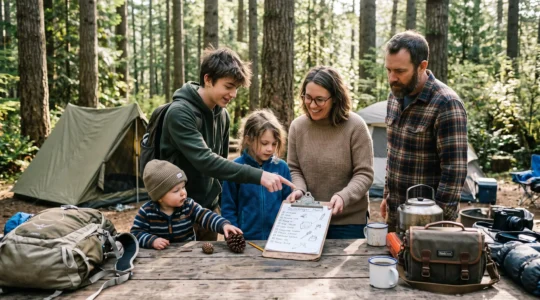
How to Create Nature-Based Scavenger Hunts That Educate Children Outdoors?
A pinecone with tightly closed scales, a bird calling from an unseen branch, or a trail of tiny footprints can turn an ordinary camping morning into an outdoor investigation. The…
Lire la suite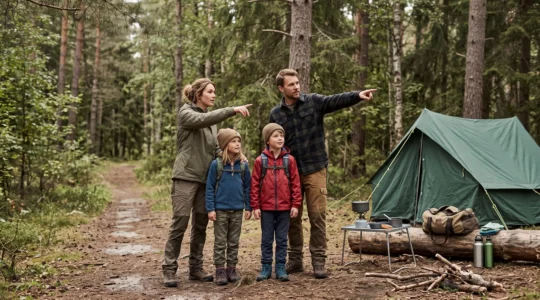
How to Explore Surrounding Wilderness Safely While Camping?
The most interesting discoveries on a camping trip often happen just beyond the tent: an unfamiliar bird call, animal tracks beside a trail, or a woodland floor covered with spring…
Lire la suite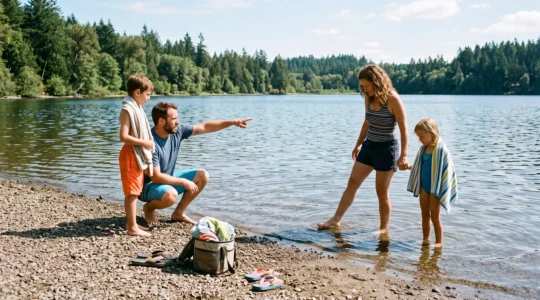
How to Assess Natural Water Bodies for Safe Family Swimming?
A beautiful lake, quiet river or sheltered beach can look perfectly suitable for family swimming while concealing hazards that are difficult to recognise from the shore. Currents, sudden changes in…
Lire la suite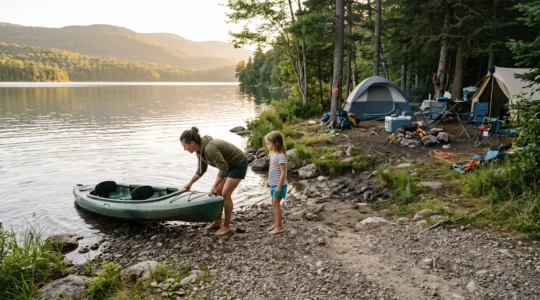
How to Enjoy Lake and River Activities Without Damaging Aquatic Ecosystems?
A peaceful lake beside a campsite can appear untouched, yet its shallow edges may contain fish eggs, aquatic plants, insect larvae and other organisms that are easily disturbed. Swimming, kayaking,…
Lire la suite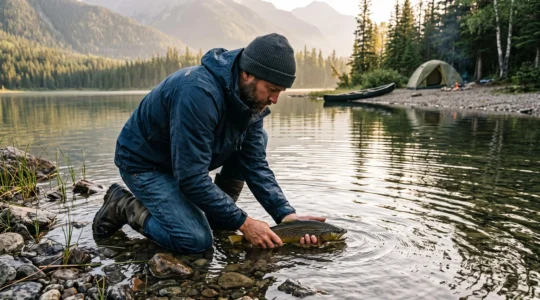
How to Fish for Trout Responsibly Using Catch-and-Release Practices?
Responsible trout catch-and-release fishing begins before the first cast. The tackle an angler chooses, the temperature of the water and the condition of nearby spawning habitat can all affect whether…
Lire la suite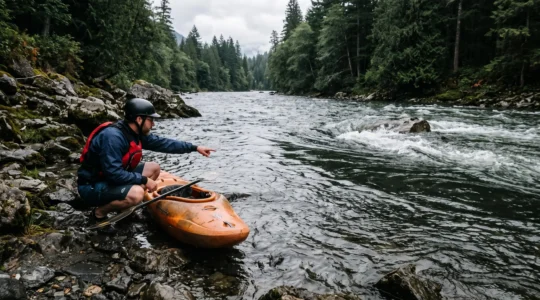
How to Recognise and Navigate Water Currents Safely While Kayaking?
A river can look surprisingly peaceful from the bank while carrying enough force to push a kayak into rocks, submerged branches or a dangerous hydraulic. Recognising water currents means learning…
Lire la suite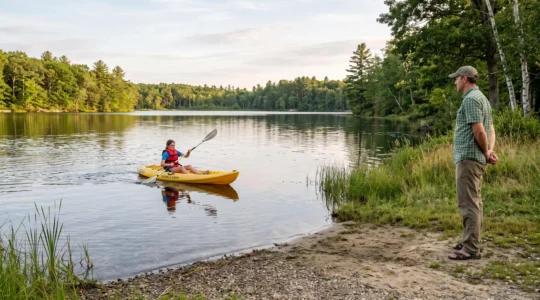
How to Choose Lakes That Provide Safe Learning Conditions for Kayak Beginners?
A lake can look perfectly calm from a campsite and still be unsuitable for someone learning to kayak. An exposed stretch of water can develop uncomfortable waves when the wind…
Lire la suite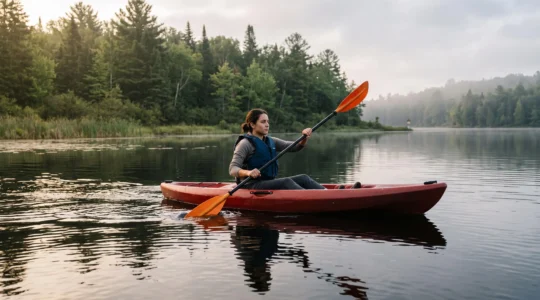
How to Learn Basic Kayaking Strokes for Confident Lake Paddling?
Learning basic kayaking strokes begins with controlling the paddle, not paddling harder. On a calm lake, a relaxed grip, consistent blade placement, and deliberate torso rotation help a beginner travel…
Lire la suite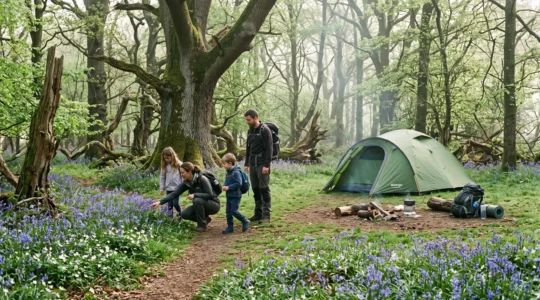
How to Experience Ancient Woodland Sites Respectfully During Camping Visits?
An ancient woodland can feel remarkably timeless: broad trunks rising above mossy banks, spring flowers spreading beneath the canopy, and fallen timber slowly returning to the soil. Yet the qualities…
Lire la suite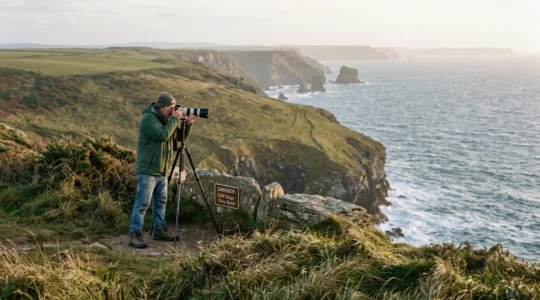
How to Capture Clifftop Views Safely Without Approaching Unstable Edges?
A dramatic clifftop photograph does not require standing beside a vertical drop. Many of the strongest coastal compositions come from established viewpoints, inland slopes and paths where the photographer can…
Lire la suite