Transportation & mobility
Every camping trip begins long before the tent peg hits the ground. It begins in the driveway, with a question that shapes the whole adventure: how will you get there, and how will you carry everything you need? Transportation and mobility is the backbone of camping and travel — the towing techniques, roof cargo habits, RV choices and vehicle preparation routines that turn a stressful journey into part of the holiday itself. This pillar page connects all the key ideas in one place, so you can understand not just the individual skills, but how they fit together.
Why Transportation Decisions Define Your Camping Experience
Think of your journey as the first night of your trip. If the car sways on the motorway, if the roof box howls in the wind, or if a warning light appears a hundred miles from the nearest garage, the holiday starts on the wrong foot. Mobility, done well, is invisible: you arrive rested, your fuel bill is reasonable, and your gear is exactly where you left it.
The topic breaks naturally into four pillars, and each one has its own dedicated articles on this site:
- Towing a caravan or trailer — weights, mirrors, stability and low-speed manoeuvres.
- Roof-mounted cargo — racks, boxes, aerodynamics and weight limits.
- RV and motorhome travel — costs, sizing, rental versus buying and wild camping rules.
- Remote and mountain-road readiness — vehicle inspection, brakes, tyres and descent technique.
Towing: Matching Your Vehicle to Your Van
Start With the Law, Not the Marketing
The single most important towing rule is this: your car must be legally rated to tow your caravan’s fully loaded weight — not its empty weight. A caravan rated at 1,300 kg empty can easily reach 1,600 kg once you add water, gas, awning and food. As a rule of thumb, keeping the loaded caravan at or below 85% of your towing vehicle’s kerb weight gives noticeably more stable and forgiving handling.
Stability Is a System, Not an Accessory
Motorway sway is one of the most frightening experiences a new tower can face. Two tools address it in different ways:
- Weight distribution hitches redistribute the nose weight pressing on the tow bar, restoring steering and headlight performance to the towing car.
- Stabiliser bars (friction stabilisers) dampen snaking movements once they begin, acting like a shock absorber for yaw.
They are complementary, not competing. Think of the weight distribution hitch as fixing the cause and the stabiliser as damping the symptom.
Low-Speed Skills: Mirrors, Reversing and Jackknifing
Most towing accidents happen at crawling speed. Properly adjusted extended mirrors eliminate the blind spots along the caravan’s flanks, and understanding the steering geometry of a trailer — where the trailer cuts the corner opposite to your car’s nose — prevents the classic jackknife. The key reversing mistake is steering as if the trailer follows the car: it does the opposite. Small, slow corrections of the wheel, with regular stops to reassess, are what separate confident towers from frustrated ones.
Speed Discipline
Experienced towers deliberately travel around 15 mph slower than they would unladen, even in perfect conditions. This is not timidity — it is physics. Towing masses need far longer stopping distances, crosswinds hit harder, and a tyre failure at high speed becomes catastrophic with a tonne and a half in tow. Slower driving also cuts fuel consumption dramatically, because aerodynamic drag rises with the square of speed.
Roof Cargo: Carrying More Without Paying More
The Aerodynamics Tax
Anything on your roof pushes into the airstream. A poorly arranged roof load can raise fuel consumption by 10–20% or more. The good news is that layout matters: distributing weight low and evenly, placing the heaviest items over the car’s centreline, and choosing a low-profile hard-shell box can cut wind resistance by as much as 30% compared with a careless setup. A hard-shell box also tends to be noticeably quieter on the motorway than soft bags, whose fabric flutters audibly at sustained speeds.
Weight Limits Are Non-Negotiable
Every roof rack, bar and vehicle has a maximum roof load, usually stated in the handbook. This limit includes the weight of the rack itself. Exceeding it raises the centre of gravity, makes the vehicle more nervous in corners, and can damage the roof structure. Just as important is the forward-shift risk: a load strapped with slack webbing will slide forward under hard braking, potentially through the windscreen. Compress the load, use ratchet straps with edge protection, and re-test tension after the first few miles.
Remove What You Are Not Using
An empty roof rack left on all year is a silent running cost. It creates drag, noise and fuel penalty while carrying nothing. Removing racks and boxes when not in use is one of the cheapest efficiency upgrades available — and it also reduces the temptation to overload on impulse.
RV and Motorhome Travel: A House on Wheels, a Wallet on Wheels
The Real Cost Picture
RV travel feels free once the vehicle is paid for, but the true daily cost includes several quiet line items:
- Fuel — a motorhome often consumes 25–50% more than a family car.
- Campsite fees, which peak sharply in high season.
- Insurance, servicing, tyres and depreciation.
- Consumables: gas, hook-up electricity, waste handling.
Adding these up gives many owners a realistic figure somewhere between a mid-range hotel and a budget one — the trade being freedom of location rather than pure savings. For travellers camping roughly 15 days per year, renting frequently works out cheaper than owning; ownership starts to make financial sense somewhere well above that usage level.
Choosing a Size You Will Actually Use
Common regret runs in both directions: buyers who choose too small and always feel cramped, and buyers who choose a large rig that never leaves the driveway because driving it feels intimidating. A useful test is to list your realistic trips for the next two years and match the vehicle to them, not to an idealised dream itinerary. A slightly smaller RV that gets used thirty nights a year beats a palace that gets used three.
Spontaneity Versus Amenities, and the Wild Camping Question
Part of the RV appeal is guaranteed accommodation — peak-season campsite scarcity simply stops being a problem. But the other half of the appeal, stopping wherever the view is good, comes with a legal trap. In many countries, wild camping in a motorhome is restricted or outright prohibited outside designated areas, and a large share of first-time wild campers are moved on or fined because they assumed otherwise. Checking local rules for each region before you go is a five-minute habit that protects the whole trip.
Remote Roads: Preparing the Vehicle for Silence
Inspection Before Departure
Remote camping trips fail in predictable ways, which means they can be prevented predictably. Before a trip far from assistance, work through a structured check:
- Cooling system: coolant level, hose condition and radiator cleanliness — overheating is the classic remote-road failure.
- Tyres: tread depth, sidewall damage and correct pressures including the spare; a blowout on a mountain road is a serious event, not an inconvenience.
- Brakes: sufficient pad life remaining before committing to a route with long descents.
- Charging system: a healthy alternator and battery, confirmed before you are 200 miles from the nearest help.
Pack a tool kit matched to what you can actually fix roadside: wheel brace, jack, jump leads, fuses, cable ties, tyre repair kit and a torch. Tools you cannot use are just weight.
Descending Mountains: The Brake Fade Problem
Long descents are where unprepared vehicles reveal themselves. Riding the brake pedal continuously overheats the discs and pads, causing brake fade — a spongy, weakening pedal — and in the worst cases, failure. The remedy is engine braking: selecting a lower gear (manually, even in an automatic, typically below roughly a 10% gradient) and letting the engine’s compression hold the speed down so the brakes rarely touch the pedal.
Good descent practice follows a simple rhythm:
- Choose the gear before the descent begins, not halfway down.
- Brake firmly and briefly to shed speed, then release completely and let engine braking work.
- On sustained gradients, pause where safe to let the brakes cool with airflow, rather than resting them every kilometre in stop-start fashion.
- If you smell hot brakes, stop immediately in a safe place and let everything cool naturally — pouring water on hot discs can crack them.
Bringing It All Together
Transportation and mobility for camping is not four separate skill sets — it is one mindset: respect the physics of mass, air and heat. A tower who slows by 15 mph, a driver who removes the empty roof rack, an RVer who checks wild camping laws, and a mountain traveller who descends in third gear are all applying the same principle. Master it, and the road stops being the stressful part of your trip and becomes what it should be: the scenic opening chapter. The detailed articles in this category take each of these topics apart step by step — start wherever your next journey will test you first.
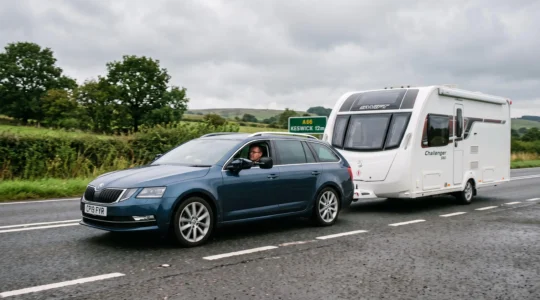
How to Manoeuvre Towing Equipment Safely on UK Roads and Campsites?
Safe caravan towing depends on understanding how the trailer responds to steering, braking, speed and changes in road surface. A manoeuvre that feels straightforward in an unladen car becomes more…
Lire la suite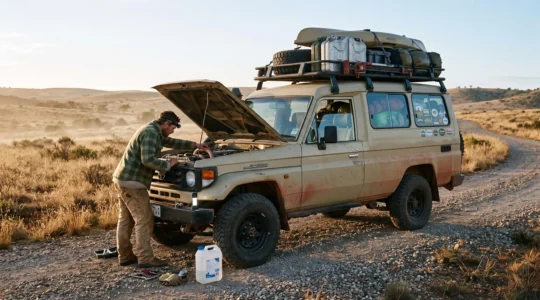
How to Inspect Your Vehicle Before Remote Camping Trips to Prevent Roadside Failures?
A vehicle that starts reliably every morning can still develop a serious mechanical problem when loaded with camping equipment and driven for hours across remote roads. Long climbs, uneven surfaces,…
Lire la suite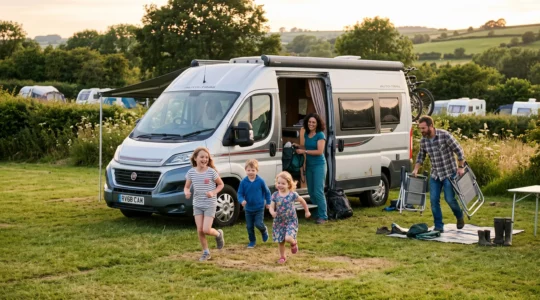
How RVs Balance Home-Like Amenities With Travel Spontaneity?
An RV can turn an extended road trip into something closer to everyday living. A proper bed, cooking facilities, heating, storage and a familiar place to relax travel with you….
Lire la suite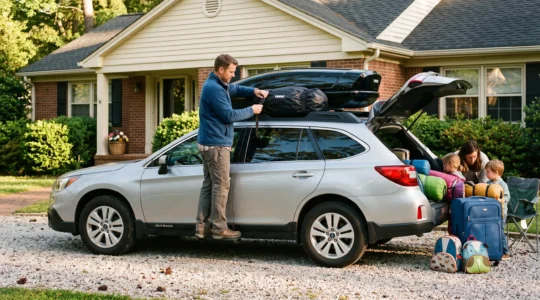
How to Secure Roof-Mounted Gear Without Excessive Fuel Consumption?
Roof-mounted camping gear creates a practical trade-off: extra luggage space comes at the cost of increased aerodynamic drag, potential wind noise and additional fuel consumption. A secure installation is essential,…
Lire la suite