Family camping
Family camping is one of those rare activities that can genuinely bring every generation together around the same campfire. Yet anyone who has tried it knows the reality: camping with a toddler is nothing like camping with a teenager, and a trip that delights one can exhaust the other. This pillar page serves as your complete introduction to family camping, connecting the key ideas that make outdoor stays work for everyone — from planning and campsite selection to task sharing, weather preparation and safety. Think of it as the map of the territory; each section links to deeper questions you will want to explore before your next departure.
What Family Camping Really Means
Family camping is not simply camping with more people. It is a different discipline altogether. Adult-only camping can be spontaneous and flexible; family camping is closer to orchestrating a small expedition where every participant has different needs, energies and limits. The metaphor we like best: a family camping trip is like a symphony. Each child is an instrument with its own range, and the parents are the conductor ensuring no one plays too loud, too long, or out of tune.
Understanding this changes everything. It means success is measured not by distance hiked or sights seen, but by whether everyone — from the three-year-old to the sixteen-year-old — leaves with a positive memory.
Planning Trips That Engage Toddlers and Teenagers
The widest age gap is the biggest planning challenge in family camping. Toddlers need constant supervision, short activity cycles and familiar sleep routines. Teenagers need independence, social connection and a reason to put their phone down voluntarily. A trip planned around only one of these groups will inevitably frustrate the other.
The solution is a layered itinerary: a shared core of activities, plus parallel options that respect each age. For example, a morning nature treasure hunt for the little ones can run alongside a longer trail walk for the teens, meeting back at camp for lunch. For a full framework on balancing these needs, see our article on planning family camping trips that engage both toddlers and teenagers.
- Toddlers (1–4): short walks, sand and water play, early bedtimes, familiar comfort items.
- Children (5–11): playgrounds, bike rides, simple camp chores, group games.
- Teens (12+): independence zones, task ownership, photo or video roles, later curfews.
The Scheduling Trap: Why Pace Beats Programme
Many families fail at camping not because of bad weather or bad sites, but because of a single scheduling mistake: treating the trip like a sightseeing marathon. Cramming each day with activities turns a holiday into a stressful marathon, and exhausted children become unhappy campers — sometimes permanently put off camping altogether.
A healthy family camping rhythm usually follows the one-anchor rule: one major activity per day, with unstructured time around it. Children consistently rank free play at the campsite — digging, exploring, meeting other kids — as their favourite part of the trip. Protect that time.
Choosing the Right Campsite for Your Family
The campsite you choose shapes the entire trip, and « family-friendly » on a brochure guarantees far less than you might hope. The label says nothing about playground safety standards, pool supervision, night-time noise, or how far your pitch sits from the washrooms a toddler must reach at 2 a.m.
What to Verify Before Booking
When evaluating a managed campsite with child-safe amenities, go beyond the marketing and check concrete criteria:
- Playground compliance: in the UK, look for conformity with BS EN 1176 playground equipment standards.
- Water safety: fenced, lifeguard-supervised pools are generally safer for children under eight than unsupervised natural lakes.
- Emergency provision: distance to the nearest medical facility, on-site first-aider, mobile signal coverage.
- Layout: whether the site design lets toddlers stay safe while teens get the independence they crave.
- Sleep environment: proximity to entertainment venues, late-night bars or main roads — the classic saboteur of a child’s sleep routine.
Tent or Campervan: Which Builds Stronger Memories?
Neither setup is objectively superior, but they create different family dynamics. Tents involve children in every stage — pitching, finding pegs, choosing spots — which builds involvement and ownership. Campervans remove friction (bad weather, restless toddlers) but can insulate the family from the very experiences that make camping memorable. Many experienced families recommend starting with a tent on short trips, then graduating to a campervan as your base for longer explorations.
Designing a Campsite That Works for Every Age
Once on site, how you arrange your pitch matters as much as where you are. A well-designed family campsite is zoned like a small village: cooking away from sleeping areas, a visible play zone within sight of the adult seating area, and a defined teen corner with hammocks or a separate small tent where they can retreat.
The guiding principle is graduated autonomy: toddlers stay within arm’s reach, young children within sightline, teens within agreed boundaries. This mirrors our detailed article on designing a campsite that keeps toddlers safe yet gives teens space.
Giving Every Family Member a Real Role
Nothing undermines a family trip faster than one or two adults doing all the work while children merely consume the experience. Assigning age-appropriate camping tasks transforms children from passengers into crew. A six-year-old can collect kindling; a ten-year-old can manage the lantern; a teenager can plan one meal entirely on their own. The psychological effect is well documented: contribution creates belonging, and belonging creates enthusiasm.
Build a simple task rotation before departure so expectations are clear, and let older children choose their responsibilities — ownership matters more than efficiency.
Weather Preparedness: The Make-or-Break Factor
Ask seasoned camping families what ended their worst trip, and the answer is almost always rain handled badly. Your wet-weather plan effectively decides whether your family ever camps again, because a single miserable, soaked night can erase years of positive memories.
- Pack a tarp or shelter that creates a usable outdoor space in rain.
- Keep one full change of clothes per person in waterproof bags, always dry.
- Prepare a wet-weather activity kit: cards, drawing supplies, downloaded audio stories.
- Know when to shorten the trip — leaving early is a success strategy, not a failure.
Altitude and Temperature: Packing for Extreme Variation
For families heading to the hills or mountains, temperature adds a layer of complexity. A common rule of thumb is that temperature drops roughly 1°C per 100 metres of elevation gain — meaning a 15°C swing from valley base to summit camp is entirely realistic. Packing for such trips requires a layering system built on versatile fabrics such as merino wool and synthetics that perform across a wide temperature range, rather than cotton, which stays wet and cold. Add layers before you feel cold, and protect electronics from condensation when moving between warm and cold zones.
Safety Systems Every Family Should Have
Safety in family camping is less about fear and more about systems. Before any trip, a competent family should be able to answer three questions instantly: where is the first-aid kit, who knows the emergency procedure, and how does everyone find each other? Establish simple rituals:
- A daily check-in habit, even on small sites.
- A designated meeting point every child can identify.
- A route plan left with a trusted contact, even for a single night away.
- A review of the site’s emergency medical provision on arrival, not after an incident.
These same systems, learned in the family context, are exactly what prepare older children for confident independent and eventually solo wilderness camping later in life.
From Family Trips to Lifelong Campers
Perhaps the greatest gift of family camping is what it plants for the future. Children who grow up pitching tents, reading weather, managing tasks and solving small problems outdoors become adults who seek out nature rather than fear it. Every well-planned trip is an apprenticeship. Start small, stay flexible, let each child own a piece of the adventure, and the family campfire becomes what it should be: not a test of endurance, but the warmest room in your house — one that happens to have a sky full of stars for a ceiling.
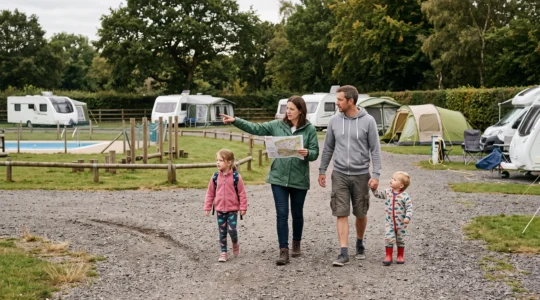
How to Choose Managed Campsites With Child-Safe Amenities and Supervision?
A campsite can advertise heated swimming pools, adventure playgrounds and family entertainment while leaving parents uncertain about the things that matter most: whether children can reach water unattended, who checks…
Lire la suite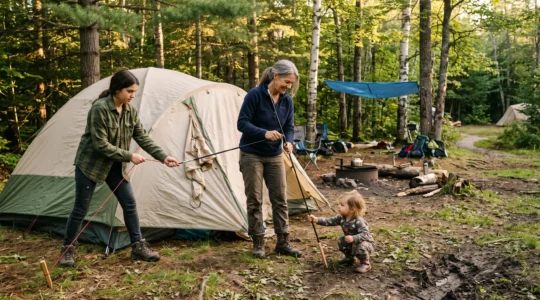
How to Plan Family Camping Trips That Engage Both Toddlers and Teenagers?
A three-year-old wants to investigate every pine cone. A fifteen-year-old wants independence, challenging activities and some privacy. Their parents want everyone to enjoy the same camping trip without spending the…
Lire la suite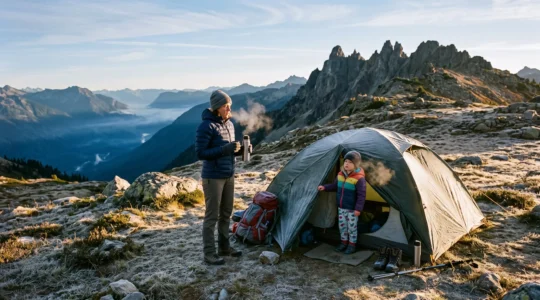
How to Pack for Camping Trips Where Temperature Drops 15°C From Base to Summit?
A campsite that feels comfortable at 25°C in the valley can become dangerously cold after a climb into the mountains. A 15°C temperature difference changes more than clothing requirements: it…
Lire la suite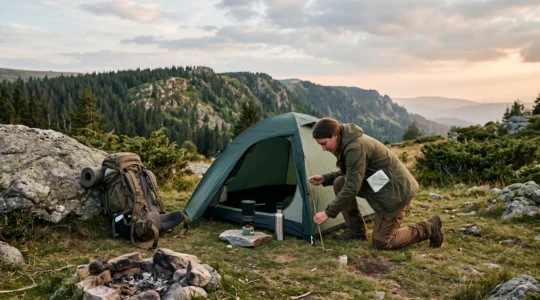
How to Camp Alone Safely Without Backup Support?
Camping alone safely without immediate backup requires more than reliable equipment or the courage to spend a night outdoors. It requires independent navigation, practiced emergency responses, realistic route planning and…
Lire la suite