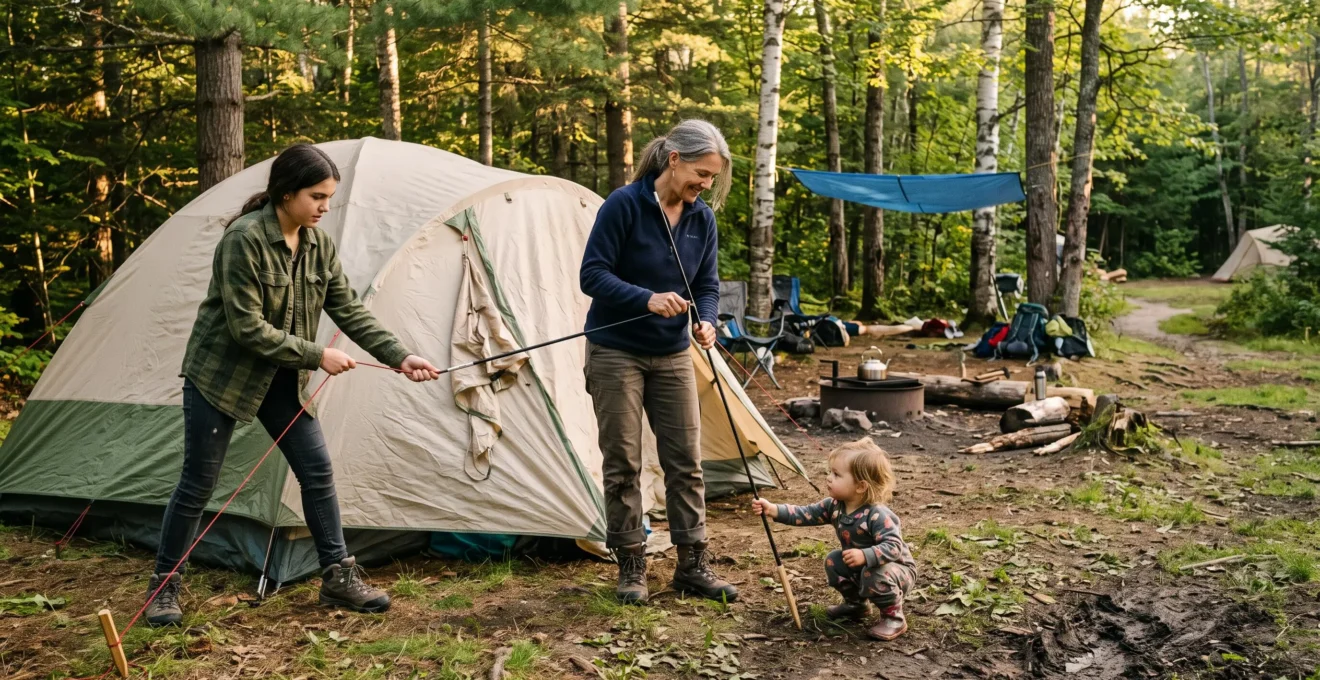
A three-year-old wants to investigate every pine cone. A fifteen-year-old wants independence, challenging activities and some privacy. Their parents want everyone to enjoy the same camping trip without spending the weekend negotiating competing demands. The solution is not to find activities that entertain every age in exactly the same way. It is to design a shared outdoor experience with different levels of participation.
Successful mixed-age family camping starts with a manageable campsite, clear safety boundaries and a flexible daily rhythm. Younger children need familiar routines, close supervision and accessible activities. Teenagers benefit from meaningful choices, personal space and opportunities to take responsibility. Both can contribute to the same campsite community without following identical schedules.
For a first trip, choose a short stay that allows the family to test its equipment, routines and expectations. Preparation should focus less on packing every possible activity and more on creating a campsite where everyone has something worthwhile to do, somewhere comfortable to rest and a clear plan when conditions change.
Family Camping Essentials for Mixed Ages
- Give toddlers supervised participation, tweens manageable responsibilities and teenagers ownership of meaningful tasks.
- Build days around a few shared moments while allowing different activity, rest and independence needs.
- Choose a campsite with manageable hazards, suitable facilities, weather protection and an agreed emergency plan.
- How to Assign Camping Tasks That Make Every Family Member Feel Valued?
- The Scheduling Mistake That Turns Family Camping Into a Stressful Marathon
- Tent or Campervan: Which Setup Creates Stronger Family Memories?
- How to Design a Campsite That Keeps Toddlers Safe Yet Gives Teens Space?
- Why Your Wet-Weather Plan Decides If Your Family Ever Camps Again?
- How to Tailor Scavenger Hunt Difficulty for Mixed-Age Groups on One Campsite?
- How to Build a Three-Day Menu Using Only Ambient-Stable Ingredients?
- How to Choose Managed Campsites With Child-Safe Amenities and Supervision?
How to Assign Camping Tasks That Make Every Family Member Feel Valued?
Assign camping tasks according to each child’s abilities, interests and desired independence rather than dividing chores equally. Toddlers can participate in simple activities beside an adult, tweens can manage defined responsibilities, and teenagers can take ownership of complete projects. The objective is to make each contribution meaningful without transferring adult safety duties to children.
A camping trip creates opportunities for cooperation that are harder to reproduce at home. Setting up shelter, organizing equipment and preparing meals are visible activities with immediate results. According to Recreation.gov’s recommendations for camping with kids, involving family members in packing, assigning campsite chores and allowing children to participate in organizing camp areas are practical ways to prepare for a family trip.
A useful approach is to create a capability ladder with responsibilities that grow in complexity. The following assignments are examples, not fixed developmental requirements.
| Age group | Suitable contribution | Adult involvement |
|---|---|---|
| Toddlers, approximately 3–5 | Carry lightweight items, match tent pegs to equipment, collect safe objects designated by an adult | Continuous close supervision and hands-on assistance |
| School-age children and tweens, approximately 6–12 | Organize activity supplies, prepare a checklist, help maintain the washing station | Clear instructions and checks appropriate to ability |
| Teenagers, approximately 13–15 | Plan a walking route, coordinate a meal or manage shared equipment inventory | Agreed boundaries, equipment training and adult oversight for safety-critical work |
The distinction between assigned help and owned responsibility matters. Asking a teenager to carry plates involves little decision-making. Inviting them to plan a family dinner, select suitable ingredients, organize preparation and serve the meal creates a project they can influence. A parent still supervises stove use, food hygiene and any hazardous equipment.
For toddlers, the outcome matters less than participation. A young child handing an adult lightweight tent components may slow setup, but that shared experience can be more valuable to the family than completing every task quickly.
Not every job belongs on the capability ladder. Fire management, hazardous tools, vehicle movement and supervision of younger children remain adult responsibilities. A teenager helping a sibling does not become the default babysitter.
A visible task board also prevents one parent from silently completing everything left unfinished. At the end of the day, invite everyone to identify what worked, which duties were too difficult and which responsibilities should change tomorrow.
Once everyone has a meaningful role, the next challenge is giving the family enough time to enjoy those contributions without rushing from one activity to another.
The Scheduling Mistake That Turns Family Camping Into a Stressful Marathon
The scheduling mistake is treating a camping trip like a tightly organized day at home, with fixed activities and little room for unexpected discoveries. Mixed-age families generally need a more adaptable rhythm: a small number of shared daily anchors surrounded by flexible periods for rest, exploration and independent activities. A full itinerary is not necessarily a successful one.
Back-to-back plans create competing pressures. A toddler may need a nap just when an older child wants to explore a trail. A teenager might enjoy staying awake to observe the night sky while younger siblings need an earlier bedtime. Trying to synchronize every activity can make parents responsible for repeatedly moving reluctant children between commitments.
A practical alternative is the anchor-and-float schedule. Choose one or two predictable gathering points, such as breakfast and a shared evening meal, then allow the time between them to change according to energy, weather and individual interests.
| Part of day | Younger children | Older children and teenagers |
|---|---|---|
| Morning | Shared breakfast followed by supervised campsite exploration | Shared breakfast followed by a walking route or equipment project |
| Midday | Lunch and a familiar rest routine | Lunch, followed by reading, photography or another agreed activity |
| Afternoon | Flexible play with an adult | Optional challenge or permitted independent time |
| Evening | Shared meal and age-appropriate bedtime | Shared meal and a later activity within agreed boundaries |
This example assumes adults can provide appropriate supervision across the different activities. Splitting schedules must never mean leaving young children unattended.
Warning signs that the family has entered marathon mode include repeated arguments about departure times, abandoned activities, rushed meals and parents constantly directing everyone toward the next appointment. Treat these signals as reasons to simplify the schedule rather than demand more cooperation.
There is no established number of daily unstructured hours that suits every mixed-age family. Recreation.gov encourages unstructured play and discovery, but does not prescribe a duration. A first short trip provides an opportunity to observe how long younger children can comfortably explore and how much independence older children actually enjoy.
Keep the plan responsive to children’s physical capabilities and changing conditions. The National Park Service’s pre-trip camping safety recommendations emphasize matching activities to participants’ abilities, testing equipment and preparing alternatives when circumstances become unsafe.
The daily rhythm becomes easier to manage when the family’s sleeping and living arrangements also support its mix of ages.
Tent or Campervan: Which Setup Creates Stronger Family Memories?
Neither a tent nor a campervan guarantees stronger family memories. The better choice is the accommodation that makes shared activities enjoyable while allowing everyone to sleep, recover and feel comfortable. Tents offer hands-on setup and direct contact with the outdoors, while campervans can provide more weather protection and a contained living space. Family preferences and practical needs should determine the choice.
Accommodation changes how family members interact. Pitching a tent can become a cooperative project involving poles, fabric and agreed roles. A campervan can free up time otherwise spent constructing shelter, allowing the family to focus on walks, games or cooking together.
It would be misleading to claim that tents scientifically produce better memories or that teenagers consistently prefer campervans. The available camping safety guidance does not establish those comparisons. Instead, assess the experiences each arrangement makes possible and the trade-offs your family can comfortably handle.
| Decision factor | Tent | Campervan |
|---|---|---|
| Shared setup | More opportunities for cooperative pitching and organizing | Usually less shelter assembly, leaving time for other activities |
| Toddler sleep | Requires attention to bedding, temperature and noise | May offer a more enclosed sleeping environment |
| Teen privacy | Can be improved with separate permitted sleeping areas | Depends on vehicle layout and sleeping arrangements |
| Wet weather | Dry communal space may require an additional shelter | Enclosed living space may offer greater comfort |
| Outdoor interaction | Much daily activity naturally occurs outside | Families may need to plan outdoor activities deliberately |
The dominant family constraint should guide the decision. If difficult sleeping arrangements could undermine a toddler’s comfort, prioritize a reliable rest environment. If a teenager is enthusiastic about leading outdoor setup and camping skills, a tent may provide appealing opportunities.
Hybrid arrangements can reduce the apparent trade-off. A family tent with a separate day shelter creates a communal area outside the sleeping space. Some managed campgrounds offer ready-pitched tents, reducing setup work while retaining the experience of sleeping under canvas.
Where campground rules and vehicle capacity permit, a campervan combined with a separate small tent may provide older children with additional space. Sleeping arrangements must still meet site requirements and appropriate supervision needs.
Before departure, practice using the chosen equipment. The National Park Service recommends testing camping gear ahead of the trip, including through a backyard trial. This is particularly useful for identifying difficulties with bedding, shelter assembly and access during the night.
Whatever shelter the family chooses, its position within the campsite affects both children’s independence and adults’ ability to supervise safely.
How to Design a Campsite That Keeps Toddlers Safe Yet Gives Teens Space?
Organize the campsite into a closely supervised family core, a shared activity area and an agreed space for older children. Position young children’s play where an adult can supervise directly, keep hazards away from common routes, and give teenagers appropriate personal space. Boundaries should reflect the site’s actual layout, visibility, individual capabilities and risks rather than fixed age-based distances.
A campsite that looks peaceful to an adult can contain hazards at a toddler’s height. Tent guy lines cross walking routes, extinguished fire pits may remain hot, vehicles travel through access lanes, and water features can be difficult to see from a pitch.
Start with a ten-minute arrival walkthrough, used as a practical family preparation routine rather than a certified safety inspection.
- Inspect existing fire rings and prohibit children’s access to them, including when a fire appears extinguished.
- Identify guy lines, pegs and trip hazards; reposition equipment where appropriate and make unavoidable obstacles visible.
- Locate roads, parking areas, water edges, steep ground and any other features requiring adult-controlled access.
- Secure food storage and coolers, checking for closures, tipping hazards and local wildlife requirements.
- Choose a supervised play location away from cooking equipment, hot surfaces and vehicle movement.
The central family area should contain the main shelter, an accessible gathering space and a play location visible to the supervising adult. Cooking equipment needs a separate controlled position within the wider campsite arrangement, not inside the toddler play zone.
Beyond the family core, create a shared activity zone where tweens can work on projects and older children can spend time without being constantly involved in toddler play. Teenagers might organize their own seating area or help establish an additional shelter if the campsite permits it.
This zoning system is a planning aid, not a validated safety standard. Physical separation never replaces supervision. For younger children, an adult should remain close enough to intervene immediately when hazards arise.
Teenagers may be allowed to explore beyond the pitch when their judgment, experience and the campground environment make that appropriate. Agree on permitted areas, check-in points, companions, return times and what to do if someone becomes separated. A sibling’s responsibility for helping with boundaries should never replace parental oversight.
The National Park Service supports emergency planning, the buddy system and clear procedures for separation. Campground loops, road crossings and facility locations should influence each family’s specific boundaries.
Five Checks Before Children Explore the Campsite
- Walk the pitch and mark each identified hazard on a simple campsite sketch.
- Choose the toddler play area and confirm which adult will supervise it; record the location and arrangement on the sketch.
- Agree on older children’s permitted zones and identify them on the same sketch.
- Select a recognizable family meeting point and practice what everyone should do if separated; write down the agreed procedure.
- Confirm emergency contacts, reception access and relevant site rules; keep the details in an accessible family note.
A well-arranged pitch makes ordinary days easier, but its effectiveness also depends on what happens when rain, wind or thunderstorms disrupt outdoor plans.
Why Your Wet-Weather Plan Decides If Your Family Ever Camps Again?
A wet-weather plan helps protect both the family’s safety and the enjoyment of a first camping trip. Prepare dry sleeping arrangements, covered communal space, suitable clothing and activities that work for different ages. Most importantly, establish the conditions under which everyone will move to proper shelter, change plans or leave the campsite rather than continuing in unsafe conditions.
Rain does not necessarily end a camping trip, but it changes what the family can comfortably do. Younger children may struggle with damp clothing and restricted movement, while teenagers may become frustrated if the only alternative is sitting inside a crowded tent.
A practical kit begins with layered clothing suitable for the forecast, waterproof outerwear and accessible dry changes for each family member. Sleeping bags and spare clothing should be protected from moisture during transport and stored where leaks or wet equipment will not reach them.
A separate covered communal space, such as a properly secured shelter or suitable campervan awning, can make ordinary rainfall easier to manage. The setup must be appropriate for expected conditions and manufacturer guidance. Cooking and heating equipment must never be operated in enclosed or poorly ventilated spaces unless expressly designed and approved for that use.
Different ages need different rainy-day options. Toddlers may enjoy supervised puddle observation or sensory play in suitable conditions. Tweens can create stories, record wildlife observations or solve puzzles. Teenagers can plan routes, organize photography projects or design an upcoming meal. Outdoor activities should stop when weather conditions become hazardous.
The crucial distinction is between inconvenient rain and dangerous weather. Thunderstorms require an immediate change of plan, not another waterproof layer.
According to the National Weather Service‘s lightning safety recommendations, campers who hear thunder should seek a substantial building or a fully enclosed metal-topped vehicle with closed windows. Tents, open shelters and isolated trees are not safe lightning refuges. Remain in appropriate shelter for at least 30 minutes after the last thunder.
30 minutes
Minimum time to remain in suitable shelter after the last thunder, according to National Weather Service lightning guidance. This precaution applies to thunderstorms, not ordinary rain.
National Weather Service, Lightning Tips
Strong winds, flooding, dangerous access conditions or inadequate shelter also justify changing or ending a trip. Check relevant local weather warnings and ask the campground about substantial buildings or emergency facilities before arrival. Do not assume that a temporary campsite structure or every recreational vehicle is a suitable storm refuge.
Ending a camping trip early can be a responsible decision. On a first outing, preserving everyone’s safety and willingness to try again is more useful than proving the family can tolerate a miserable night.
When conditions are safe for outdoor exploration, simple games can bring different ages together without forcing everyone into the same level of difficulty.
How to Tailor Scavenger Hunt Difficulty for Mixed-Age Groups on One Campsite?
Create one shared scavenger hunt with different versions of each clue according to children’s abilities. Toddlers can locate and point to recognizable objects, tweens can identify or describe them, and teenagers can solve riddles or document observations. Everyone explores the same permitted area, but older children receive additional challenges rather than simply finishing before younger siblings.
The most reliable starting point is a list of features that are reasonably easy to observe within the campsite’s safe exploration boundaries. Leaves, tree bark, contrasting textures, bird sounds and cloud shapes offer flexible clues without requiring children to find rare objects or disturb wildlife.
For example, a clue involving a tree can have several levels:
- Toddler: Find a tree with rough-looking bark and show an adult.
- Tween: Compare the texture of two trees and describe the differences.
- Teenager: Photograph contrasting bark textures, record observations and explain how another player could identify the difference.
The same approach works with sounds and shapes. Younger children can imitate a bird call they hear, while older participants identify the direction of the sound or create an audio clue. Children should observe natural objects without removing protected materials, disturbing habitats or entering restricted areas.
Competition can become difficult when a teenager solves every clue before a preschooler understands the instructions. A cooperative format avoids that imbalance. Let teenagers create or explain selected clues, invite tweens to organize observations and give toddlers a recognized role in finding visible features.
The game’s success condition can be completing a collective discovery sheet rather than awarding prizes for speed. This makes age differences part of the activity rather than a disadvantage.
Smartphones can become useful tools for older children’s tasks. Photography, short sound recordings and time-lapse experiments add complexity without requiring separate games. Agree on device boundaries, respect other campers’ privacy and avoid photographing strangers without permission.
Calibrate difficulty by adjusting the thinking required rather than the distance travelled. A teenager can complete a complex photographic challenge while remaining near a toddler who is searching for recognizable shapes.
Recreation.gov includes natural observation, photography and other exploratory activities among its family camping suggestions, although it does not establish a particular scavenger-hunt system as superior.
Before starting, confirm permitted boundaries and explain how everyone should respond if they lose sight of their group. Young children need close adult supervision throughout the activity.
Shared exploration can lead naturally into the next cooperative activity: preparing food that accommodates different appetites, preferences and levels of cooking experience.
How to Build a Three-Day Menu Using Only Ambient-Stable Ingredients?
Build a three-day camping menu around unopened foods explicitly labelled for storage without refrigeration, combining no-cook breakfasts, assembly lunches and simple cooked dinners. Reuse ingredients across meals to reduce packing and waste, while offering familiar textures for toddlers and flexible portions for teenagers. Check packaging instructions carefully because a product that is shelf-stable unopened may require refrigeration after opening.
Ambient-stable foods can include dry grains, unopened canned legumes, dried fruit, nut or seed products suitable for family dietary needs, and certain packaged ready-to-eat foods. UHT products are suitable for ambient storage only when their packaging permits it and they remain unopened.
Hard cheeses, cured meats and other foods sometimes described as travel-friendly should not automatically be treated as safe without refrigeration. Their storage requirements depend on the specific product, packaging and instructions.
A warm vehicle or sun-exposed tent can create conditions very different from a cool household cupboard. Keep food shaded, protected from contamination and within its specified storage conditions.
The menu below is an illustrative three-day plan, not a nutritional prescription. It assumes suitable food allergies and dietary needs have been checked, safe drinking water is available, and every packaged ingredient is labelled for storage without refrigeration until opened.
| Day | Breakfast | Lunch | Dinner |
|---|---|---|---|
| Day 1 | Oats with dried fruit and individually portioned shelf-stable milk | Wraps with canned chickpeas and suitable shelf-stable spreads | Rice with canned beans, corn and tomato sauce |
| Day 2 | Instant porridge with dried fruit | Bean-and-corn wraps with whole fruit | Pasta with canned tomatoes and chickpeas |
| Day 3 | Oats with fruit and individually portioned shelf-stable milk | Wraps with freshly opened canned beans and suitable seasonings | One-pot rice with canned vegetables and legumes |
The menu repeats oats, wraps, beans, tomatoes and grains across meals so fewer different ingredients are required. Use suitable single-use packaging where refrigeration is unavailable, and prepare only quantities that can be safely consumed immediately. Do not plan to retain opened perishable ingredients or cooked leftovers without appropriate temperature control.
For toddlers, adapt texture, portion size and preparation to their eating abilities, and supervise meals to reduce choking risks. Older children can assemble their own wraps, select appropriate snacks or help plan a dinner. Account for appetite, dietary restrictions and the energy demands of planned activities rather than assuming every child needs identical portions.
FoodSafety.gov advises considering shelf-stable foods for camping and keeping perishables at 40°F (4°C) or below. Its outdoor guidance also emphasizes clean hands, safe water and protection from cross-contamination.
Perishable foods should not remain unrefrigerated for more than two hours, reduced to one hour when temperatures exceed 90 °F (32 °C). These limits are not permission to keep opened products unrefrigerated for those full periods regardless of their labels or preparation conditions.
40°F / 4°C
Recommended maximum storage temperature for perishable food transported in a cooler. This is a refrigeration benchmark, not an ambient-storage limit for unopened shelf-stable products.
FoodSafety.gov outdoor food-handling recommendations
For further preparation details, consult FoodSafety.gov’s outdoor food-safety advice. Food packaging remains the deciding reference for whether individual ingredients require refrigeration before or after opening.
Cooking also requires sufficient safe water for drinking, preparation, utensil cleaning and handwashing. Water collected directly from streams or rivers should not be assumed potable. Where water supplies or washing facilities are limited, choose meals requiring fewer utensils and less preparation.
Once meals and equipment are planned, the final decision is selecting a campground whose layout and facilities can support the family’s specific combination of ages.
Key Takeaways Before Booking
- Evaluate campground safety through visible features such as traffic separation, sightlines, water hazards and accessible emergency information rather than relying on a general family-friendly label.
- Compare facilities for toddlers and teenagers separately so the campsite provides appropriate supervised play and genuinely interesting options for older children.
- Confirm site rules, supervision arrangements, weather shelter and food-storage facilities directly before making a reservation.
How to Choose Managed Campsites With Child-Safe Amenities and Supervision?
Choose a managed campground by checking its physical layout, facilities, safety arrangements and suitability for every child’s age. Prioritize clear separation between play areas and vehicle traffic, manageable access to toilets and water, visible communal spaces and reliable emergency information. Staff availability is helpful, but it must not be mistaken for continuous supervision of children.
Terms such as « family-friendly » or « great for kids » provide little practical information by themselves. A campground may have a playground, swimming pool and organized activities yet still place family pitches beside busy internal roads or far from the facilities younger children need.
Begin with the site’s layout. Ask whether pitches can be selected away from vehicle access routes, whether play areas are visible from nearby accommodation, and whether walking to toilets or washing facilities requires crossing traffic areas.
For water facilities, establish whether pools are fenced or otherwise access-controlled, which supervision arrangements operate, and which rules apply to younger children. Facilities and applicable requirements vary across countries and jurisdictions. A staffed pool should not be assumed to provide continuous individual supervision.
The same distinction applies to the campground reception and activity program. A host or staff member can provide information, help with site procedures and respond to reported issues, but does not automatically take responsibility for supervising children. Organized childcare, if offered, should be assessed separately according to its stated supervision arrangements, age limits and applicable requirements.
The following comparison helps turn marketing claims into questions that can be answered before booking.
| Criterion | What to verify | Why it matters |
|---|---|---|
| Internal traffic | Pitch locations, vehicle routes and restrictions around play spaces | Helps adults manage vehicle-related hazards |
| Playground layout | Visibility, age suitability and surrounding hazards | Supports more manageable supervision |
| Water facilities | Access controls, posted rules and actual supervision arrangements | Clarifies precautions and adult responsibilities |
| Reception and emergencies | Staffed hours, emergency contact procedures and designated shelters | Supports preparation for unexpected problems |
| Teen activities | Suitable recreation areas, permitted independent activities and nearby attractions | Provides options beyond younger children’s facilities |
| Practical amenities | Potable water, toilets, washing areas and appropriate food storage | Reduces routine logistical difficulties |
Recreation.gov identifies potable water, toilets, prepared tent areas, picnic tables, food-storage boxes and campground hosts among useful amenities to consider when planning camping with children. Availability and suitability must still be checked for the specific destination.
For a family with a toddler and a teenager, age fit matters as much as the number of amenities. A site designed primarily around younger children’s play may offer limited options for teenagers. Conversely, a location with extensive adventure activities may have inconvenient facilities or unsuitable play spaces for preschoolers.
Consider the surrounding area as part of the decision. Accessible walking or cycling routes, nearby towns and appropriate outdoor recreation can provide opportunities for older children when the campground itself has a limited activity program. Confirm route suitability and access conditions before departure.
Use official campground information, applicable inspection or rating systems, recent parent reviews and direct communication with the operator. Reviews mentioning specific age groups and the actual layout are more informative than general ratings alone.
When contacting a campground, describe the children’s ages and ask targeted questions about pitch placement, playground visibility, pool arrangements, quiet hours, emergency procedures and suitable teen activities. Keep the answers with the booking details so expectations remain clear.
For a first family trip, shortlist campgrounds against these criteria, confirm the important details directly and choose a manageable stay that allows everyone to test the experience before planning a longer adventure.
How long should a first camping trip last with children of very different ages?
A short trial stay can be more manageable than immediately committing to a long holiday. One or two nights may provide an opportunity to test sleeping arrangements, meals, equipment and family routines, provided the location and conditions are suitable. The ideal duration depends on previous outdoor experience, travel distance, children’s needs and access to facilities. There is no established universal first-trip duration for mixed-age families.
Should teenagers be required to participate in every family camping activity?
Not necessarily. Shared meals, selected activities and meaningful contributions can create opportunities for family interaction without requiring every hour to be spent together. Teenagers can help choose activities and negotiate appropriate independent time. The amount of freedom should reflect their abilities, experience, campground rules and the surrounding hazards.
What should parents do if a toddler struggles to sleep in a tent?
Start by checking immediate comfort and safety: suitable bedding, temperature, dry clothing, noise and whether the sleeping environment feels unfamiliar. Maintaining recognizable bedtime routines may help some children adjust. Practicing with the tent before departure can reveal practical problems. If sleep remains difficult, changing the sleeping arrangement or shortening the trip can be more appropriate than persisting with an unsuitable setup.
Can children explore a managed campground without an adult?
Managed campgrounds do not automatically provide supervision outside specifically organized and appropriately supervised programs. Toddlers require close adult supervision. For older children, independence should be decided according to maturity, experience, site layout, local rules and identified hazards. Agree on boundaries, companions, meeting points and separation procedures before permitting any independent exploration.
What if bad weather makes the planned family activities impossible?
Replace the original itinerary with suitable alternatives such as storytelling, observation projects, puzzles or covered activities when conditions remain safe. During thunderstorms, move immediately to a substantial building or another appropriate lightning-safe shelter and follow official guidance. If flooding, severe wind or inadequate shelter creates unacceptable risk, change plans or leave the campsite safely. A successful trip does not require completing every scheduled activity.