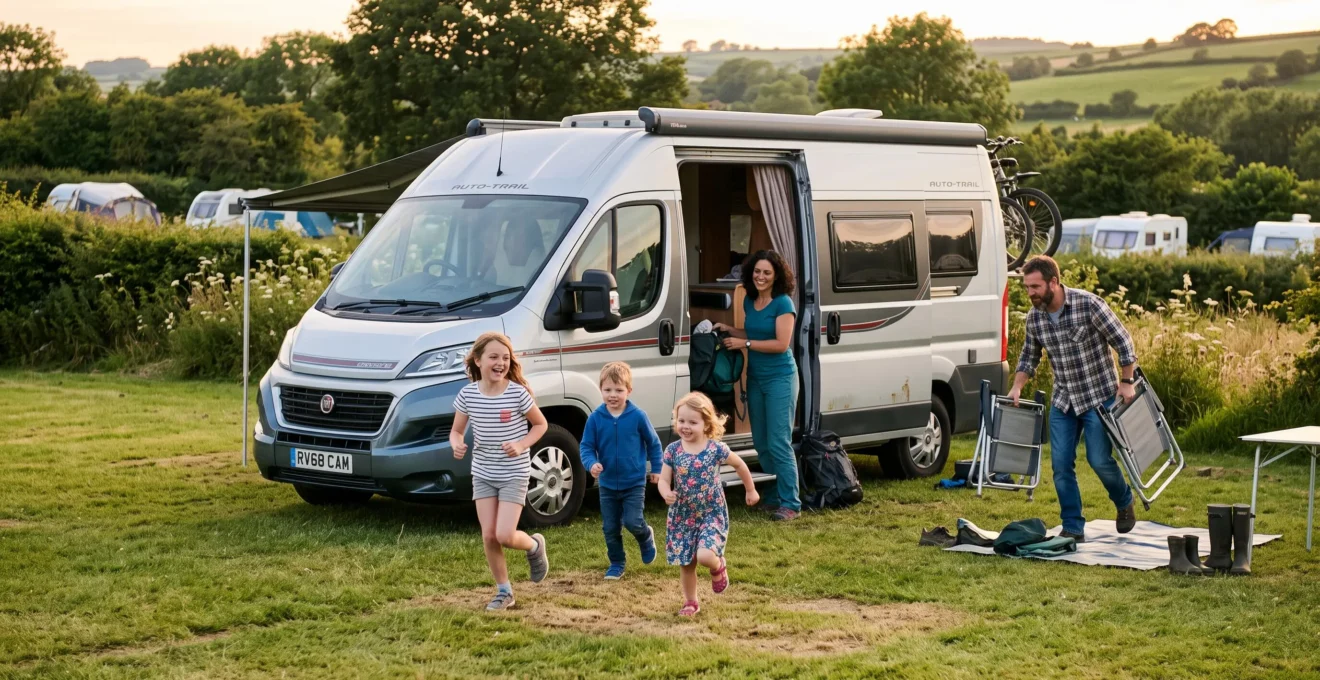
An RV can turn an extended road trip into something closer to everyday living. A proper bed, cooking facilities, heating, storage and a familiar place to relax travel with you. Instead of packing suitcases between hotels, you can change destinations while keeping your accommodation largely unchanged.
For people considering several weeks touring Britain, that combination is appealing. A campervan makes it possible to explore the Yorkshire Dales, continue towards Scotland or change direction when the weather deteriorates, without having to find a different hotel room at every stop.
Yet owning or renting an RV does not mean unrestricted overnight parking. Campsite availability, vehicle dimensions, water supplies, waste disposal and local regulations still shape the journey. Larger motorhomes can provide greater domestic comfort while making narrow roads and spontaneous stops more challenging.
The most satisfying approach is to choose the level of comfort that supports the way you actually travel, then build enough flexibility into the itinerary to enjoy unexpected opportunities.
RV comfort and travel freedom at a glance
- RVs provide familiar sleeping, cooking and living facilities, but their true daily cost includes ownership or rental expenses, not just campsite fees.
- Spontaneous touring works best with a mixture of advance reservations, flexible destinations and legally permitted overnight stops.
- Vehicle size, annual usage and driving confidence determine whether a compact campervan, larger motorhome or rented RV offers the better balance.
- What Is the True Daily Cost of RV Camping Including All Hidden Expenses?
- Why Do RV Owners Never Worry About Peak-Season Campsite Availability?
- How to Choose an RV Size You’ll Actually Use Rather Than Regret Buying?
- The Legal Mistake That Gets RV Wild Campers Fined or Moved On?
- Should You Rent or Buy an RV if You Camp 15 Days Per Year?
- How to Group Campsites Geographically to Cut Total Driving by 40%?
- Tent or Campervan: Which Setup Creates Stronger Family Memories?
- How to Manoeuvre Towing Equipment Safely on UK Roads and Campsites?
What Is the True Daily Cost of RV Camping Including All Hidden Expenses?
The true daily cost of RV camping combines the vehicle’s fixed annual expenses with the variable costs of each journey. Campsite fees alone substantially understate the budget because insurance, depreciation, maintenance, fuel and storage still matter. The more nights you use an owned motorhome, the more widely its fixed costs are spread.
A motorhome parked outside your house between holidays is not financially inactive. Its market value may decline, insurance remains payable, and mechanical components still require attention. For prospective buyers, these costs can make occasional trips considerably more expensive per night than expected.
A practical calculation starts by separating two categories:
- Fixed costs: annual depreciation or an appropriate ownership-cost allocation, insurance, vehicle tax or registration charges, storage and financing costs where applicable.
- Variable costs: fuel, campsite pitches, servicing attributable to use, tyres, gas, electricity, tolls, water and waste-disposal charges.
For an owned vehicle, estimate the annual fixed costs and divide them by the number of nights actually spent travelling. Add the variable expenditure per night. Avoid counting both the full purchase price and annual depreciation as separate costs: doing so would exaggerate the economic cost of ownership.
Hypothetical example: the effect of annual usage
Suppose a motorhome has £4,800 in annual fixed ownership costs. At 20 nights of use, that represents £240 per night before fuel, campsites or food. At 80 nights, the same fixed expenditure represents £60 per night.
These figures are illustrative assumptions, not market averages. They demonstrate why annual usage changes the calculation even when the vehicle and its annual fixed costs remain identical.
Comparing RV travel with hotels or holiday cottages requires consistent assumptions. Include hotel accommodation, transport, parking and meals for the same itinerary. For the RV, include its ownership or rental costs, campsites, fuel and relevant services. Grocery spending should be treated consistently across both options rather than assuming every hotel guest eats in restaurants.
The break-even point occurs when the total cost of RV travel becomes lower than the equivalent accommodation-and-transport alternative. It varies with destination, season, vehicle value, fuel consumption and annual usage.
That calculation also reveals whether paying for ownership throughout the year is justified, a question that becomes particularly important when comparing renting with buying.
Why Do RV Owners Never Worry About Peak-Season Campsite Availability?
RV owners do have to worry about peak-season campsite availability. Their advantage is not guaranteed access to a pitch, but the ability to change destinations without changing their accommodation. Flexible travellers can redirect a trip towards less crowded areas, although popular coastal destinations and national parks may still require advance reservations.
Consider a summer itinerary through Cornwall. A family travelling in a motorhome may find that its preferred coastal campsite is fully booked. Instead of searching for another hotel or abandoning the trip, it can consider a different region with suitable available pitches. The freedom comes from geographical choice, not from exemption from campsite rules.
A useful approach is late-booking travel with protected anchor dates. Reserve the nights that matter most, such as a popular holiday weekend or a stay near a major attraction, while leaving less-demanded sections of the itinerary open.
This approach works especially well when the journey includes several possible destinations rather than one essential location.
American national parks demonstrate the limits of improvisation. According to the Yosemite National Park campground reservation information, several campgrounds release reservations five months ahead, and non-lottery availability can disappear within minutes. Yosemite also prohibits sleeping inside vehicles outside registered campsites.
Alternative overnight arrangements may help, but only where permitted. Options can include designated motorhome stopovers, participating host properties, authorised commercial parking areas and suitable public-land campsites. None should be assumed legal merely because another traveller has stayed there.
In the United States, the Bureau of Land Management camping rules explain that dispersed camping is generally available on many BLM-managed lands, subject to closures, local restrictions, permits and stay limits. This permission does not automatically extend to national parks or private property.
The most resilient itinerary therefore includes a preferred destination, an alternative region and a legally verified overnight option. A self-contained vehicle improves your ability to change plans, but it cannot create available pitches in an already crowded location.
For long-distance touring, that flexibility becomes more valuable when the vehicle is compact enough to access a broad range of roads and campsites.
How to Choose an RV Size You’ll Actually Use Rather Than Regret Buying?
Choose an RV size around your normal journeys, not the maximum number of people it can theoretically accommodate. A larger motorhome offers more living space and potentially greater onboard capacity, but it can restrict parking, campsite access and narrow-road driving. The right vehicle is one you feel comfortable using frequently.
Before comparing layouts, consider where and how the vehicle will travel. A couple touring rural Scotland may value manoeuvrability more than an additional lounge. A family spending several weeks at a time in one location may prefer permanent beds, a washroom and separate living areas.
The main decision criteria are driving confidence, passenger requirements, route characteristics, trip duration and dependence on campsite facilities.
The differences become clearer when comparing typical vehicle categories.
| Consideration | Compact campervan | Larger motorhome |
|---|---|---|
| Road access | Generally easier on narrow routes | More attention to width, height and turning space |
| Sleeping arrangements | May require converting seating | More likely to offer permanent beds |
| Cooking and washing | Often more compact or limited | More space for dedicated facilities |
| Water and storage | Usually more constrained | Potentially greater capacity |
| Spontaneous stops | Often easier to park where permitted | More dependent on suitable vehicle dimensions |
| Maintenance | Fewer or smaller habitation systems in some layouts | Potentially more systems requiring upkeep |
Oversizing creates a genuine contradiction: buying extra comfort for travel can make travelling less convenient. A vehicle that feels spacious at a campsite may feel intimidating on a single-track road or in a small village car park.
Conversely, choosing the smallest possible campervan can create daily frustrations. Limited water storage, cramped sleeping arrangements and the need to rearrange furniture every evening may become tiring on an extended journey.
Before buying, rent a vehicle close to your intended size for a realistic trip. Include ordinary activities such as supermarket shopping, parking near attractions, preparing meals, using the washroom and manoeuvring on campsite pitches.
Record what feels inconvenient rather than relying on showroom impressions. The ideal layout is often the one that removes repeated daily frustrations without introducing driving restrictions you are unwilling to accept.
Even a perfectly sized motorhome, however, remains subject to the rules governing where it can stop overnight.
The Legal Mistake That Gets RV Wild Campers Fined or Moved On?
The most consequential wild-camping mistake is assuming that permission to park also means permission to camp overnight. Laws, landowner rights and local restrictions differ across the UK and other countries. A motorhome may be legally parked in a location where overnight occupation or camping activities are prohibited.
There is no reliable evidence in the supplied sources that 50% of RV wild campers are fined or moved on. The important issue is the legal distinction between access, parking and camping, rather than an unsupported percentage.
Scotland illustrates this distinction particularly clearly. The Scottish Outdoor Access Code guidance on access rights describes responsible lightweight tent camping but excludes motor vehicles from ordinary statutory access rights. Scotland’s reputation for wild camping therefore does not provide blanket permission to stay overnight in a motorhome.
In England and Wales, camping on private land generally requires the landowner’s permission unless another specific authorisation applies. Parking rules, local restrictions and the legal position of sleeping in a vehicle must be considered separately.
In the United States, requirements differ between land-management authorities. BLM-managed land may allow dispersed camping, while national parks, state parks and national forests operate under their own applicable rules.
Even the distinction between overnight parking and camping is not universal. Deploying an awning, placing chairs outside, using levelling equipment or remaining for an extended period may affect how a particular authority interprets the activity. These are potential indicators, not a universal legal test.
Consequences depend on the applicable law and circumstances. Travellers may be instructed to leave, face penalties where an enforceable restriction has been breached, or encounter more serious enforcement measures in certain jurisdictions. Vehicle seizure is not an automatic consequence of ordinary unauthorised overnight parking.
A practical verification process reduces the risk of arriving somewhere unsuitable after dark.
Five checks before choosing an overnight RV stop
- Identify who controls the land and record the owner or managing authority in your trip notes.
- Check the relevant authority’s current camping and parking rules, saving the applicable guidance or permit details.
- Inspect local signs and restrictions, recording any relevant time limits or vehicle exclusions.
- Confirm that your vehicle dimensions and planned activities are permitted, producing a simple yes-or-no suitability decision.
- Identify a second authorised overnight location and save its address or navigation coordinates before travelling.
Traveller reviews and camping applications are useful for discovering possible locations, but they cannot replace permission from the relevant authority or landowner. A previously tolerated stop may no longer be available.
Once the practical limits of overnight stopping are understood, the next financial question is whether the vehicle should be rented or owned.
Should You Rent or Buy an RV if You Camp 15 Days Per Year?
Renting is often the lower-commitment option for someone using an RV only 15 days per year, but that duration alone does not determine the cheaper choice. Ownership becomes more attractive when annual use increases or when personalisation and guaranteed vehicle access matter. The financial break-even point depends on actual rental prices and ownership costs.
Start by calculating the annual cost of owning the specific motorhome you want. Include depreciation, insurance, storage, servicing, financing costs where relevant and any ownership-related charges. Then estimate the costs that arise only when you travel.
Compare this with the full rental price for the same number of days, including any mileage allowances, insurance excess arrangements, equipment charges and other applicable fees.
A simple financial comparison is:
Annual ownership cost = annual fixed ownership costs + annual usage-related costs.
Annual rental cost = rental charges + rental-specific fees + travel expenses not already included.
Costs common to both options should be treated consistently. For example, if the same campsite and fuel costs apply to either vehicle, those amounts do not determine which ownership model is cheaper.
Financial considerations are not the only factors.
- Rental availability: popular vehicle sizes may be difficult to secure during school holidays or major travel periods.
- Vehicle familiarity: owners can become accustomed to one vehicle’s dimensions, controls and maintenance needs.
- Personalisation: ownership allows equipment and storage arrangements to be adapted to individual preferences.
- Resale exposure: owners carry the risk that the vehicle’s eventual resale value is lower than anticipated.
Depreciation deserves particular attention when considering a new motorhome. Its resale value can decline even during periods when it is rarely used, and the amount depends on the vehicle and market conditions.
For uncertain future usage, a staged decision is sensible. Rent a compact campervan for one trip, try a larger motorhome on another, and record how many nights you genuinely want to spend travelling. Buying can follow once the preferred layout and likely annual usage become clearer.
Ownership should also be reassessed if circumstances change. Selling a little-used vehicle may reduce future fixed costs, although the proceeds and transaction costs must be considered.
Whether rented or owned, the vehicle delivers more freedom when the route itself is designed to avoid unnecessary driving.
How to Group Campsites Geographically to Cut Total Driving by 40%?
Grouping campsites geographically can reduce unnecessary driving by keeping nearby attractions together and using a small number of well-positioned bases. A 40% reduction is a planning target, not a guaranteed outcome. The actual saving depends on the route, regional geography, vehicle size and how often travellers relocate their accommodation.
Instead of choosing a new campsite every night, identify clusters of attractions that can be visited from the same location. A family exploring the Lake District, for example, could select a suitable base for several nearby walks and villages before relocating to another part of the region.
This approach is particularly valuable with a larger motorhome because each relocation involves more than the driving itself. Travellers may need to disconnect services, secure loose items, prepare the living area for travel and set up again on arrival.
Planning starts with a map of desired destinations. Mark attractions, then group those close enough to visit comfortably from a shared campsite. Choose bases according to road access, facilities and realistic journey times rather than straight-line distances.
For a measurable comparison, create two versions of the same itinerary:
- A moving-base itinerary that changes campsites frequently.
- A clustered itinerary that uses fewer campsites and visits attractions from each base.
Calculate the total road distance for both, including day trips and journeys between campsites. The percentage reduction is the original distance minus the revised distance, divided by the original distance, multiplied by 100.
Hypothetical route comparison
Imagine an initial itinerary requiring 1,000 miles of driving. A revised route using geographical clusters requires 600 miles for the same planned attractions. The reduction is (1,000 − 600) ÷ 1,000 × 100 = 40%.
This is a mathematical illustration, not a measured result from an actual RV journey. Another itinerary could achieve a much smaller saving or even increase mileage if the chosen bases are poorly located.
Driving distance is only part of the benefit. Fewer relocation days can reduce driver fatigue, vehicle wear and the amount of holiday time spent packing and unpacking. Children may also find a more settled rhythm easier than daily changes of accommodation.
When estimating journey times, account for vehicle dimensions, appropriate road speeds, breaks and routes unsuitable for larger motorhomes. A conventional navigation estimate may not reflect all the constraints of RV travel.
Less time on the road also creates more opportunities for shared activities, which matters when deciding what kind of camping experience a family wants.
Tent or Campervan: Which Setup Creates Stronger Family Memories?
Neither a tent nor a campervan automatically creates stronger family memories. Tents can encourage close contact with nature and memorable shared routines, while campervans provide more dependable sleeping and cooking conditions during extended trips. The better choice depends on children’s ages, weather tolerance, journey length and how the family enjoys spending time together.
Tent camping can make ordinary tasks part of the adventure. Pitching a tent together, listening to rain on the fabric and preparing breakfast outdoors create distinctive experiences. For families who enjoy simple outdoor routines, these activities may become central memories of the trip.
However, the same conditions can become tiring when bad weather continues for several days. Damp equipment, interrupted sleep and limited shelter can affect enthusiasm, particularly during a longer itinerary.
A campervan changes the experience by providing a more consistent domestic environment. Parents can prepare meals under cover, children have somewhere sheltered to relax, and bedding does not need to be packed away into a car every morning.
Comfort can support adventure rather than replace it. When everyone sleeps well and meals are easier to organise, the family may have more energy for walking, cycling and exploring new places.
There are trade-offs. A campervan requires suitable legal overnight locations, can be less convenient to park than a car, and may encourage the family to spend more time indoors. Tent camping can feel more immersive, particularly on short summer stays when the weather is favourable.
A hybrid arrangement offers another possibility: use a campervan for transport, cooking and essential shelter, with a separate tent for children where the campsite permits it. This provides some of the outdoor experience without making the entire family dependent on tent accommodation.
Before committing to expensive equipment, try a short family camping trip that extends beyond the initial excitement. Observe sleep quality, enthusiasm after several nights, tolerance for changing weather and the amount of effort required each day.
For extended UK touring across different seasons, the campervan’s sheltered living space may offer a more sustainable routine. For occasional weekends in good weather, a tent may provide all the comfort and adventure the family wants.
Families considering caravans as another accommodation option should also recognise that towing introduces driving and manoeuvring responsibilities of its own.
Key takeaways before towing
- A caravan may offer comfortable accommodation while leaving the tow car available for local excursions, but moving the combined outfit requires additional planning.
- Driving licence entitlement, vehicle towing limits and the trailer’s loaded weight must be checked together rather than separately.
- Practising manoeuvres before a trip can make narrow campsite entrances and reversing situations more manageable.
How to Manoeuvre Towing Equipment Safely on UK Roads and Campsites?
Safe caravan towing on UK roads requires a suitable driving licence, a correctly matched vehicle and trailer, properly secured equipment and driving techniques adapted to the additional length and weight. On campsites, slow movements, wider turns and planned reversing manoeuvres help prevent collisions. Preparation should begin before the journey, not at the first narrow entrance.
Driving entitlement is an essential starting point. In Great Britain, the applicable car-and-trailer entitlement depends on the licence held and relevant licensing rules. Category B and B+E terminology may appear in licence records, while B96 is not a standard separate Great Britain licence category to assume applies to UK towing.
Drivers should check their actual entitlement through the DVLA and the applicable government guidance, particularly when using a licence issued outside Great Britain. Northern Ireland has separate administrative arrangements that may require checking.
Legal entitlement alone does not establish that a particular combination is suitable. The towing vehicle’s manufacturer specifies relevant towing limits, while the trailer and combination must remain within applicable mass restrictions. Actual loading and axle limits also matter.
Once the combination is legally suitable, driving technique becomes the priority. Towing increases the space required for turning, reversing and stopping. Drivers should allow more room around obstacles and avoid sudden steering inputs.
The UK Highway Code advises that trailer sway or snaking should be managed by easing off the accelerator and reducing speed gently rather than braking harshly. Reduced speed limits apply to towing combinations, and suitable additional mirrors are required when the normal rearward view is obstructed.
Before every departure, inspect the coupling, secondary coupling or breakaway arrangement as applicable, electrical connections, lights, tyres and load distribution. Confirm that the outfit is within its permitted weights and that the trailer is secured according to the manufacturer’s instructions.
On a campsite, study the access route before entering. Narrow lanes, stone walls, hedges, slopes and one-way systems can leave little room for correction. When uncertain, stop safely and inspect the available space rather than attempting to force the outfit through.
Reversing a caravan requires particular practice because trailer movement differs from ordinary car reversing. Use small steering corrections, move slowly and stop when visibility is inadequate. A competent guide outside the vehicle may help, provided clear signals are agreed and the guide remains in a safe position.
Practise in a suitable open area before travelling. Include straight reversing, turning, positioning alongside a marked boundary and stopping to reassess an awkward approach. Professional towing instruction may be worthwhile for inexperienced drivers.
Motorhomes without trailers avoid some of these towing-specific complications, although large vehicles still require careful attention to height, width, turning space and reversing visibility.
Before committing to a purchase, arrange a realistic trial trip in the type of vehicle you intend to use. Include ordinary roads, a campsite arrival, overnight living and the return journey. The right setup should feel manageable not only when parked comfortably, but also when plans change unexpectedly.
Can you travel around the UK in a motorhome without booking every campsite?
Yes, provided you can find suitable legal overnight locations. Booking popular destinations and busy holiday dates in advance is sensible, while quieter regions may offer greater flexibility. Travelling without fixed accommodation bookings does not remove the need to verify parking and camping permissions.
Can a campervan provide enough comfort for several weeks of touring?
A campervan can support extended touring when its sleeping arrangements, storage, cooking facilities and access to water and sanitation match the occupants’ needs. Compact layouts may require more frequent campsite service stops and greater organisation than larger motorhomes.
Do you need a fully self-contained motorhome to travel spontaneously?
No. A self-contained vehicle can make some authorised overnight locations more practical, but it does not create permission to camp. Smaller campervans can also support flexible touring when travellers plan regular access to toilets, washing facilities, water and waste disposal.
Is an RV suitable for touring Britain during colder months?
It can be, provided the vehicle has appropriate heating, ventilation, insulation and protection for water systems under the expected conditions. Travellers should also consider shorter daylight hours, weather-related road restrictions and the seasonal availability of campsites and service facilities.
What should first-time RV travellers test before buying?
Test the complete daily routine rather than only the sleeping accommodation. Drive on representative roads, park near attractions, prepare meals, use the washroom, manage water and waste, and stay several consecutive nights. The experience should reveal whether the vehicle’s comfort justifies its cost and driving constraints.