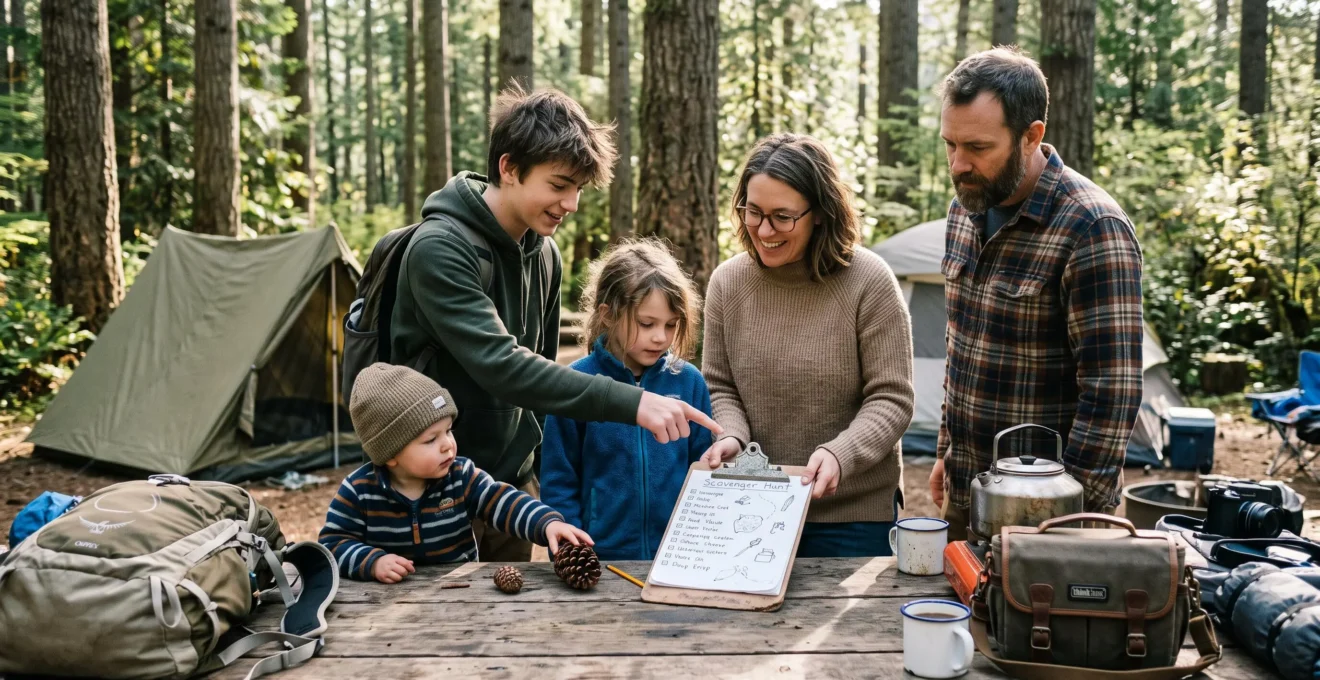
A pinecone with tightly closed scales, a bird calling from an unseen branch, or a trail of tiny footprints can turn an ordinary camping morning into an outdoor investigation. The challenge is making those discoveries meaningful for children with different abilities, interests and attention spans.
Nature-based scavenger hunts work best when children investigate rather than simply collect. Instead of asking campers to bring back five leaves, invite them to compare leaf shapes, find evidence of animal activity, or explain why moss grows in a particular spot. Each discovery becomes an opportunity to practise observation, reasoning and environmental responsibility.
Parents and group leaders can create these experiences with a short checklist, a familiar route and a few well-chosen questions. Children aged 5–12 can participate at different levels, while younger siblings and teenagers contribute through adapted missions. The goal is not to finish the list fastest. It is to help children notice, remember and care about the natural world surrounding their campsite.
Nature Scavenger Hunts: The Essentials
- Build one shared route with different challenge levels, from sensory discovery to ecological reasoning.
- Replace collecting with observing, photographing, listening and recording to protect habitats.
- Extend learning through short conversations, drawings and wildlife logs after the hunt.
- How to Plan Family Camping Trips That Engage Both Toddlers and Teenagers?
- How to Assign Camping Tasks That Make Every Family Member Feel Valued?
- How to Tailor Scavenger Hunt Difficulty for Mixed-Age Groups on One Campsite?
- What Transforms a Scavenger Hunt From Entertainment Into Lasting Nature Education?
- How to Run Scavenger Hunts Without Children Picking or Disturbing Wildlife?
- Why Photo Scavenger Hunts Outperform Traditional Collection Lists for Learning?
- Should You Run Scavenger Hunts Before or After Meals for Maximum Engagement?
- How to Record Wildlife Sightings Ethically During Campsite Exploration?
How to Plan Family Camping Trips That Engage Both Toddlers and Teenagers?
Plan one shared outdoor mission with different responsibilities rather than separate activities for every age group. Toddlers can explore colours, sounds and textures while older children solve clues and teenagers navigate or coordinate the team. A common destination keeps everyone involved, but flexible tasks respect differences in independence, attention and physical ability.
A practical approach is the tiered mission: everyone explores the same campsite loop, but each participant receives a different challenge. At a fallen tree, a toddler might point to something rough, a seven-year-old might identify signs of decay, and a teenager might investigate why fallen wood provides habitat.
This structure addresses different motivations. Very young children often enjoy immediate discoveries and repetition. Teenagers may prefer independence, meaningful choices and responsibilities that signal trust. Invite an older sibling to design a riddle or choose the next observation station rather than requiring them to follow a younger child’s checklist.
Before setting out, consider each child’s energy, attention and mobility. The following grid is a planning tool, not a developmental assessment.
| Child’s current needs | Suitable activity | Route adjustment |
|---|---|---|
| High energy, short attention | Find three contrasting natural colours | Short loop with frequent stops |
| Low energy or limited mobility | Listen for birds and map nearby sounds | Accessible, mostly stationary location |
| Strong curiosity, sustained attention | Compare two habitats and explain differences | Fewer stops with longer investigations |
| Seeking autonomy | Navigate, design clues or lead discussion | Agreed route with supervised choices |
Planning exclusively around the youngest child can leave older siblings feeling overlooked. Designing everything around teenagers can overwhelm younger campers. Neither situation is inevitable, but both can undermine cooperation.
Give the whole group one shared objective, such as finding evidence of three different habitats, and allow each child to contribute a distinct observation.
Once the route accommodates everyone, assigning meaningful responsibilities helps turn a group of individual explorers into a cooperative team.
How to Assign Camping Tasks That Make Every Family Member Feel Valued?
Assign camping responsibilities according to children’s interests and capabilities, then rotate them so everyone contributes to both preparation and discovery. Visible records of completed tasks help younger children recognise their contributions, while genuine decision-making responsibilities can make older campers more willing to participate. Avoid treating age as the only measure of competence.
Distinguish between support tasks, which help the activity function, and discovery tasks, which shape what the group learns.
- Support tasks: carrying the checklist, checking supplies, keeping time and recording observations.
- Discovery tasks: finding clues, comparing species, selecting observation points and interpreting evidence.
A child who always carries equipment but never investigates may begin to feel like an assistant rather than an explorer. Rotate responsibilities between stations. For example, the equipment keeper becomes the next clue solver, while the previous navigator takes responsibility for the wildlife log.
Make contributions visible with a small mission tracker. Write each child’s name beside their current role and leave a box for them to mark after completion. This creates a tangible record of participation without requiring constant adult praise.
For teenagers, wording matters. Compare “Can you help with the map?” with “You’re responsible for choosing the safest route between these two checkpoints.” The second communicates trust and a defined responsibility, while adults retain responsibility for safety.
The evening before the hunt, ask three short questions: What do you most enjoy discovering outdoors? Would you rather lead, create, observe or record? Is there anything you would prefer not to do?
Use the answers to allocate initial roles, then let children exchange tasks as the activity develops. A quiet child who loves drawing may enjoy documenting wildlife more than leading a group, regardless of age.
Once children feel ownership of the hunt, the next challenge is making clues demanding enough to sustain curiosity without excluding less experienced explorers.
How to Tailor Scavenger Hunt Difficulty for Mixed-Age Groups on One Campsite?
Use layered clues that allow children to investigate the same natural feature at different levels of complexity. Start with identification, progress to connections between observations, and finish with interpretation. A short trial clue helps adults adjust difficulty based on children’s responses rather than relying on age categories alone.
The identify–connect–interpret method works particularly well on a single campsite route. Consider a patch of moss growing near a tree.
| Level | Example clue | Learning focus |
|---|---|---|
| Identify | Can you find something green growing on the tree or ground? | Recognition and observation |
| Connect | How does this patch differ from the nearby dry ground? | Comparison and environmental relationships |
| Interpret | What might explain why moss grows more abundantly here? | Reasoning and hypothesis formation |
Children can answer at their own level without being separated into competing groups. A younger child may discover the moss, while an older participant helps compare light and moisture conditions.
This is a form of scaffolding: a more experienced learner provides enough support for someone else to complete a challenge. Give older campers explanatory riddles rather than simply harder lists. For instance, ask them to describe the characteristics of a conifer without naming it so a younger teammate can identify one.
The National Park Service offers Acadia National Park’s educational outdoor activities, including scavenger hunts for kindergarten through eighth grade and exercises involving navigation, plant adaptations, sound mapping and wildlife observation. These provide practical examples of varied outdoor challenges, although they do not experimentally validate this specific three-level system.
On arrival day, test one clue for approximately five minutes. Notice whether children solve it immediately, remain interested after a hint, or abandon it. Adjust the next clues accordingly.
A confident six-year-old naturalist may handle interpretive questions better than a nine-year-old encountering forest habitats for the first time. Offer challenge levels as choices rather than permanent age labels.
Appropriate difficulty makes the activity accessible, but the educational value depends on what children do with their discoveries.
What Transforms a Scavenger Hunt From Entertainment Into Lasting Nature Education?
A nature scavenger hunt becomes educational when finding an object leads to observation, questioning and later recall. Children should investigate why something exists, how it relates to its surroundings and what might change if it disappeared. Revisiting discoveries through conversation, drawing or storytelling gives children another opportunity to retrieve and explain what they learned.
The essential shift is from finding to understanding. A checklist asking children to spot a feather rewards recognition. Adding “What might feathers help a bird do?” introduces function, adaptation and reasoning.
A reusable question sequence can turn almost any discovery into an investigation:
- What do you notice about its colour, shape, sound or position?
- Why might it be found in this particular place?
- How could it interact with other living things?
- What might happen if this feature disappeared?
Not every question requires an immediate correct answer. Children can make predictions, compare evidence and revisit uncertain explanations with a trusted field guide or knowledgeable ranger.
Learning also benefits from opportunities to recall information. A systematic review of retrieval practice in classrooms examined 50 educational experiments and reported learning benefits across different settings and subjects. The review did not test family camping hunts, but it provides a rationale for inviting children to remember and explain earlier discoveries.
50 experiments
The systematic review examined retrieval practice in educational settings. Its findings support active recall as a learning strategy, not a quantified improvement from campsite scavenger hunts.
Agarwal, Nunes and Blunt, Educational Psychology Review, 2021.
Try a simple learning loop: investigate a feature during the morning hunt, ask children to recall it at dinner, then invite them to draw or describe it the following day. Keep the conversation playful rather than turning it into a test.
Memorable discoveries can become useful anchors for these conversations. A surprising animal call or an unfamiliar insect may inspire an especially engaging follow-up question. Rather than manufacturing a wildlife encounter, plan one distinctive challenge, such as listening silently for a minute and comparing the sounds each child notices.
Competitive scoring and strict time limits can shift attention toward completion. For educational hunts, reward careful explanations, thoughtful questions and cooperation rather than speed alone.
Children can develop these investigative habits without taking natural objects home, making habitat protection an integral part of the learning experience.
How to Run Scavenger Hunts Without Children Picking or Disturbing Wildlife?
Design scavenger hunts around observing rather than collecting. Ask children to spot, compare, count, listen or photograph natural features while leaving plants, rocks, animals and shelters undisturbed. Explain why each rule matters, agree on a simple group charter before starting, and establish a clear procedure for unexpected wildlife encounters.
The language of the checklist influences the activity itself. Replace “collect three leaves” with “find three different leaf shapes.” Instead of “bring back a feather,” ask children to describe where they saw one without picking it up.
These alternatives support Leave No Trace principles. The organisation’s Leave What You Find principle recommends leaving plants, rocks and other natural objects in place because they can contribute to habitats and ecological processes.
Explain the reasons in child-friendly language. Picking a flower may prevent it from producing seeds. Moving a log can expose organisms sheltering underneath. Feeding wildlife may encourage animals to approach people for food, potentially creating unsafe encounters.
Before starting, invite children to write a short nature-respect charter. Suggest three rules if they need inspiration: leave living things where they are, watch animals from a distance, and never move shelters or nests. Having children help formulate the charter gives them a meaningful role in setting expectations, although the degree to which this improves compliance has not been established by the supplied evidence.
Prepare a Wildlife-Friendly Hunt in Five Steps
- Choose an appropriate campsite route and mark its boundaries on a simple map.
- Rewrite five collecting prompts as observation challenges and produce a revised checklist.
- Agree on three habitat-protection rules and write a child-approved charter.
- Assign an adult-supervised wildlife observer and record the responsible person’s name.
- Prepare an encounter instruction card stating: stop, keep your distance, tell an adult and follow local guidance.
If a child discovers a nest, burrow or injured animal, everyone should stop and avoid approaching or touching it. Note the general location privately and tell an adult. The adult can consult campsite staff, a ranger or an appropriate local wildlife service when assistance appears necessary. Do not attempt to handle or rescue wildlife without qualified guidance.
Once observation replaces collection, photographs offer one way to preserve discoveries without removing anything from the environment.
Why Photo Scavenger Hunts Outperform Traditional Collection Lists for Learning?
Photo scavenger hunts can be more suitable than collection-based hunts because children document discoveries without removing natural objects. Taking a photograph also encourages choices about subject, framing and visible details. However, photography has not been proven universally superior for learning, and screen use can distract from sounds, smells and other sensory experiences.
Traditional collection lists often emphasise obtaining objects: a leaf, a stone, a flower or a feather. A photographic challenge can instead ask children to show evidence of a particular characteristic, such as an unusual bark pattern or a plant growing in shade.
This creates opportunities for deliberate observation. Before taking a picture, children must decide what makes the subject interesting and which details belong in the frame. Adults can deepen the task by asking, “What should someone notice when looking at your photograph?”
Photography also supports the no-collection approach. Children can document a flower where it grows or photograph animal tracks without disturbing their surroundings. When photographing wildlife, distance and animal welfare always take priority over image quality.
A family does not need several cameras. Rotate one phone or compact camera between participants. An older child can act as photographer for a younger sibling who identifies the subject and directs the composition.
During an evening review, choose a few photographs and ask children to explain what they noticed, why they chose each subject and what they still want to investigate. This introduces an opportunity for active recall without requiring a lengthy lesson.
Keep the camera secondary to the outdoor experience. A useful hybrid hunt might include three photographs, two listening challenges and one comparison of safe-to-touch nonliving surfaces, where local rules permit contact.
For example, children could photograph an interesting leaf arrangement, listen for two distinct bird calls and describe how sunlight feels different between an open clearing and a shaded path.
There is no need to photograph every discovery. Sometimes a sketch, spoken description or moment of quiet attention is more appropriate.
Whether children use cameras or notebooks, the timing of the activity can influence how comfortably they participate.
Should You Run Scavenger Hunts Before or After Meals for Maximum Engagement?
Choose scavenger hunt timing according to children’s energy, hunger and attention rather than following a universal before-or-after-meal rule. Short, active hunts can work before meals when children are comfortable and alert. After meals, quieter observation activities may be more suitable. Avoid starting demanding challenges when children are already hungry, tired or frustrated.
A pre-lunch hunt has one practical advantage: lunch creates a clear endpoint. Children know when the activity will finish, which may help those who struggle with open-ended tasks.
However, hunger is not automatically motivating. If children are irritable, distracted or asking repeatedly for food, provide a snack or eat first rather than trying to channel discomfort into concentration.
After meals, consider lower-intensity challenges such as sound mapping, cloud observation or sketching a familiar tree. Avoid strenuous activity immediately after a substantial meal if participants are uncomfortable.
| Time | Suggested hunt | Watch for |
|---|---|---|
| Before lunch | Short clue trail with a defined finish | Hunger and declining concentration |
| After lunch | Seated observation or nature sketching | Sleepiness and reduced motivation |
| Late afternoon | Photography and habitat comparisons | Weather, changing light and fatigue |
| After dinner | Brief listening activity near camp | Bedtime, visibility and supervision |
Meals can also provide a natural connection to the activity. Make choosing an approved picnic location the final clue, or compare familiar culinary herbs brought from home with the scents of the surrounding environment.
Never encourage children to taste wild plants or fungi as part of a scavenger hunt. Accidental misidentification can be dangerous, and even familiar-looking plants should not be eaten without reliable expert identification and appropriate permission.
If children abandon a hunt halfway through, consider whether timing contributed before rewriting every clue. Repeat a comparable short activity at a different time and observe whether participation changes. This is an informal troubleshooting method, not a controlled experiment.
A well-timed hunt leaves enough energy for children to reflect on what they discovered, especially when wildlife encounters deserve careful documentation.
Key Takeaways Before Recording Wildlife
- Make respectful distance and undisturbed habitats more important than completing a sighting checklist.
- Record meaningful observations, not just species names, so children can revisit what they learned.
- Keep sensitive wildlife locations private and distinguish family records from information suitable for public sharing.
How to Record Wildlife Sightings Ethically During Campsite Exploration?
Record wildlife sightings through quiet observation, a simple field log and careful handling of location information. Children should note what they saw, where and when they saw it, and one behaviour or distinguishing feature. They must avoid approaching, feeding, touching or disturbing animals, and sensitive nesting or den locations should remain private.
Start by modelling responsible observation. Stop walking when wildlife appears, speak quietly and allow the animal to continue its normal behaviour. Use binoculars or a zoom lens rather than approaching for a better view.
The National Park Service’s wildlife-watching guidance recommends maintaining appropriate distances and following local rules. Many U.S. national parks require at least 25 yards from most wildlife and 100 yards from certain predators, but requirements vary between parks and species. These figures should not be treated as universal standards for campsites across English-speaking countries.
When an animal reacts to visitors, that may indicate they are too close. Move away calmly and never pursue wildlife to complete a challenge. Avoid flash, baiting and moving natural shelters.
Give children a four-field sighting log that is easy to complete without interrupting the experience.
| What | Where | When | One observation |
|---|---|---|---|
| Small songbird | Woodland edge | Morning | Repeated a short call from a branch |
| Butterfly | Sunny clearing | Afternoon | Visited several flowers |
| Squirrel | Near tall trees | Late afternoon | Moved between branches |
These entries illustrate a possible recording format, not documented sightings. Children can add drawings, tentative identifications or questions they want to investigate later.
Explain the difference between private records and shareable information. A family notebook may contain a precise location for future personal reference, but publicly sharing the coordinates of a nest, den or sensitive species can attract unwanted visitors. Remove precise geotags from photographs before sharing when necessary.
Some campsites, parks and ranger services accept useful wildlife reports. Ask staff whether observations are welcome and what information they need. Reporting an unusual or concerning encounter may be more valuable than submitting routine sightings.
Review the log during a later camping trip. Comparing observations from different places or seasons encourages children to develop new questions and recognise that wildlife activity changes with habitat and conditions.
For your next camping trip, choose a short, safe route, prepare a handful of observation clues and leave space for unexpected discoveries. End the activity by asking each child to share one thing they noticed and one question they would like to explore next time.
What equipment do children need for a nature scavenger hunt?
A paper checklist, pencil, suitable outdoor clothing and drinking water are enough for a basic hunt. A magnifying glass, binoculars, field guide or shared camera can enrich observation, but none is essential. Adults should also carry appropriate safety supplies for the location and conditions.
How long should a scavenger hunt last for children aged 5–12?
There is no universally ideal duration. A practical starting point is a short activity of roughly 15–30 minutes, adjusted for age, interest, terrain and weather. This is a planning suggestion rather than a research-established optimum. Extend the hunt when children remain engaged, or stop earlier if they become tired.
Can children complete a nature scavenger hunt without reading?
Yes. Use pictures, colours, simple symbols and spoken clues. Non-readers can identify shapes, compare sounds or point out natural features while an older teammate records their discoveries. Picture-based checklists also make mixed-age activities easier to share.
What should families do if the expected animals or plants are not visible?
Replace exact-species targets with broader observations, such as evidence of animal activity, different leaf shapes or contrasting habitats. Avoid disturbing shelters or approaching wildlife to force a discovery. Not finding an expected species can itself inspire questions about season, weather and habitat.
How can families continue nature learning after returning home?
Review photographs and field notes, ask children to recall favourite discoveries, and investigate unanswered questions using reliable nature guides. A local park walk can provide an opportunity to compare familiar habitats with those explored while camping. These recall activities adapt general educational principles to family nature learning without requiring another camping trip.