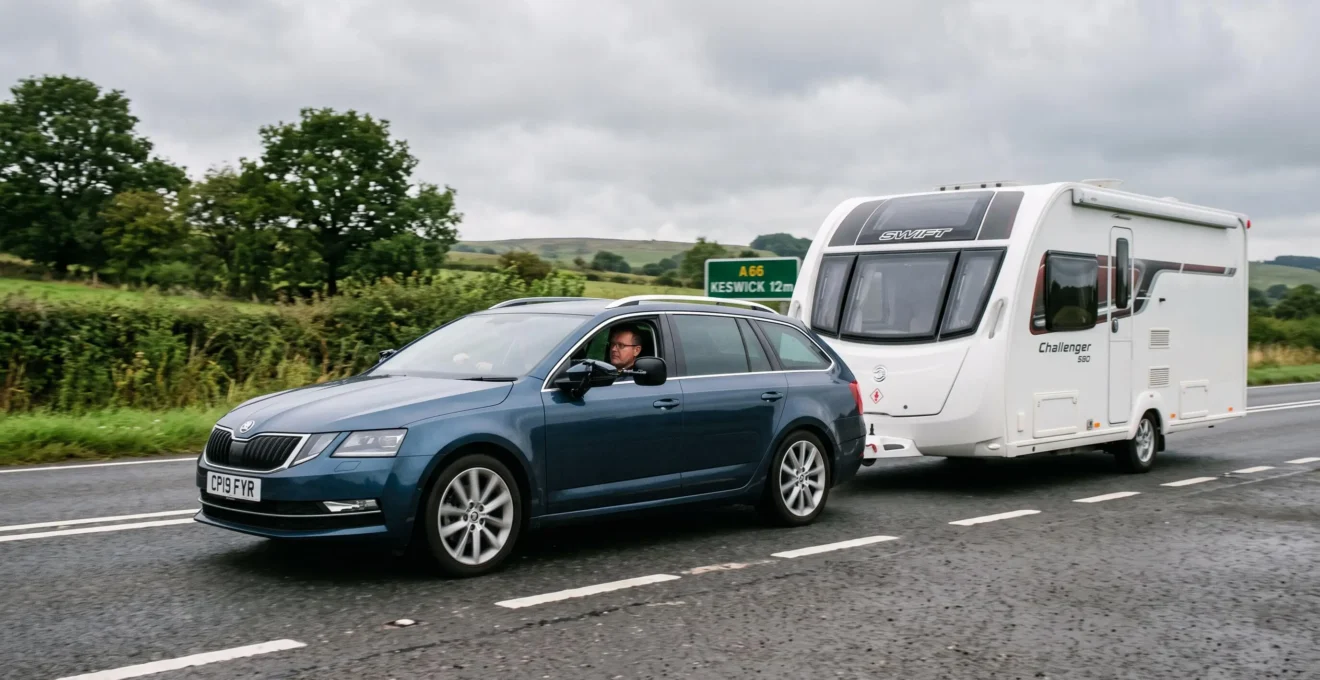
Safe caravan towing depends on understanding how the trailer responds to steering, braking, speed and changes in road surface. A manoeuvre that feels straightforward in an unladen car becomes more demanding when a caravan adds length, weight and an articulated connection behind the rear axle.
On UK roads and campsites, the safest approach combines three disciplines: keeping the outfit mechanically compliant, anticipating the caravan’s movement and making deliberate, gradual control inputs. Correctly positioned mirrors, sensible loading and sufficient space are more valuable than trying to correct a developing problem at the last moment.
For first-time towers, reversing and narrow campsite entrances often cause the greatest anxiety. These skills become manageable when practised slowly in an open area, preferably with a qualified instructor. Motorway stability, legal towing weights and pre-departure inspections deserve equal attention: even confident steering cannot compensate for an overloaded caravan or defective tyres.
Caravan towing safety at a glance
- Set towing mirrors from the driving seat and practise reversing with small, early steering corrections.
- Check actual loaded weights, noseweight, tyre condition and the manufacturer’s towing limits before travelling.
- Reduce speed for crosswinds, descents and restricted visibility; if snaking develops, ease off the accelerator gently.
- How to Adjust Your Mirrors for Complete Visibility When Towing a Caravan?
- The Steering Mistake That Causes Jackknifing When Reversing With a Trailer?
- Stabiliser Bars or Weight Distribution Hitch: Which Stops Motorway Sway?
- How to Verify Your Car Can Legally Tow Your Caravan’s Loaded Weight?
- Why Should You Drive 15mph Slower When Towing Even in Good Conditions?
- How to Verify Your Roof Load Stays Within Manufacturer Weight Limits?
- The Tyre Check That Prevents Blowouts on Remote Mountain Roads?
- How to Inspect Your Vehicle Before Remote Camping Trips to Prevent Roadside Failures?
How to Adjust Your Mirrors for Complete Visibility When Towing a Caravan?
Adjust caravan towing mirrors from the driver’s normal seating position until both sides of the outfit and the road behind are visible. The mirrors must provide the legally required rearward field of view, not merely show the caravan’s bodywork. Extension mirrors are generally necessary when a caravan obstructs the view provided by the car’s original mirrors.
UK towing-mirror requirements concern a defined field of view behind the vehicle combination. The relevant mirror geometry depends on the applicable vehicle and mirror regulations, so a simple glance along the caravan’s sides is not proof of compliance. Suitable towing mirrors must allow the driver to monitor approaching traffic and the area alongside the caravan without relying on guesswork.
The Northern Ireland government‘s towing safety information identifies inadequate towing mirrors as a potential offence carrying a fine of up to £1,000 and three penalty points. The practical requirement is straightforward: the caravan must not conceal traffic that the driver needs to see.
Flat and convex extension mirrors offer different benefits. A flat mirror presents a less distorted view of relative distance, whereas a convex mirror covers a wider angle but makes vehicles appear smaller and potentially farther away. Some drivers prefer different mirror types on opposite sides, although the correct choice depends on the outfit, the approved mirror design and the driver’s ability to judge traffic accurately.
Set the mirrors using the following sequence:
- Park the coupled outfit on level ground, away from moving traffic.
- Adjust the driving seat and the car’s original mirrors to their normal positions.
- Secure both extension mirrors according to their fitting instructions.
- From the driving seat, adjust each extension mirror until a narrow reference to the caravan’s side remains visible and the road behind occupies most of the reflection.
- Check both sides with a helper positioned safely away from traffic, then confirm the mirror arms remain stable.
On narrow campsite lanes, the nearside mirror becomes particularly useful for monitoring the caravan’s rear corner relative to kerbs, hedges and pitch boundaries. However, mirrors cannot eliminate every blind spot. Stop and use a guide whenever the available view is insufficient.
Remove clip-on extension mirrors after unhitching, unless the mirror arrangement is specifically approved and compliant for solo driving. Unnecessary projections can create a hazard for pedestrians, cyclists and parked vehicles.
Once the rearward view is reliable, it becomes easier to interpret the caravan’s movement during the most unfamiliar manoeuvre: reversing.
The Steering Mistake That Causes Jackknifing When Reversing With a Trailer?
The steering mistake most likely to cause jackknifing is applying too much steering lock and continuing to reverse after the caravan has developed a sharp angle to the car. Reversing an articulated outfit requires counter-intuitive initial steering inputs, followed by early corrections. When the angle becomes excessive, stop and pull forward to straighten the combination.
During forward travel, the caravan follows the towing vehicle around a bend. In reverse, the towball becomes the articulation point through which the car pushes the caravan. Turning the car’s steering wheel initially to the right generally sends the caravan’s rear towards the left; turning left initially sends it towards the right.
This relationship is easiest to understand at very low speed. The tow car’s rear moves laterally relative to the caravan, creating an angle at the coupling. As reversing continues, the caravan rotates around its axle or axle group, and its rear moves in the opposite direction to the initial steering input.
Small steering inputs can produce a substantial change in articulation angle when the vehicle continues reversing. The precise response depends on wheelbase, towbar geometry, trailer length and steering angle.
Use a deliberate reversing routine:
- Inspect the intended route on foot, including overhead obstacles, pedestrians and soft ground.
- Begin with the car and caravan as straight as possible.
- Reverse at walking pace, applying a small initial steering input.
- Watch the caravan’s rear corners through the extension mirrors, especially the nearside corner when reversing towards a kerb or pitch boundary.
- As the caravan approaches the intended line, steer to reduce the articulation angle rather than allowing it to increase.
- Stop immediately if the angle develops faster than expected. Pull forward to straighten before trying again.
Think of the towbar as the pivot reference. The task is not to steer the caravan directly but to control the position of the tow vehicle relative to that pivot. The rear corner visible in the mirror provides an early indication of the caravan’s trajectory.
Jackknifing occurs when the articulation becomes so acute that the caravan and tow vehicle approach physical contact. Continuing to reverse risks damaging bodywork, coupling components and equipment. Do not attempt to recover a severe angle by forcing the steering further while reversing.
Grass pitches introduce additional uncertainty. Soft soil, wet grass and uneven ground can alter tyre grip and resistance, making the caravan’s response less predictable. Use gentler corrections, avoid sudden acceleration and never ask a helper to stand between the vehicles or directly behind a moving caravan.
Accurate low-speed control is one part of towing confidence; maintaining stability at road speed requires a different understanding of loading and sway.
Stabiliser Bars or Weight Distribution Hitch: Which Stops Motorway Sway?
A friction stabiliser and a weight distribution hitch address different aspects of towing behaviour. A friction stabiliser resists unwanted articulation and helps dampen sway, while a weight distribution hitch uses leverage to alter axle loading. Neither guarantees the prevention of motorway snaking, and neither compensates for incorrect noseweight, poor loading or an unsuitable car-caravan combination.
Caravan sway, often called snaking, is a side-to-side oscillation involving the caravan and tow vehicle. It can develop or intensify when loading is poorly balanced, noseweight is inadequate, speed is excessive for conditions or disturbances such as crosswinds and passing heavy vehicles affect the outfit.
A friction stabiliser introduces resistance to rotation at the coupling. This can reduce the effect of smaller disturbances, but it cannot remove the underlying cause of instability.
A weight distribution hitch uses a mechanical leverage system to redistribute some of the load imposed through the hitch across the combination’s axles. It is not simply a stronger stabiliser, and it must not be assumed compatible with a particular European caravan chassis or towbar.
The distinction matters when selecting equipment:
| Criterion | Friction stabiliser | Weight distribution hitch |
|---|---|---|
| Main purpose | Dampen articulation and sway | Alter axle-load distribution |
| How it works | Introduces frictional resistance at the coupling | Applies leverage through hitch components |
| Primary limitation | Cannot correct poor loading | Does not automatically eliminate sway |
| Compatibility | Requires an appropriate coupling and approved components | Requires explicit compatibility with car, towbar and caravan chassis |
| First priority | Correct loading and noseweight | Manufacturer approval and axle-weight compliance |
A relatively light caravan behind a suitably rated, heavier tow vehicle may be stable with correct loading and an approved friction stabiliser. A heavier caravan behind a lighter car requires particular scrutiny of the entire weight match. A weight distribution hitch should not be treated as permission to exceed limits or as a remedy for an unsuitable combination.
Vehicle manufacturers may impose restrictions because hitch forces can interact with towbar construction, suspension behaviour, electronic stability systems and vehicle sensors. Check the car, towbar and caravan manufacturers’ instructions before installing any distribution system.
A good stabiliser will not cure instability caused by a poor towing vehicle/ trailer combination.
If snaking begins on the road, ease off the accelerator and reduce speed gently. Avoid abrupt steering, sharp acceleration or harsh braking intended to force the caravan straight. Maintain a steady direction while the oscillation subsides, then stop somewhere safe and investigate the cause.
Before buying additional stabilising equipment, establish whether the loaded outfit is legally permitted and appropriately matched in the first place.
How to Verify Your Car Can Legally Tow Your Caravan’s Loaded Weight?
To verify legal towing capacity, compare the car’s manufacturer-approved towing limits, gross train weight, axle limits and towball load with the caravan’s actual loaded weight and plated maximum authorised mass. Check the driver’s licence entitlement separately. A caravan may be within the car’s mechanical capacity yet still breach another weight, equipment or licensing restriction.
Start with the car’s manufacturer plate, usually found on the vehicle body, and its handbook or official technical documentation. The plate normally identifies the maximum permitted vehicle mass, maximum combined mass and axle limits. The car’s permitted braked trailer mass and towball load must also be confirmed from manufacturer information.
The caravan’s mass in running order is not its holiday-ready weight. Gas cylinders, water, food, clothing, equipment and fitted accessories can increase the actual mass. Weigh the caravan in its intended travelling condition, using a suitable weighbridge, and check its maximum technically permissible laden mass.
For a braked trailer, the combination must remain within the car’s permitted train weight and applicable towing limits. The DVSA trailer and caravan safety checks also require drivers to account for passengers, fuel and other loads when assessing vehicle weight.
Consider this hypothetical weight-matching example:
Worked example: checking a loaded outfit
Suppose a car has a manufacturer-approved braked towing limit of 1,800 kg and a maximum train weight of 4,000 kg. The car weighs 2,100 kg in its actual travelling condition, while the loaded caravan weighs 1,500 kg.
The combined actual mass is 2,100 + 1,500 = 3,600 kg, leaving 400 kg below the hypothetical train-weight limit. The caravan is also 300 kg below the stated braked towing limit.
This does not establish complete legality. The caravan’s plated limit, car and caravan axle loads, noseweight, vehicle gross weight and licence entitlement must still be checked. Manufacturer restrictions can also affect the permitted combination.
UK licence categories must not be confused with vehicle towing capacity. Current GOV.UK category information describes relevant category B trailer allowances up to 3,500 kg maximum authorised mass, subject to the applicable conditions, while category BE entitlements depend partly on their recorded valid-from date.
Drivers with BE entitlement valid before 19 January 2013 may have different trailer mass allowances from those whose BE entitlement became valid on or after that date. Confirm the specific entitlement shown on the licence against the GOV.UK driving licence categories guidance. Northern Ireland licensing arrangements should be checked against the applicable local requirements rather than assumed identical in every historical case.
The familiar 85% guideline compares caravan weight with the tow car’s kerbweight as a conservative matching recommendation often used for inexperienced caravanners. It is not a statutory towing limit. A combination below 85% can still be unsafe if loaded badly, and exceeding the guideline does not automatically establish an offence.
Legal compliance, insurance conditions, warranty restrictions and mechanical suitability are separate questions. Check policy terms and manufacturer instructions rather than assuming that passing one weight calculation resolves all four.
Once the combination is properly matched, driving speed becomes one of the most important remaining influences on stability and stopping margin.
Why Should You Drive 15mph Slower When Towing Even in Good Conditions?
Driving approximately 15 mph slower than a familiar solo-car cruising speed can provide a useful additional margin when towing, but it is not a universal legal requirement. A caravan increases the combination’s mass and length, changes braking behaviour and makes stability more sensitive to speed, gradients and crosswinds. The correct speed must always remain within the applicable towing limit.
On UK roads, a car towing a caravan is subject to lower national speed limits than a solo car on certain roads. The standard towing limits identified in official Northern Ireland guidance are 50 mph on single carriageways and 60 mph on dual carriageways and motorways, unless a lower posted limit applies. The corresponding national towing limits also apply in Great Britain, subject to local restrictions.
Consequently, a driver accustomed to travelling at 70 mph on a motorway must not simply maintain that speed with a caravan attached. The national motorway towing limit is 60 mph, and conditions may require travelling more slowly.
The physics explain why additional restraint is worthwhile. A heavier combination carries more momentum at a given speed, while braking performance depends on the condition and correct operation of both the tow vehicle and caravan braking systems. The caravan also increases overall length, making overtaking, merging and negotiating bends more demanding.
Stopping distance is not determined by mass alone: brake design, tyre grip, loading, gradient and driver reaction time all matter. Nevertheless, leaving a larger following gap is essential because the combination may not respond like the solo car.
Crosswinds are especially important. A caravan presents a substantial side area to moving air, and the resulting lateral forces can disturb the outfit. Speed reduction provides more time to respond and can reduce the severity of an emerging stability problem.
Long descents demand similar caution. Select an appropriate gear and manage speed before the gradient becomes steep, following the vehicle manufacturer’s instructions. Do not rely on continuous heavy braking to control an already accelerating outfit.
Heavy goods vehicles can provide a general reference for steady traffic flow in the left-hand lane, but they are not speed-setting authorities. Maintain your own legal, safe speed and following distance; do not follow a lorry closely or accelerate simply to match it.
60 mph
Standard maximum speed for a car towing a caravan on UK motorways and dual carriageways, unless a lower applicable limit applies.
Official UK towing-speed guidance
On motorways with three or more lanes, towing vehicles must not use the right-hand lane under the relevant UK motorway rules. Plan overtaking early and avoid unnecessary lane changes.
Slower, smoother driving also reduces the demands placed on the caravan’s structure, tyres and load restraint, including equipment mounted high on the roof.
How to Verify Your Roof Load Stays Within Manufacturer Weight Limits?
Verify caravan roof loading by identifying the manufacturer’s permitted roof load, adding the mass of every roof-mounted accessory and comparing the total with that limit. Include permanent equipment such as solar panels and aerials as well as any temporary carried items. Roof strength, permissible payload and whether loading is allowed during travel must all be checked separately.
A caravan roof is not necessarily designed to carry the same loads as a car roof. Its structural capacity depends on the particular body construction, reinforcement, attachment points and manufacturer’s instructions. Some roofs are intended only for maintenance access under specified conditions; others may support approved permanently mounted equipment.
Do not infer a safe roof load from the apparent strength of the panels or from another caravan model. Obtain the specific limit and installation requirements from the caravan manufacturer or approved documentation.
For a straightforward calculation, consider a hypothetical caravan whose manufacturer explicitly permits 40 kg of travelling roof-mounted equipment. Suppose an approved solar installation weighs 15 kg, its mounting hardware weighs 5 kg and another approved accessory weighs 8 kg.
The combined equipment mass is 15 + 5 + 8 = 28 kg, leaving 12 kg against that hypothetical limit. This arithmetic is useful only if all components are approved for their mounting locations and the manufacturer’s definition of roof load includes those items.
Check whether the quoted limit applies while travelling or only when stationary. A static load allowance must not be treated as permission to transport the same load on the road.
Roof-mounted equipment also changes the caravan’s weight distribution. Placing mass high above the axle raises the centre of gravity, potentially increasing sensitivity to lateral forces and body movement. That makes roof modifications relevant to the motorway stability assessment, not merely to roof integrity.
Every accessory contributes to the caravan’s total travelling mass. Even a roof installation within its structural allowance may cause the caravan to exceed its remaining payload capacity or alter noseweight and axle loading.
Secure equipment using manufacturer-approved fixings and installation methods. Roof penetrations, waterproofing and electrical cable routing should be checked by an appropriately competent installer where necessary.
After checking high-mounted equipment, attention should move to the components carrying the load directly against the road: the tyres and wheels.
The Tyre Check That Prevents Blowouts on Remote Mountain Roads?
The most important caravan tyre check before remote mountain travel combines cold inflation pressure, load suitability and age-related condition. Adequate tread alone does not establish safety because caravan tyres can deteriorate during long periods of storage. Inspect sidewalls, confirm manufacturer-specified pressures, check the spare and replace tyres showing damage or unacceptable ageing.
Caravan tyres often accumulate fewer miles than everyday car tyres. Consequently, they may retain substantial tread while their rubber ages through exposure to sunlight, weather and prolonged stationary loading. Cracks, bulges and structural deterioration are warning signs even when the tread pattern looks healthy.
The Caravan and Motorhome Club tyre and wheel advice recommends replacing caravan tyres at five years and not using them beyond seven years. It gives stricter recommendations for tyres requiring inflation pressures of 50 psi or more, including checking for deterioration from three years and not using them at five years.
These are specialist maintenance recommendations, not universal statutory UK tyre-age limits. Age begins on the tyre’s manufacturing date, which can be established from its sidewall date marking, rather than the date it was fitted.
Check tyre pressures when cold, using the caravan manufacturer’s specification for the actual load and tyre arrangement. The pressure marked on the tyre sidewall must not automatically be interpreted as the correct everyday operating pressure. The caravan handbook or approved technical information should govern the setting.
Mountain roads add prolonged climbs, descents and potentially limited roadside assistance. Under-inflation or overloading can cause excessive tyre flexing and heat generation, increasing the risk of failure. A caravan tyre failure may also destabilise the towing combination, particularly if the driver reacts abruptly.
Inspect the inner and outer sidewalls where accessible, tyre valves, wheel rims and visible tread. Confirm that each tyre has the appropriate load rating and specification. The legal tread minimum identified in UK guidance is 1.6 mm across the central three-quarters of the tread and around its entire circumference, but meeting that minimum does not establish overall tyre safety.
Caravan wheels are not necessarily rotated in the way car wheels may be. Check all tyres individually, including the spare. After tyre or wheel work, confirm wheel fasteners have been tightened to the manufacturer’s specified torque and follow the prescribed rechecking procedure.
Carry a compatible spare where appropriate, a wheel brace that fits the caravan fasteners and suitable approved lifting equipment. A stable support arrangement may be necessary on soft ground, but never improvise an unsafe lifting point or work beneath an inadequately supported caravan.
Wheel bearings also deserve attention before demanding journeys. Unusual noise, excessive play or abnormal heating should be investigated by a competent technician rather than left until departure.
A tyre inspection is most effective when it forms part of a wider pre-trip check covering the towing vehicle, caravan and recovery arrangements.
Key takeaways before a remote camping journey
- Confirm that the loaded outfit is mechanically sound before relying on driver skill to manage difficult roads.
- Prioritise defects that could immobilise the combination, especially tyres, cooling, coupling and essential electrical connections.
- Plan for limited recovery access by checking the route, available services and caravan-specific breakdown cover.
How to Inspect Your Vehicle Before Remote Camping Trips to Prevent Roadside Failures?
Inspect the tow car and caravan as one connected system before remote camping trips. Prioritise faults capable of stopping the journey or making the outfit unsafe: tyres, cooling, brakes, coupling, breakaway cable, electrical connections and lighting. Complete the inspection while parked safely, then test the coupled outfit before entering remote roads where assistance may be difficult to obtain.
A useful pre-trip inspection is not a substitute for scheduled servicing. Its purpose is to detect obvious defects, verify essential functions and identify problems requiring professional attention before departure.
Begin with the towing vehicle. Check coolant level according to the manufacturer’s cold-engine instructions, inspect for visible leaks and confirm there are no unresolved dashboard warnings. Assess battery condition, particularly if the vehicle has been standing unused, and investigate starting difficulties rather than assuming a long drive will resolve them.
Check brake condition and operation, including any warning indicators, and ensure the vehicle is suitable for the anticipated gradients. Inspect tyres, pressures and visible damage on both the car and caravan.
At the caravan coupling, confirm the hitch is fully engaged and locked in accordance with the manufacturer’s procedure. Check that the breakaway cable is correctly attached to the designated point, is undamaged, has sufficient slack for manoeuvring and cannot drag on the road.
Raise and secure the jockey wheel fully for travel. Check the caravan’s braking equipment and ensure gas cylinders and appliances are secured and configured for travel according to their instructions. Suspected gas leaks require professional attention; do not attempt to locate them using a flame.
The 13-pin electrical connection deserves particular attention. Moisture, dirt, corrosion or damaged contacts can interrupt lighting and other trailer circuits. Although electrical connector faults are a credible cause of towing problems, the supplied official guidance does not establish that they are the most common cause of roadside breakdowns.
Inspect the connector and cable for visible damage. With a helper safely observing from behind and to the side of the stationary outfit, test indicators, brake lights, tail lights, fog lights and other required functions. Confirm that the cable has sufficient movement for cornering without dragging or becoming trapped.
Five verifiable checks before departure
- Confirm the weight match: retain the loaded caravan weight and compare it with the car’s towing, train-weight and axle limits.
- Record tyre readiness: note cold pressures, inspect sidewalls and verify the spare tyre’s condition and age.
- Verify the coupling: confirm hitch engagement, correct breakaway cable attachment and a fully secured jockey wheel.
- Complete the electrical test: have a helper observe every required caravan light while the corresponding vehicle control is operated.
- Confirm remote-trip readiness: check fuel stops, likely mobile coverage gaps and written evidence that recovery cover includes the caravan.
Fuel planning matters because towing can increase consumption and remote routes may have widely spaced filling stations. Identify suitable stopping points before departure, particularly where access for a long outfit could be restricted.
Check mobile coverage along the route where information is available, but do not assume continuous reception. Carry essential contact information and a practical contingency plan for locations without service.
Finally, inspect the recovery policy wording. Some arrangements cover the towing vehicle but impose separate conditions on recovering an attached caravan. Confirm eligible vehicle dimensions, caravan recovery, onward transport and any relevant geographical restrictions before relying on the policy.
Before setting off, resolve any safety-critical defect rather than accepting it as a manageable inconvenience. A short, controlled test drive near home, followed by a final visual check in a safe stopping place, provides an opportunity to identify unusual behaviour before the journey becomes difficult to interrupt.
Should a beginner practise reversing before arriving at a campsite?
Yes. Practise on suitable private ground with permission, away from traffic and pedestrians. Begin with straight reversing, then introduce gentle turns and recovery by pulling forward. Professional towing instruction is particularly useful for understanding articulation and avoiding jackknifing.
Can a caravan stabiliser make an overloaded outfit safe?
No. A stabiliser cannot compensate for exceeding permitted weights, incorrect noseweight or unsuitable loading. Correct the underlying problem before travelling, even if the caravan has an approved anti-sway system.
Is the 85% caravan matching guideline legally compulsory?
No. The 85% guideline is a conservative matching recommendation, particularly relevant to inexperienced towers, rather than a statutory limit. The legal assessment depends on the applicable vehicle, trailer, axle, train-weight and licensing requirements.
Should a driver reverse onto a soft grass pitch without assistance?
Only when the route, ground conditions and surrounding area can be assessed safely. If visibility is restricted, stop and use a competent guide who remains visible and clear of the outfit. Avoid excessive throttle or steering inputs on slippery ground.
What should a driver do if the caravan begins snaking on a motorway?
Ease off the accelerator, maintain a steady direction and allow speed to decrease gently. Avoid sharp steering, acceleration or harsh braking as an immediate corrective reaction. Once stable, stop in a safe place and investigate loading, tyre condition, noseweight and other possible causes before continuing.