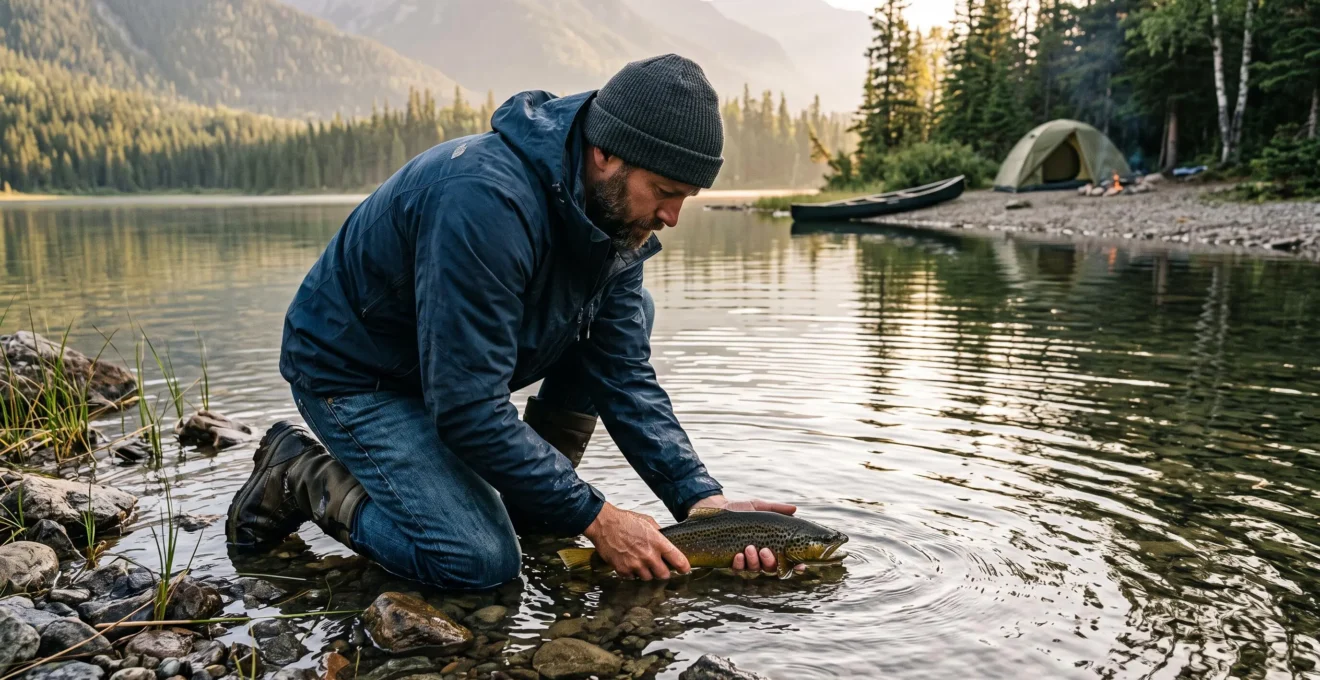
Responsible trout catch-and-release fishing begins before the first cast. The tackle an angler chooses, the temperature of the water and the condition of nearby spawning habitat can all affect whether a trout survives after being returned to its river or lake. For campers, these decisions also influence where and when fishing should take place.
A trout swimming away is encouraging, but it does not guarantee survival. Exhaustion, physical injury and damage to the fish’s protective mucus layer can create problems that are not immediately visible. Good technique therefore aims to prevent avoidable stress throughout the encounter, rather than relying on recovery efforts at the end.
The practical priorities are straightforward: land trout promptly, keep them wet, minimise handling, remove hooks carefully and release fish only when they can maintain their position and swim independently. Equally important is knowing when conditions make fishing inappropriate. Families sharing a campsite can apply these principles without specialised equipment, while protecting the surrounding aquatic environment.
Responsible trout release: essential practices
- Use tackle capable of landing trout promptly, with hooks that can be removed without unnecessary injury.
- Keep trout in the water whenever possible, touch them only with wet hands and reassess fishing when water temperatures rise.
- Protect spawning gravel, respect wildlife and clean equipment before moving between lakes or rivers.
- How to Set Up Tackle That Lands Fish Fast Enough to Ensure Survival?
- The Touching Error That Kills Released Trout Days After Catch?
- At What Water Temperature Should You Stop Fishing to Avoid Killing Released Trout?
- How to Help Caught Trout Recover Before Release to Maximise Survival Rates?
- Why Do Ethical Anglers Prioritise Barbless Hooks Over Expensive Rod Upgrades?
- When Should You Stay Out of Shallow Lake Edges to Protect Spawning Fish?
- How Far Should You Park From Wildlife to Observe Without Causing Stress?
- How to Enjoy Lake and River Activities Without Damaging Aquatic Ecosystems?
How to Set Up Tackle That Lands Fish Fast Enough to Ensure Survival?
Choose a rod, line and reel drag suitable for the trout likely to be caught, allowing firm but controlled pressure throughout the fight. Tackle that is too light can prolong exhaustion, while excessive force can damage the fish or break the line. The objective is a prompt landing followed by uncomplicated, low-contact hook removal.
A hooked trout uses energy escaping the line. During a strenuous fight, muscular demand can exceed the oxygen available to support it, contributing to metabolic disturbance and an oxygen deficit that must be resolved afterward. Longer or harder fights can increase physiological stress, particularly when other conditions are unfavourable.
The Florida Fish and Wildlife Conservation Commission freshwater fishing tips recommend playing fish rapidly, preparing release equipment in advance and avoiding unnecessary handling. These are general freshwater recommendations rather than experimental comparisons of trout tackle configurations.
For campsite fishing, the most useful setup is one that balances control, handling simplicity and the expected size of the fish:
- Rod: Select a rod with sufficient strength to steer the anticipated trout without sudden, excessive pressure. An appropriately flexible action can help cushion movements during the fight.
- Line: Choose a strength suited to the fish and conditions instead of automatically selecting the lightest available line. Excessively delicate tackle may force an unnecessarily cautious fight.
- Reel drag: Adjust it so the trout can take line under strong pressure without repeated uncontrolled runs or abrupt break-offs.
- Hook and lure: Prefer configurations that are straightforward to remove. Multiple exposed hook points can complicate handling, especially when a fish moves inside the net.
Landing quickly does not mean dragging a trout across gravel, lifting it by the line or forcing it into a hard surface. A suitable rubberised, knotless landing net helps support the fish while keeping it submerged. Barbless hooks and accessible forceps further simplify the transition from landing to release.
A family camping kit can remain compact: a properly matched rod and reel, spare single hooks, forceps, a thermometer and an appropriate landing net. Position the net and unhooking tools within reach before casting, rather than searching through campsite storage with a fish already hooked.
The best setup is not necessarily the most expensive or powerful. It is the one an angler can control reliably, from the first run to the moment the hook is removed without avoidable delay.
The Touching Error That Kills Released Trout Days After Catch?
Touching trout with dry hands, cloth gloves or towels can damage their protective mucus layer, increasing vulnerability to infection after release. A fish may appear unharmed and swim away despite that damage. Wet hands before contact, avoid squeezing the body and keep handling brief, ideally while the trout remains supported in water.
Trout skin is covered by mucus that forms part of the fish’s protective barrier against pathogens. Dry or abrasive contact can disturb this coating and expose sensitive tissues to additional stress. Damage does not necessarily produce an immediate visible wound, making poor handling particularly easy to underestimate.
Visible injuries such as bleeding, missing scales and torn fins warrant concern, but their absence does not establish that a release has been successful. Mucus disruption and other handling-related stress may have consequences after the fish disappears beneath the surface. The available source guidance supports the infection-protection role of mucus, not a predictable number of days until a damaged trout dies.
Wet hands or avoid contact is a practical rule for both experienced anglers and children learning to fish. Wet both hands before touching the trout, and support its body gently without gripping the abdomen or pressing around the gill covers.
Photography is a common source of unnecessary exposure. An angler may hold a fish while someone finds a phone, opens the camera and adjusts the framing. During that delay, the trout remains out of its normal breathing environment, potentially compounding stress from the fight.
A more protective approach is to prepare the camera before landing the trout. One person can handle photography while another manages the submerged fish. Choose a position that allows the photograph to be taken at water level without prolonged lifting. If the equipment is not ready, skip the photograph.
No universal two-second photo routine or precisely safe period of air exposure is established by the supplied sources. The meaningful objective is to minimise exposure rather than to treat any short duration as a guarantee.
The safest handling may involve no direct hand contact at all. When the hook is accessible, an angler can often remove it while the trout remains upright and supported in the landing net.
Preventing skin damage requires attention before the fish reaches the shore. That same preventive approach becomes even more important when warm water reduces its ability to recover.
At What Water Temperature Should You Stop Fishing to Avoid Killing Released Trout?
Stop catch-and-release trout fishing when water temperatures reach locally advised limits or when conditions indicate that fish are struggling to recover. The familiar 68°F (20°C) guideline is a reference point, not a universal safety guarantee. Trout species, water conditions and regional fisheries advice should determine whether an angling session remains responsible.
As water warms, it generally holds less dissolved oxygen. Trout also experience increasing physiological demands as temperatures rise, creating a particularly difficult combination during capture. A fish that might recover from a short fight in cool, well-oxygenated water can face greater stress under warmer conditions.
The conservation organisation Keep Fish Wet discusses this issue in its discussion of trout temperature and release practices. Rather than treating the traditional 68°F guideline as an absolute dividing line, it encourages anglers to think in terms of temperature-sensitive angling thresholds and fish-handling conditions.
For campers visiting unfamiliar waters, this means that a single temperature reading should inform the decision without replacing local guidance.
| Field observation | Conservation implication | Practical response |
|---|---|---|
| Water is cool and within locally advised fishing conditions | Temperature-related stress may be lower, although capture still has an impact | Fish only where permitted and maintain careful handling practices |
| Water is warming toward a local advisory threshold | Oxygen availability and recovery conditions may become less favourable | Shorten or cancel the session rather than relying on faster handling alone |
| A local restriction or conservation advisory advises against fishing | Fish protection takes priority over recreational plans | Do not fish under the restricted conditions |
| Trout appear distressed or recover poorly | Observed behaviour raises concern even without a definitive temperature threshold | End the session and avoid further capture |
Carry a small water thermometer and measure the water actually being fished. Repeat measurements as conditions change, rather than assuming an early reading applies throughout the day. Check the relevant fisheries authority’s guidance before departing and again when arriving at the campsite.
Trout concentrated in cooler inflows or current seams may be using local thermal refuges. Their presence is not an invitation to target them repeatedly. Similarly, lethargic behaviour or unusually difficult recovery should trigger caution, though neither observation alone establishes a precise temperature limit.
For families, a morning fishing session may offer cooler conditions than the afternoon, but even early fishing should be avoided when water remains too warm. Hiking, wildlife watching or other low-impact campsite activities provide alternatives without adding further pressure to vulnerable trout.
A thermometer helps identify changing conditions, but restraint remains the most important response. When recovery prospects are uncertain, choosing not to catch another fish is the most reliable way to avoid adding capture-related stress.
How to Help Caught Trout Recover Before Release to Maximise Survival Rates?
Keep the trout upright in suitable, well-oxygenated water while assessing whether it can maintain its balance and swim independently. Support an exhausted fish gently, facing it into natural current where appropriate, without repeatedly pushing and pulling it backward. Release it once it can leave under its own power rather than following a fixed revival time.
Recovery begins with removing the cause of unnecessary stress. A trout that has been landed promptly, kept submerged and unhooked carefully may already be capable of swimming away. In that situation, prolonged restraint is unlikely to be helpful simply because the angler believes revival should take a particular length of time.
An exhausted fish may need temporary support. Keep its body aligned naturally in the water with the gills submerged. In flowing water, orient it into a gentle current so water moves through the mouth and across the gills in the normal direction.
Avoid the familiar back-and-forth motion sometimes used by anglers trying to revive fish. Pulling a trout backward can interfere with normal water movement across the gills, while excessive manipulation adds handling stress. If gentle forward assistance is appropriate in still water, avoid forceful or repeated movement.
Readiness matters more than elapsed time. Useful observations include:
- The trout maintains an upright position without rolling onto its side.
- Breathing movements are observable and the fish remains responsive.
- The fish shows coordinated movement rather than drifting helplessly.
- It can leave voluntarily and maintain controlled swimming.
These signs help guide a release decision but cannot confirm eventual survival. A trout that swims away may still be affected by injuries or physiological stress sustained earlier.
Choose the recovery location carefully. Avoid holding fish in shallow, overheated shoreline pools, against abrasive rocks or over disturbed sediment. Where suitable habitat is available, use water with natural circulation and enough depth to support the fish safely.
Revival cannot reliably reverse every consequence of a prolonged fight, damaging hook removal or unsuitable water conditions. If multiple fish require substantial assistance, that pattern should prompt an immediate reassessment of fishing practices and whether to continue.
Five checks for a lower-stress trout release
- Prepare the release station: Place the landing net and hook-removal tool within reach before casting. Verify that both are immediately accessible.
- Check the water: Measure the fishing area’s temperature and consult local guidance. Record whether conditions are suitable for continued fishing.
- Keep the fish supported: Position the landed trout upright in the water. Confirm that its gills remain submerged during unhooking.
- Assess independent movement: Observe balance and coordinated swimming before withdrawing support. Confirm that the trout can move without being pushed away.
- Review the encounter: Identify any long fight, difficult hook removal or poor recovery. Use that observation to change the approach or end the fishing session.
The effectiveness of recovery depends on everything that happened beforehand. Hook selection is one of the simplest areas where anglers can prevent avoidable complications rather than trying to correct them afterward.
Why Do Ethical Anglers Prioritise Barbless Hooks Over Expensive Rod Upgrades?
Ethical anglers often favour barbless hooks because they can make hook removal quicker and less damaging without requiring expensive equipment. A premium rod may improve an angler’s experience, but it does not automatically simplify unhooking. The most useful gear improvement is one that reduces avoidable injury and handling time throughout the release process.
A hook barb is a backward-facing projection designed to resist the hook slipping out. That same projection can catch tissue during removal, increasing the effort needed to extract the hook. Flattening the barb or choosing a purpose-made barbless hook removes that particular obstruction.
For campers introducing children to fishing, the difference is especially practical. A hook that can be removed cleanly reduces the likelihood of prolonged manipulation while someone searches for additional tools or tries to manage a moving fish.
Single hooks can also simplify handling compared with lures carrying multiple exposed points. However, hook type alone does not determine whether a fish is deeply hooked. Fishing method, hook placement, bait use and how promptly a bite is detected can all influence the difficulty of release.
Barbless hooks do not eliminate the need for good technique. They can still penetrate sensitive tissue, and an angler must still control the fish carefully. Likewise, the supplied evidence does not establish a measurable survival advantage of barbless hooks over every possible premium rod upgrade.
Consider two otherwise comparable campsite setups. One uses expensive tackle with multiple barbed hooks; the other uses appropriately matched, modest equipment with a single barbless hook and readily accessible forceps. The second setup may be easier to manage during release, even though its purchase price is lower. This is a practical comparison, not a controlled mortality study.
Deep hooking requires a different decision. If a trout has swallowed a hook and removal would require tearing tissue around the throat or gills, do not pull forcefully. Cutting the line close to the accessible hook may avoid immediate extraction injuries, although it does not guarantee the fish will survive or that the hook will pass or deteriorate harmlessly. Follow local regulations and fisheries guidance on deeply hooked fish.
Similarly, difficulty removing a hook is a reason to review the setup, but no evidence-based universal rule establishes that every extraction lasting more than a few seconds indicates unsuitable tackle.
Before a trip, inspect existing lures and consider whether their barbs can be flattened without compromising the hook. Check local tackle restrictions, since hook requirements can vary between fisheries.
Reducing injury during capture protects individual trout. Protecting spawning areas extends that responsibility to fish that may never be caught, including the next generation.
When Should You Stay Out of Shallow Lake Edges to Protect Spawning Fish?
Stay out of shallow gravel areas when trout may be spawning or when active spawning nests are visible. Wading, anchoring or repeated disturbance can damage buried eggs and disrupt reproduction. Because spawning periods vary by species and location, rely on local restrictions and habitat observations rather than assuming that shallow water is safe outside a fixed calendar window.
Trout commonly deposit eggs in gravel nests known as redds, where suitable water movement can supply oxygen to developing embryos. Spawning habitat is often associated with flowing, oxygenated gravel areas, including stream reaches and certain lake inflows or outlets.
Eggs buried beneath the gravel may be difficult to see. A camper crossing a shallow channel can disturb the spawning substrate without noticing any immediate consequence. Protecting the gravel therefore requires identifying sensitive places before entering the water.
On Montana’s Bighorn River, the National Park Service specifically advises visitors not to walk on gravel beds during and immediately after spawning and not to fish directly over active redds. Its guidance for fishing the Bighorn River also highlights the importance of limiting fight duration and allowing trout to recover before release. These recommendations concern a particular fishery and should not be mistaken for universal regulations.
Visual clues worth investigating include unusually clean patches of gravel, trout paired or holding over shallow gravel and activity concentrated near suitable inflows. These features are not definitive proof of an active redd; substrate appearance and spawning behaviour differ among species and environments.
The safest response to a suspected spawning area is to give it space. Avoid wading through the site or casting repeatedly at fish engaged in spawning activity.
For campsite activities, distinguish between the different kinds of disturbance:
- Wading: Choose established access points away from potentially active redds. Do not cross spawning gravel simply because the water is shallow.
- Fishing: Avoid targeting visibly spawning trout or repeatedly presenting lures to fish holding over suspected nests.
- Paddling: Launch and land watercraft in designated areas rather than dragging hulls or anchors through sensitive gravel.
- Children’s shoreline play: Select a permitted recreation area away from stream mouths and suspected spawning grounds.
Some trout populations spawn in different seasons, and local habitat conditions affect where suitable nesting areas develop. Neither a single season nor the presence of bright gravel alone provides a reliable, universal identification rule.
A campsite map can help families separate designated swimming, paddling and fishing locations from inflows and other sensitive habitat. This simple planning step reduces the chance that an apparently harmless activity will disturb reproduction.
Habitat protection also includes the animals living beside the water. Observing birds and other wildlife from an appropriate distance helps preserve the same waterside environment that supports trout.
How Far Should You Park From Wildlife to Observe Without Causing Stress?
Park or stop far enough from wildlife that animals can continue feeding, resting or caring for young without changing their behaviour. No single distance protects every species. Obey posted minimum distances and access restrictions, then increase separation whenever an animal becomes alert, moves away or otherwise reacts to your presence.
An animal remaining in place does not necessarily mean it is undisturbed. Wildlife may interrupt feeding, increase vigilance or alter its behaviour before attempting to escape. These changes can impose costs even when campers do not observe an obvious flight response.
Distance should therefore be assessed through both site rules and the animal’s response. Watch from an established trail or designated viewing area where possible, and use binoculars instead of approaching to obtain a closer view.
Several behavioural changes suggest that observers should withdraw:
- An animal repeatedly raises its head or stops feeding to watch people.
- Its posture becomes noticeably alert or defensive.
- It changes direction, leaves a resting place or begins moving away.
- Adults interrupt care of young or move away from a nesting area.
These observations are warning signs rather than a scientifically calibrated distance test. Some animals may remain still despite disturbance, and official minimum-distance requirements continue to apply even when wildlife appears relaxed.
Campers also need to consider pressures unrelated to direct approach. Unsecured food and rubbish can attract animals into areas occupied by people. Bird nests may be disturbed by repeated attempts to obtain photographs, while recreational drones can create additional disturbance and may be prohibited by site regulations.
Repeated encounters matter. Even when one short disturbance seems minor, successive visitors approaching the same feeding or nesting area can create sustained pressure. Wildlife protection is therefore a shared responsibility among everyone using the campsite.
A practical family rule is to observe from a stable position, keep food secured, avoid approaching nests and end the encounter when animals begin responding to people. Binoculars provide a closer view without requiring physical proximity.
The fisheries sources supplied for this article do not establish species-specific wildlife viewing distances. Campers should use applicable park guidance and wildlife regulations rather than treating behavioural observations as substitutes for official restrictions.
Respectful observation complements careful fishing: both depend on recognising that recreation can affect animals even when the impact is not immediately visible.
Key principles for protecting campsite waters
- Protect the entire aquatic habitat, not only trout caught and released during a fishing session.
- Choose recreational access points with attention to spawning gravel, shoreline vegetation and wildlife activity.
- Prevent organisms and plant fragments from travelling between water bodies on damp equipment.
How to Enjoy Lake and River Activities Without Damaging Aquatic Ecosystems?
Enjoy lakes and rivers responsibly by choosing suitable activity zones, avoiding sensitive shoreline habitats and cleaning equipment between water bodies. Fishing, swimming, paddling and shoreline play can coexist with conservation when families respect local restrictions and minimise disturbance. Protecting trout also means maintaining the wider aquatic ecosystem on which fish depend.
Catch-and-release fishing is only one part of a campsite’s environmental footprint. The same shoreline may support aquatic insects, spawning fish, feeding birds and vegetation that stabilises banks. Repeated trampling or unnecessary boat disturbance can affect these habitats even when no fish are directly handled.
A useful starting point is to match the activity to the least sensitive available location rather than treating every section of shore as interchangeable.
| Activity | Prefer | Avoid |
|---|---|---|
| Trout fishing | Permitted fishing areas with suitable water conditions and accessible landing points | Spawning sites, temperature-stressed fish and prohibited sections |
| Swimming | Designated swimming areas with established access | Protected habitat, unstable banks and sensitive inflows |
| Kayaking or canoeing | Established launches and routes that minimise shoreline disturbance | Dragging craft through vegetation or disturbing shallow spawning areas |
| Shoreline play | Durable, permitted recreation surfaces | Fragile banks, nesting areas and potentially active spawning gravel |
Water quality also deserves attention. Use campsite washing facilities rather than introducing detergents or wash water directly into rivers and lakes. Keep personal-care products out of the water wherever practical, and follow bathing and conservation rules at the site. The supplied source pack does not quantify the aquatic effects of individual sunscreen or detergent products, so product-specific environmental claims should not be inferred from it.
Another concern arises when campers move from one lake to another. Wet waders, paddles, boats and footwear can carry aquatic organisms or plant material between sites. These transfers can contribute to the spread of invasive species.
The UK Environment Agency recommends a Check, Clean and Dry routine for preventing aquatic invasive species. Its guidance includes inspecting equipment, cleaning it thoroughly and allowing it to dry before the next use. The advice is presented in the context of invasive floating pennywort management, but the biosecurity routine is relevant to wider water-based recreation.
Begin by inspecting boots, nets, paddles, hulls and other equipment for visible vegetation, organisms and trapped debris. Pay attention to folds, seams and damp compartments where material may remain unnoticed.
Remove debris and clean the equipment thoroughly in an appropriate location away from the water being protected. Follow applicable local instructions for cleaning temperatures, treatment methods and wastewater disposal. Finally, dry equipment and clothing completely before visiting another water body. A quick rinse alone should not be assumed to provide adequate biosecurity.
For campers moving between fishing destinations, the routine belongs at departure rather than arrival. It is easier to avoid transporting material when gear is checked and cleaned before being packed into a vehicle.
Family participation can make conservation more consistent. Adults can explain why children should avoid sensitive gravel, why fishing stops during unsuitable conditions and why apparently clean equipment still needs inspection before being used elsewhere.
These choices form a connected approach to responsible recreation. Fast landing limits avoidable capture stress; wet-handed handling reduces physical injury; appropriate recovery protects the individual trout; and spawning-area protection, wildlife distancing and equipment hygiene address broader ecological pressures.
Local regulations remain essential. Angling methods, seasonal closures, water access, wildlife protections and equipment-cleaning requirements differ among destinations. Checking the relevant fisheries authority, protected-area guidance and campsite rules before each activity is part of responsible planning.
Before the next camping trip, identify permitted fishing and recreation zones, check current water conditions, prepare a low-contact release kit and plan how equipment will be cleaned before departure. These small decisions help make outdoor recreation compatible with protecting the waters that make it possible.
Is catch-and-release fishing always harmless to trout?
No. Trout can experience physiological stress, physical injuries and harmful handling conditions even when released alive. Landing fish promptly, minimising air exposure, protecting their mucus layer and avoiding fishing in unsuitable temperatures can reduce avoidable risks, but none of these practices guarantees survival. If conditions are poor, not fishing is the more protective choice.
Should trout be removed from the water for photographs?
Keeping trout submerged is preferable whenever possible. Prepare photographic equipment before landing the fish, use a water-level composition and minimise any necessary air exposure. Avoid dry hands, towels and prolonged posing. If taking a photograph would delay release or require excessive handling, skip it.
Can children safely participate in catch-and-release trout fishing?
Children can participate under appropriate adult supervision when the equipment and handling process are prepared in advance. An adult should help with controlling the fish, hook removal and decisions about release conditions. Children can also learn to measure water temperature, identify sensitive habitat and clean equipment. The priority is animal welfare and safe hook handling rather than catching or photographing as many fish as possible.
What should campers do if a trout swims away but appears weak?
A weak departure may indicate incomplete recovery, but swimming behaviour alone cannot establish whether the trout will survive. Do not repeatedly chase or recapture the fish to assess it. Instead, review possible causes such as a prolonged fight, warm water or difficult hook removal, and stop fishing if further captures are likely to expose trout to similar conditions. Follow local fisheries guidance when injuries or abnormal fish behaviour are observed.
Do fishing waders and landing nets need cleaning between nearby waters?
Yes. Even neighbouring water bodies can contain different aquatic organisms or invasive species. Inspect waders, nets, boots and other wet equipment for vegetation and debris, clean them thoroughly and dry them before reuse. Follow the applicable local biosecurity requirements, particularly where specific invasive species or aquatic disease controls apply.