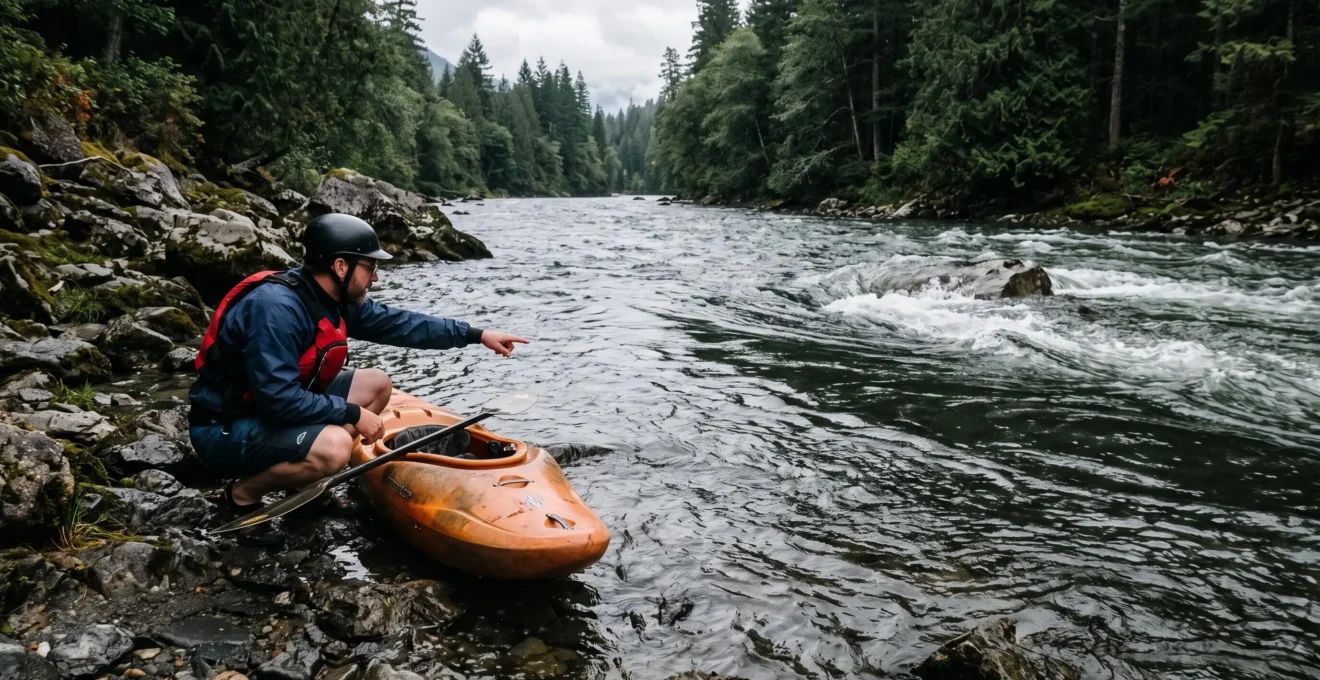
A river can look surprisingly peaceful from the bank while carrying enough force to push a kayak into rocks, submerged branches or a dangerous hydraulic. Recognising water currents means learning to interpret surface patterns, understand how moving water interacts with obstacles and anticipate where the kayak will travel before committing to a route.
For paddlers accustomed to still lakes, the biggest adjustment is that steering and propulsion no longer determine movement independently. The current contributes its own direction and speed. A kayak pointing toward one bank may travel diagonally downstream, while apparently sheltered water can contain powerful circulation.
Safe navigation therefore begins with observation rather than paddling strength. Downstream-pointing tongues, upstream-facing waves, eddy lines, floating debris and changes in surface texture all provide clues. None guarantees a safe passage without checking what lies downstream.
The practical goal is to connect those observations to decisions: where to launch, which line to follow, when to cross, where to stop and when conditions justify staying ashore.
River Current Reading: Essential Safety Principles
- Read water patterns together: V-shaped tongues suggest channels, upstream-facing Vs suggest obstructions, and eddy lines reveal changes in current direction.
- Plan crossings and resting points before entering fast water. Maintain controlled momentum through current boundaries and identify a safe downstream exit.
- Assess water levels, weather, strainers, dams and your demonstrated skills before launching. Portage whenever a hazard cannot be avoided reliably.
- How to Read Water Surface Patterns to Find the Safest River Route?
- The Current Boundary That Capsizes Paddlers Crossing From Calm to Fast Water?
- How to Cross Rivers Diagonally Without Being Swept Downstream?
- How to Judge if River Current Is Within Your Kayaking Ability Before Launching?
- What Makes Fallen Trees in Rivers More Dangerous Than Rapids for Kayakers?
- How to Spot Hidden Currents From Surface Water Patterns Before Entering?
- How to Paddle Straight Without Constant Corrective Strokes?
- How to Choose Lakes That Provide Safe Learning Conditions for Kayak Beginners?
How to Read Water Surface Patterns to Find the Safest River Route?
To read a river route, identify the main downstream current, locate obstacles and find sheltered eddies before launching. A downstream-pointing V often marks a relatively unobstructed tongue through a rapid, while an upstream-pointing V can reveal a submerged rock. These patterns indicate where water travels, but they cannot establish that a route is safe without inspecting downstream hazards.
Start by looking at the river as a connected flow rather than individual waves. Smooth, fast-moving tongues often form where water accelerates into a channel. Behind rocks or bank projections, sheltered areas called eddies may contain slower or upstream-circulating water. The boundary between these flows is an eddy line.
In BC Outdoors’ river navigation and rescue article, Darren Wagner explains how downstream and upstream V patterns help paddlers identify channels and obstacles. His guidance also emphasises interpreting river features before entering them.
Read the sequence, not just the next feature. A promising tongue may lead toward a submerged obstacle, while a nearby eddy could offer a place to stop and inspect the next bend. A practical route might connect a clear channel, a manageable eddy and another unobstructed passage.
Surface smoothness is especially deceptive near a horizon line, where the river appears to disappear beyond a drop. Low-head dams can produce recirculating hydraulics downstream, and their approach may look calm. If the landing or downstream water cannot be seen, stop well upstream and scout from shore.
Reassess the river after rainfall, changes in dam releases and significant bends. Rising water can conceal rocks, accelerate channels and move debris into previously clear routes.
Five Checks Before Choosing a River Line
- Identify the main current direction and mark its visible tongue on a route sketch.
- Locate upstream-pointing Vs, foam disturbances and obstacles; record each suspected hazard.
- Identify at least one accessible eddy or safe bank before the next difficult feature.
- Inspect the downstream continuation, especially bends and horizon lines; confirm that the exit is visible.
- Check current conditions and decide whether to paddle, scout further or portage; state the decision before launching.
Once the route is identified, the next challenge is moving between its currents without losing balance at their boundaries.
The Current Boundary That Capsizes Paddlers Crossing From Calm to Fast Water?
An eddy line is the boundary between the main downstream current and slower or reversing water in an eddy. Crossing it can destabilise a kayak because different parts of the hull encounter different flow directions and speeds. Successful crossings require an appropriate approach angle, controlled momentum, deliberate edging and a clear exit, ideally practised under qualified supervision.
Imagine a kayak leaving sheltered water behind a rock. Its bow enters the faster current while its stern remains in the eddy. The moving water begins turning the bow before the stern experiences the same force. The resulting rotation can surprise paddlers who expect the kayak to behave as it does on a lake.
The risk increases when a paddler hesitates directly on the boundary. Without sufficient movement to complete the crossing, the boat can remain exposed to competing currents. Strong shear, turbulent boils and an unexpected edge angle can make recovery more difficult.
Momentum is useful, but speed alone is not the solution. The approach should match the current strength, boundary width and available space. Set the boat angle before reaching the eddy line, maintain controlled movement and use the edge appropriate to the direction of the turn and current. A supporting brace may help maintain stability, but poorly timed bracing can also compromise balance.
For example, when peeling out of an eddy into the main flow, the kayak commonly edges downstream into the turn. Entering an eddy from the main current generally requires a different setup and edge relationship. The correct movement depends on which way the kayak is crossing and turning; a universal instruction to lean downstream is unsafe.
Not every eddy offers useful shelter. A broad, accessible eddy beside a gentle channel may provide a suitable practice environment. An eddy immediately behind a strainer, beside an undercut bank or below a powerful drop can introduce additional hazards.
Andrew Westwood‘s instruction in Paddling Magazine’s instruction on catching eddies explains how lateral momentum, ferrying and approach angle influence eddy entry. The article concerns canoe handling, so kayak-specific edging and bracing should be learned with appropriate instruction.
Before crossing, identify where the kayak should finish and where a swimmer could reach safety if the manoeuvre fails. An eddy without a safe exit is not necessarily a refuge.
The same relationship between hull angle and water movement becomes particularly important when crossing an entire river.
How to Cross Rivers Diagonally Without Being Swept Downstream?
Crossing a river diagonally requires a ferry angle: point the kayak partly upstream while generating enough forward motion to move sideways across the current. The current and the kayak’s movement combine to determine the actual path. A successful ferry depends on current speed, available paddling power, crossing distance and the absence of dangerous downstream obstacles.
When a kayak points directly toward the opposite bank, the current continues carrying it downstream. The resulting path is diagonal even if the paddler maintains a perfectly straight heading. Pointing upstream introduces a component of paddling movement that opposes this drift.
A useful way to visualise the manoeuvre is to imagine two arrows. One points downstream, representing the current. The other follows the kayak’s movement through the water. Their combined effect determines the boat’s movement relative to the bank.
The ferry angle is not a fixed number. A moderate upstream angle may work in gentle current, while stronger flow requires different positioning and may exceed the kayak’s ability to hold a crossing line altogether.
For a supervised practice ferry on suitable moving water:
- Choose a broad section with clear visibility, accessible banks and no consequential downstream hazards.
- Identify a target eddy or landing area and a safe alternative downstream.
- Enter the current with the bow angled upstream relative to the flow.
- Maintain steady, effective strokes while monitoring sideways progress and downstream drift.
- Make small angle adjustments early rather than turning sharply after drifting beyond the target.
Over-correction is a common problem. Turning the bow too far upstream reduces the movement available to carry the kayak across the river. The paddler may work harder without approaching the opposite bank.
Before attempting a ferry, compare the strength of the current with the boat’s demonstrated ability to move against it. If downstream drift cannot be controlled, the desired crossing may be impossible at that location.
Cold water, powerful current, limited visibility and downstream strainers increase the consequences of failure. Under those conditions, carrying the kayak around the section or choosing another crossing is safer than attempting to overpower the flow.
If the intended ferry cannot be maintained, avoid exhausting yourself by repeatedly fighting upstream. Where a safe route exists, transition to a controlled downstream approach toward an accessible eddy or bank. Never treat a downstream recovery as viable when it leads toward a dam, strainer or other unavoidable hazard.
A technically correct ferry is useful only when the river itself falls within the paddler’s actual capabilities.
How to Judge if River Current Is Within Your Kayaking Ability Before Launching?
Judge river suitability by comparing present conditions with skills you have already demonstrated, not simply by looking at a river classification. Consider current strength, water level, obstacles, weather, rescue options and the least experienced member of the group. If the route requires manoeuvres or recovery skills you cannot perform reliably, choose easier water or postpone the trip.
River difficulty classifications provide a starting point, but they do not describe every condition on a particular day. The same stretch can change significantly after rainfall, a dam release or a newly fallen tree.
At the launch, assess several independent indicators:
- River level and discharge: compare available gauge information with reliable local route guidance, recognising that a gauge reading alone does not establish safety.
- Recent and forecast weather: consider rainfall upstream as well as conditions at the launch.
- Visible hazards: look for strainers, undercut banks, strong eddy lines, horizon lines and inaccessible shorelines.
- Personal skills: evaluate controlled ferrying, eddy turns, bracing and appropriate self-rescue, including a confident wet exit and rolling where the craft and conditions require it.
- Group readiness: consider communication, equipment, rescue training and the weakest member’s ability to complete the route.
Having paddled a river previously is not proof that it remains suitable. Likewise, travelling with stronger paddlers does not remove the need for personal competence. A group should select a route that its least capable participant can reasonably manage, with additional safety margins for unfamiliar conditions.
Official Parks Canada‘s paddling safety information for Banff National Park describes how changing levels, shifting channels, sweepers and wooded banks can make hazards unpredictable. Although its route details concern Banff, the broader lesson is to reassess conditions rather than assume that a familiar river remains unchanged.
Progression should be deliberate. Practise first on gentle moving water with straightforward recovery options. Increase exposure only after essential manoeuvres are reliable, and inspect the intended take-out before committing to a downstream route.
Establish a turnaround or portage rule on shore. For example, agree that an unscoutable horizon line, an obstructed channel or an uncertain exit means the group will stop and reassess rather than continue.
Among the hazards that should trigger immediate reassessment, fallen trees deserve particular attention because their danger may be underestimated from upstream.
What Makes Fallen Trees in Rivers More Dangerous Than Rapids for Kayakers?
Fallen trees can form strainers: obstacles that allow water through while preventing a kayak or swimmer from passing. Current can press a person against submerged branches, making escape extremely difficult. Unlike a clear rapid that may carry a paddler downstream, a strainer can hold someone in place under sustained water pressure. The safest strategy is complete avoidance.
A strainer does not have to span the entire river. Branches projecting from a bank, submerged roots or a partly fallen trunk can obstruct the portion of the channel a kayak is approaching.
Warning signs include debris caught against branches, foam accumulating at unusual angles, water separating around an obstruction and turbulence that does not match the surrounding current. However, submerged wood may offer few visible clues, especially in turbid or high water.
River bends require careful observation. Faster water often moves toward the outside of a bend, where erosion can leave overhanging trees, exposed roots and undercut banks. The outside is therefore not automatically the safer route. A paddler must inspect the actual channel and identify a clear line with sufficient space to manoeuvre.
When a potential strainer appears downstream, the preferred response is to reach a safe eddy or bank well before the obstacle, then scout from land. If there is no clearly safe passage, portage. Never approach a tree to test whether the current will carry the kayak through its branches.
Foot entrapment adds another danger. In strong moving water, attempting to stand can trap a foot between rocks while the current forces the body downstream. Appropriate moving-water rescue training teaches safer responses to swimming in current; these techniques should not be improvised during an emergency.
Storms, floods and seasonal high flows can relocate wood and change channels. A route that was unobstructed on a previous trip may contain a new strainer today.
Not all dangerous currents are attached to obvious obstacles. Some reveal themselves only through subtle movement at the surface.
How to Spot Hidden Currents From Surface Water Patterns Before Entering?
Hidden currents are best detected by combining surface observations with knowledge of nearby structures and water movement. Floating debris, convergence lines, unusual vortices and changes in ripple direction can reveal flow that is difficult to see directly. These clues are imperfect, so paddlers must also identify inlets, outlets, dams and downstream hazards before entering apparently calm water.
A floating leaf or small piece of natural debris can provide a useful indication of surface movement. Watch whether it travels steadily downstream, rotates in place or follows a different direction from the surrounding ripples. Existing floating objects are preferable to introducing anything into the water.
Foam and debris sometimes collect where two surface flows converge. Small whirlpools or boils may indicate turbulent movement beneath the surface, although their appearance does not reveal the full depth or strength of the flow.
Surface movement is not a complete map of underwater current. Wind can drive the upper layer of a lake in one direction while deeper water moves differently. A kayak responds primarily to the water acting on its hull, together with wind forces on the boat and paddler.
Flatwater environments deserve particular attention near narrow connecting channels, river mouths, spillways and dam outlets. A broad lake may appear almost motionless while water accelerates toward an outflow structure.
Before entering unfamiliar water, scan in a consistent order: observe natural floating debris near the shore, identify potential downstream obstacles, locate any dam or horizon line, and look for boundaries where differently moving water meets.
A hypothetical example illustrates the risk. A paddler approaches a small weir on an otherwise quiet waterway. Upstream water appears smooth, but the drop creates a recirculating hydraulic below the structure. A kayak carried over the edge may become trapped in the returning current.
The National Weather Service information on low-head dam hazards explains how hydraulic jumps can generate upstream-directed currents capable of trapping people and watercraft. The agency also warns that low-head dams can be difficult to recognise.
111 deaths
Historical number of deaths associated with low-head dam incidents reported nationally in the United States for 2018–2020 by the National Weather Service. This is a period-specific count, not a current annual rate or a kayaking-only statistic.
National Weather Service, Northern Indiana — Low Head Dam Public Safety Awareness Month.
Do not attempt to identify a safe route over a low-head dam from its surface appearance. Locate the structure in advance and use a safe portage that avoids both its upstream approach and downstream hydraulic.
After identifying the current, effective boat handling becomes the next requirement: the kayak must follow an intended path despite the water moving around it.
How to Paddle Straight Without Constant Corrective Strokes?
Paddling straight begins with balanced forward strokes, consistent blade placement and effective torso rotation. Frequent steering corrections often compensate for uneven power or technique rather than a problem with the kayak. In moving water, however, a well-tracked kayak can still drift relative to the shore because the current changes its actual path.
On still water, a kayak that repeatedly turns toward one side may reveal a difference in stroke power, blade depth or the length of the pulling phase. Stronger strokes on one side create unequal turning forces.
Instead of immediately applying a rudder stroke, examine the forward stroke. Rotate through the torso, place the blade consistently and finish the power phase without pulling excessively far behind the body. Aim for similar stroke length and pressure on both sides.
Use steering corrections selectively. A sweep stroke is useful for deliberate changes in heading, while a stern rudder can make smaller directional adjustments. Repeatedly relying on these strokes can reduce efficiency when the underlying issue is asymmetrical propulsion.
In a current, distinguish heading from track. Heading describes where the bow points; track describes the route travelled relative to the bank. A kayak may hold a steady heading while drifting downstream because the water itself is moving.
This distinction matters when ferrying or approaching an eddy. Correcting toward a fixed shoreline landmark without considering current direction can produce unnecessary turns and reduce control.
A simple practice session on sheltered water can help identify technique problems. Choose a distant fixed landmark, paddle toward it and count the forward strokes completed between corrections. Repeat several times in comparable conditions.
If possible, ask another paddler to record a short video from behind. Uneven torso rotation, different blade depths and asymmetrical stroke timing are often easier to identify from outside the cockpit.
As technique improves, repeat the exercise in very gentle moving water with appropriate supervision. Compare the kayak’s heading with its actual movement relative to shore.
These skills are easiest to develop where wind, waves and current are predictable, making the choice of training water especially important.
Key Takeaways Before Choosing Practice Water
- Select a location where the consequences of drifting off course are low and a safe landing remains accessible.
- Evaluate wind direction and water temperature independently of how calm the surface looks.
- Build reliable forward strokes and basic manoeuvring before introducing stronger currents or exposed crossings.
How to Choose Lakes That Provide Safe Learning Conditions for Kayak Beginners?
A beginner-friendly kayaking lake has sheltered water, accessible shorelines, a gradual launch area and limited interference from motorboats. The best training location also provides protection from prevailing winds and avoids strong inlet or outlet currents. Water temperature, forecast conditions and rescue access matter as much as the lake’s apparent calmness.
For paddlers transitioning from lakes to rivers, a suitable lake provides a controlled environment for refining balance, efficient strokes and basic rescue skills before adding moving-water complexity.
Compare candidate locations using practical criteria rather than choosing the largest or most scenic lake.
| Criterion | More Suitable Conditions | Conditions Requiring Caution |
|---|---|---|
| Launch access | Gradual, shallow entry with an accessible shoreline | Steep banks, slippery rocks or limited landing areas |
| Boat traffic | Designated non-motorised areas or restricted motorboat access | Busy navigation lanes and frequent powered craft |
| Wind exposure | Sheltered practice area with a manageable return route | Long exposed reaches and wind blowing away from safe shore |
| Water movement | No significant current in the training area | Narrow outlets, spillways or strong connecting channels |
| Emergency access | Multiple accessible landing points near the practice area | Remote banks or shorelines that cannot be reached easily |
Wind direction is especially important. Paddling away from shore with a following wind may feel easy, while returning against that wind can demand much more effort. A training route should favour a manageable return, with the option to turn back early or land safely if conditions change.
A shoreward wind can offer a useful margin in some settings, but it does not eliminate risks from waves, obstacles or cold-water immersion. The safer choice is a sheltered area with short distances to accessible land.
Cold water remains dangerous even when the air feels warm. Immersion can quickly interfere with breathing and physical performance. Wear a properly fitted personal flotation device and clothing appropriate to the water temperature, and practise rescue procedures in controlled conditions.
For family learning, begin with short sessions close to a safe shore, in an area where assistance is available. Progress to longer routes only after paddlers can control their boats, return reliably and manage an appropriate assisted or self-rescue.
Open-water crossings should not be treated as the automatic next step. Their suitability depends on demonstrated ability, conditions, equipment and available rescue support.
Before each session, let the weather forecast, actual wind, water temperature and local hazards determine the plan. A previously arranged itinerary is never a reason to continue in unsuitable conditions.
For the next practice session, choose a sheltered location, identify a safe return route and work on one measurable skill. When moving-water training becomes appropriate, learn current crossings, eddy turns and rescue techniques with a qualified instructor rather than experimenting in consequential flow.
Can a kayak be carried downstream even when the paddler is moving forward?
Yes. A kayak’s movement relative to the shore combines its movement through the water with the current’s movement. Forward paddling does not necessarily prevent downstream drift, particularly when crossing a river. An upstream ferry angle can reduce that drift when the paddler has sufficient control and propulsion.
Does a smooth river surface mean the water is safe for kayaking?
No. Smooth water can occur in deep channels, sheltered areas and approaches to dangerous drops. Low-head dams are especially concerning because their hazards may be difficult to recognise from upstream. Always assess downstream structures, obstacles and possible changes in elevation before committing to a route.
What should a kayaker do when an unfamiliar river feature cannot be identified?
Stop at a safe location sufficiently upstream, inspect the feature from shore and determine whether a clear route and safe exit exist. If the hazard cannot be assessed or avoided reliably, portage or choose another route. Do not approach an uncertain feature simply to obtain a closer view from the kayak.
Are tidal currents different from ordinary river currents?
Both involve moving water that changes a kayak’s track, but tidal currents can reverse direction and vary with the tidal cycle. Narrow channels and constrictions can concentrate flow. Paddlers entering tidal areas need location-specific tidal information, suitable training and an understanding of how timing affects their planned route. The river-reading guidance in this article does not replace tidal passage planning.
What equipment is essential when learning to kayak in moving water?
Essential preparation includes a correctly fitted personal flotation device, appropriate immersion clothing, suitable footwear and a kayak appropriate to the environment. A helmet is important where impacts with rocks or other obstacles are possible. Communication and rescue equipment should match the route and group training. Equipment alone cannot compensate for missing moving-water skills or an unsafe route.