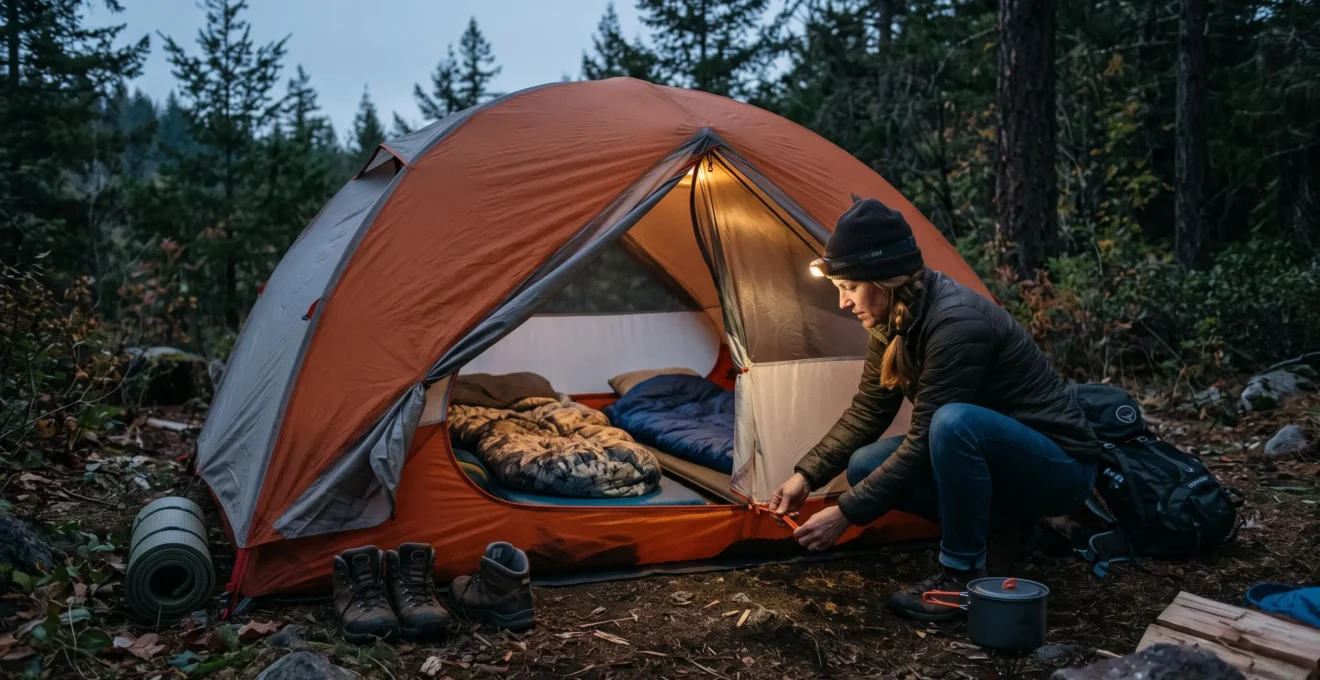
Waking inside a tent with a headache, damp sleeping bag or restless night’s sleep can raise questions about the air circulating around you. A zipped tent offers protection from wind and insects, but closing every opening can also restrict the exchange of indoor and outdoor air. Moisture from breathing, perspiration and wet equipment then becomes harder to remove.
Effective tent ventilation means maintaining a path for outside air to enter and warm, humid air to escape throughout the night. Depending on the design, this involves high rainfly vents, low vestibule openings, mesh panels and adequate separation between the tent’s inner and outer layers.
Ventilation can improve comfort and help control condensation, although it does not guarantee headache prevention or eliminate every sleep disturbance. Headaches have multiple possible causes, and symptoms associated with combustion equipment demand particular caution. The practical objective is a sheltered sleeping environment with enough airflow for the conditions, without unnecessary exposure to wind, rain or cold.
Tent ventilation essentials for healthier, more comfortable nights
- Keep compatible air inlets and outlets open overnight, ideally combining lower openings with higher vents where the tent design supports this arrangement.
- Manage condensation by ventilating the rainfly, separating wet equipment from bedding and keeping the inner tent away from damp outer surfaces.
- Never operate camping stoves, charcoal heaters or other fuel-burning appliances inside a tent. Morning headaches must not automatically be blamed on ordinary carbon dioxide buildup.
- How to Arrange Vents for Continuous Fresh Air Exchange While Sleeping?
- Why Do You Wake With a Headache After Sleeping in a Fully Zipped Tent?
- Mesh Door or Partially Unzipped Entrance: Which Ventilates Better Overnight?
- The Cold-Weather Error That Makes Tents Wetter by Blocking Airflow?
- Should You Open Extra Vents When Three People Share a Two-Person Tent?
- How to Adjust Vents on Double-Wall Tents for Maximum Dryness Overnight?
- The Ventilation Error That Causes Unbearable Heat in 80% of Summer Tents?
- How Double-Wall Tent Systems Prevent Moisture Buildup During Sleep?
How to Arrange Vents for Continuous Fresh Air Exchange While Sleeping?
Arrange tent vents to create a continuous route between outside air and the sleeping compartment. Where the design permits, combine a lower inlet with an upper outlet so warmer, moisture-laden air can escape while replacement air enters. Keep these openings available overnight, adjusting their exposure to wind and rain rather than sealing the shelter completely.
Warm air generally rises because of buoyancy. Inside a tent, body heat and exhaled moisture can contribute to this movement, although wind pressure may dominate airflow in a small shelter. A high opening gives warmer air a potential escape route, while a lower opening can admit replacement air. This low-to-high movement is commonly described as the stack effect.
However, simply opening two random gaps does not guarantee an effective flow path. A vent can be obstructed by the rainfly, blocked by luggage or positioned where outdoor wind pressure prevents the intended movement.
Sea to Summit illustrates coordinated inlet and outlet placement in its technical explanation of tent condensation. Its Alto and Telos models use lower Baseline Vents and higher Apex vents. This is a useful design example, not a universal configuration applicable to every tent.
For a tent equipped with suitable openings, a practical nighttime arrangement is to:
- Leave an adjustable upper vent partly open, using a sheltered position near the sleeping area where appropriate.
- Provide a lower opening on a protected side of the vestibule or rainfly.
- Offset vestibule openings when possible to encourage circulation without directing a strong draft onto sleepers’ faces.
- Maintain a clear passage between the inner tent, rainfly and outside air.
Wind direction matters. In gentle weather, an opening facing the breeze can encourage air movement, while a protected opening may be preferable during gusts. An outlet must not always face the prevailing wind: actual airflow depends on the tent geometry and pressure around its surfaces.
Five checks before settling into your sleeping bag
- Identify the airflow route: locate the intended inlet and outlet, then confirm both are unobstructed.
- Set the upper vent: open the protected high-level vent and verify that its cover is properly positioned against rain.
- Adjust the lower opening: create an available inlet without exposing bedding to splash or a direct cold draft.
- Check the sleeping area: briefly hold a lightweight tissue near an opening to look for air movement, recording whether it moves noticeably or remains still. This is only a qualitative observation, not proof of adequate ventilation.
- Prepare for overnight weather: check the forecast and tent instructions, then leave an appropriate protected airflow route available for the night.
Testing ventilation with a flame is inappropriate inside a tent. Even a tissue test cannot measure carbon dioxide concentration, air exchange rates or changes that occur after the wind shifts.
Air exchange works best as a continuing process rather than a brief airing session at bedtime. There is no established basis in the supplied evidence for claiming that respiratory moisture production peaks specifically during deep sleep. The relevant point is that breathing and moisture release continue throughout the night.
Why Do You Wake With a Headache After Sleeping in a Fully Zipped Tent?
A headache after sleeping in a fully zipped tent has several possible explanations, including dehydration, altitude, disturbed sleep, heat or exposure to combustion gases. Restricted ventilation may contribute to stuffiness and increased indoor carbon dioxide, but a headache alone cannot establish that carbon dioxide caused it. Carbon monoxide exposure is a separate, potentially fatal emergency.
Every sleeping person exhales carbon dioxide (CO2). When outdoor air exchange is limited, its indoor concentration can increase. Oxygen is also consumed during breathing, but the supplied sources do not establish that ordinary tent occupancy routinely causes dangerous oxygen depletion or that a particular CO2 concentration explains morning headaches.
Ventilation still matters because the same restricted airflow can allow humidity and warmth to accumulate. Exhaled moisture and water evaporating from skin, clothing or equipment can raise relative humidity, especially when the tent walls cool overnight.
Moist air reaching a sufficiently cold surface may condense into droplets. The resulting dampness, stuffiness or uncomfortable temperature can make sleeping less pleasant. However, these observations cannot independently diagnose a respiratory problem or identify the cause of a headache.
If symptoms appear repeatedly after camping, compare the circumstances rather than assuming one cause:
- Was the tent unusually hot, humid or poorly ventilated?
- Were you camping at a higher altitude than usual?
- Could dehydration, illness, interrupted sleep or other factors be involved?
- Was any stove, lantern, heater, charcoal or other combustion device used in or near an enclosed shelter?
- Did symptoms resolve after leaving the environment, and did anyone else experience them?
Feeling better after a night with more ventilation can justify reviewing the shelter setup, but it does not prove CO2 buildup was responsible. Odours from new materials may also warrant investigation, although the supplied sources do not establish their role in tent-related headaches.
Carbon monoxide (CO) must not be confused with carbon dioxide. CO is produced by incomplete combustion and cannot be reliably detected by smell. The CDC guidance on carbon monoxide and camping stoves explicitly warns against operating portable camping stoves, charcoal grills and similar equipment inside tents.
Headache, dizziness, weakness, nausea and confusion can occur with CO poisoning. If exposure is possible, leave the area for fresh air immediately, get others out and seek urgent medical assistance through local emergency services. Do not re-enter an unsafe enclosed space. Symptoms should not be dismissed simply because they resemble an ordinary morning headache.
Partially opening a vent does not make indoor combustion safe. Keeping fuel-burning appliances outside enclosed and partially enclosed sleeping spaces is a separate safety requirement from ordinary moisture-control ventilation.
Better airflow can address one environmental concern, but recurring or unexplained headaches deserve proper medical evaluation rather than repeated changes to tent vents alone.
Mesh Door or Partially Unzipped Entrance: Which Ventilates Better Overnight?
A mesh door usually offers the most practical balance between ventilation and insect protection, particularly when the rainfly also has an open vent or vestibule. A partially unzipped entrance can provide a less obstructed opening, but may admit insects, rain or drafts. The better choice depends on both tent layers and overnight conditions.
Mesh allows air through its openings while creating some resistance compared with an unobstructed gap of equivalent size. Actual airflow depends on mesh density, exposed area, wind and the surrounding rainfly. Neither option has a universally established ventilation advantage in the supplied evidence.
The distinction between the inner mesh door and outer rainfly is especially important. Unzipping the fabric panel of an inner tent may expose a large mesh surface, yet a tightly closed outer vestibule can still restrict the overall air exchange.
Conversely, opening the vestibule while keeping the inner mesh closed can provide a useful weather-dependent airflow route without sacrificing insect protection.
| Overnight condition | Mesh door with ventilated rainfly | Partially unzipped entrance |
|---|---|---|
| High insect activity | Usually preferable because the mesh barrier remains intact | May admit insects if the mesh barrier is opened |
| Warm, humid weather | Useful when the outer fly also permits airflow | Can increase the available opening if weather permits |
| Still, cool weather | Maintains insect protection with modest air exchange | May offer an additional unobstructed opening |
| Driving rain or strong wind | Prefer protected vents and the manufacturer’s storm configuration | Can expose bedding to rain or uncomfortable drafts |
| Dry weather with a separate fly | Allows the inner tent to stay protected from insects | Can be combined with wider fly openings for greater exposure to outdoor air |
The most useful default for many double-wall tents is to keep the inner mesh door closed while opening suitable rainfly vents or the vestibule as conditions allow. This preserves the insect barrier and provides a more complete airflow path.
Weather protection sets the limits. During wind-driven rain, position the entrance away from the most exposed direction where the campsite and tent design permit. Hooded vents and storm flaps may remain usable when larger openings would allow water inside.
Do not sacrifice shelter stability or waterproofing simply to create a larger entrance gap. Follow the intended operating range of the tent’s ventilation features.
For most nights, an adjustable combination of protected openings is more versatile than committing to either a fully sealed entrance or a completely open doorway. In cold weather, the same decision becomes especially important for moisture management.
The Cold-Weather Error That Makes Tents Wetter by Blocking Airflow?
The common cold-weather mistake is closing every tent vent to retain warmth. That also restricts the escape of moisture released by sleepers, increasing the chance of condensation on cold surfaces. Keeping suitable protected vents open can help remove humid air, although ventilation cannot prevent every droplet when outdoor conditions favour condensation.
Cold rainfly fabric can cool below the dew point of the nearby air. When humid air contacts that surface, water vapour condenses into liquid droplets or, under freezing conditions, may form frost.
A tightly sealed tent therefore does not necessarily remain drier. It can retain moisture from breathing, perspiration and wet equipment while offering limited means for that moisture to escape.
MSR‘s official tent condensation advice identifies weather, occupant-generated moisture and wet surroundings as major contributors. The manufacturer estimates approximately 1–2 pints of moisture per person per night from breathing and skin evaporation, but does not provide a detailed measurement protocol supporting this estimate.
1–2 pints per person per night
Manufacturer-provided estimate of overnight moisture from breathing and skin evaporation. It is not an independently established physiological constant and should not be used to predict condensation in a specific tent.
Cascade Designs / MSR technical support guidance
For cold-weather camping, the practical approach is to leave an appropriately sheltered upper opening and an available lower inlet where the tent supports that arrangement. The openings may be modest, but they should not be blocked simply because the temperature falls below freezing.
Keep sleeping bags, jackets and other equipment away from the inner walls. Contact with damp fabric can transfer moisture to insulation, making bedding feel wet even when the bulk of the condensation remains on the rainfly.
Drying wet clothing inside a closed sleeping compartment adds another moisture source. Boots, soaked jackets and damp towels can release water as they warm, increasing the burden on the shelter’s ventilation.
Store wet equipment in a suitable vestibule or contained away from bedding, while preserving clear airflow paths and access to exits. A storage sack can isolate damp gear temporarily but will not dry it; arrange proper drying when conditions permit.
In the morning, remove accessible condensation with an absorbent cloth and dry the fly whenever practical. In freezing temperatures, avoid forcefully pulling fabric that has become bonded by ice.
Comfort in cold conditions depends primarily on appropriate insulation, dry bedding and weather protection, not on sealing every airflow opening. The challenge grows when more sleepers produce moisture inside the same limited space.
Should You Open Extra Vents When Three People Share a Two-Person Tent?
Three people sharing a two-person tent should use the available protected ventilation openings as conditions and the tent design permit, but additional venting cannot fully compensate for overcrowding. More occupants produce more carbon dioxide and moisture in the same limited space, while reduced clearance around sleeping bags increases the chance of contact with damp walls.
Every occupant adds a continuing source of exhaled CO2 and water vapour. A small tent containing more sleepers must therefore handle a greater combined moisture and respiratory load than it would with fewer occupants.
This does not establish a specific hazardous CO2 concentration or minimum ventilation rate for an overcrowded tent. Those would require measurements and conditions not provided by the available sources.
Nevertheless, occupancy changes the ventilation problem. The same rainfly openings may be less effective at controlling perceived humidity and condensation when additional people, bedding and equipment fill the space.
Practical warning signs include:
- Persistent stuffiness or uncomfortable warmth inside the sleeping compartment.
- Substantial condensation collecting on the rainfly or inner surfaces.
- Sleeping bags repeatedly touching damp walls because of limited space.
- Restricted access to vents, doors or circulation gaps due to luggage and bedding.
These observations can justify improving ventilation, but they do not measure air quality. Visible breath in cold weather, for example, can occur naturally when exhaled moisture meets sufficiently cold air and is not reliable evidence that ventilation is inadequate.
Open adjustable rainfly vents, preserve mesh ventilation and use a sheltered vestibule opening where appropriate. Keep luggage from blocking the designed airflow route and avoid allowing bedding to rest against the tent walls.
Opening every vent indiscriminately is not always safe or comfortable. Strong wind and driving rain may require protected openings rather than fully exposed panels.
Spending less time inside a crowded tent while awake can reduce the duration of occupancy, but it does not solve the overnight problem while all three people are sleeping inside.
For repeated three-person use, choose a tent with an appropriate stated capacity, adequate floor area, usable sleeping clearance and suitable ventilation. A four-person model may offer greater space, although actual dimensions matter more than the capacity label alone.
Additional vents are a practical compromise for an exceptional night, not a substitute for suitable shelter capacity. In a properly sized double-wall tent, attention can shift from overcrowding to precise rainfly adjustment.
How to Adjust Vents on Double-Wall Tents for Maximum Dryness Overnight?
To keep a double-wall tent drier, open suitable rainfly vents, maintain separation between the waterproof fly and inner canopy, and preserve an exit route for humid air. Adjust vestibule openings according to wind and rain rather than sealing the outer layer automatically. The aim is to reduce moisture accumulation and protect bedding, not eliminate condensation completely.
A double-wall tent separates the inner sleeping compartment from an outer waterproof rainfly. Depending on the model, breathable inner fabric or mesh allows water vapour to move into the intervening space.
When the outer fabric cools sufficiently, some of that vapour may condense on its inner surface. The gap between the two layers helps keep those droplets away from the sleeping area, provided the fabrics remain properly separated.
Ventilating the rainfly is essential because opening the inner mesh alone does not necessarily allow trapped humid air to escape to the outdoors.
Before settling in, inspect the specific vent mechanisms:
- Open the designated high rainfly vents or hooded openings.
- Ensure any designed lower gaps or vestibule vents are unobstructed.
- Guy out the fly to establish the intended separation from the inner tent.
- Check that tension adjustments do not pull the outer layer into contact with the inner canopy.
- Use protected vestibule openings only as far as weather exposure permits.
Different tent designs provide different adjustments. A fixed mesh panel is passive and cannot be closed or enlarged. A hooded vent is designed to provide some weather protection while remaining open, subject to the manufacturer’s operating instructions.
Roll-back rainfly panels or larger vestibule openings can create greater exposed areas, but they also reduce protection from rainfall, wind or insects depending on the configuration.
REI‘s advice on preventing tent condensation recommends opening opposing rainfly vents, tensioning the fly to separate it from the inner tent and limiting wet equipment inside. It also emphasises campsite selection as part of managing condensation.
During rain, use the tent’s weather-protected ventilation features rather than assuming that every vestibule can safely remain unzipped. Wind direction, rain intensity and fly geometry determine which openings remain practical.
A damp rainfly the following morning does not necessarily indicate a failed setup. Condensation may occur even when ventilation is correctly configured, especially under humid or calm conditions.
Dry accessible moisture before packing when possible. If the tent must be packed damp, take an opportunity to air the rainfly later in the day and prevent prolonged damp storage.
These adjustments improve the management of overnight moisture, but summer introduces an additional challenge: heat trapped beneath a poorly ventilated outer fly.
The Ventilation Error That Causes Unbearable Heat in 80% of Summer Tents?
One important summer ventilation mistake is leaving the rainfly tightly closed while relying only on the inner mesh door for airflow. Heat can accumulate beneath an enclosed fly, making the tent uncomfortable even when the inner canopy is breathable. Opening suitable fly-level and lower vents can improve circulation, but the claimed 80% figure is not verified.
There is no substantiated evidence in the supplied sources that this error affects 80% of summer tents. Its relevance lies in the physical mechanism rather than that percentage.
Solar radiation heats tent fabric and surrounding surfaces. The warmed fabric transfers heat to nearby air, while limited air exchange allows some of that heat to accumulate. A closed rainfly can also restrict the movement of air through the inner mesh.
Describing this as a greenhouse-like effect is a useful simplification, not proof that every closed fly produces a particular temperature increase. Actual conditions depend on sunshine, fabric characteristics, ventilation, wind and campsite exposure.
Simply opening the inner door may therefore make little difference if the outer vestibule and rainfly vents remain tightly sealed.
In dry, suitable weather, summer ventilation can be improved by combining a lower opening with a higher outlet. Open designated rear vents, adjust suitable vestibule gaps and orient the available openings to benefit from a gentle breeze.
Where the manufacturer permits it, the rainfly may be raised or rolled back using its intended supports and attachment points. Do not improvise a sharp or unstable prop that could puncture fabric, damage the fly or collapse in wind.
For tents with a suitable mesh inner canopy, removing the fly entirely may increase openness during reliably dry conditions. However, doing so removes its rain protection and may increase direct solar exposure, depending on the remaining fabric and campsite.
The best setup also begins before pitching. Look for a site that avoids excessive afternoon sun and has access to gentle airflow without dangerous exposure.
Ground surfaces matter. Sun-warmed rock, exposed sand and other heat-retaining surfaces can contribute to a warmer environment around the tent. Choosing an appropriate site can therefore be as useful as adjusting the vents later.
Shade should be selected safely. Avoid unstable trees, dead branches, hazardous terrain and locations that violate local camping rules.
When the tent becomes uncomfortably hot, increasing ventilation may help, but it cannot always make the space safe during extreme heat. Move to a cooler environment when necessary rather than remaining inside an overheated shelter.
Hot-weather comfort depends on both airflow and campsite conditions. The same two-layer arrangement that can trap unwanted heat also serves an important purpose overnight by separating sleepers from condensation.
What to remember before choosing your overnight setup
- Evaluate a double-wall tent by whether its inner canopy, outer rainfly and ventilation gap work together, not by the presence of mesh alone.
- Some condensation on the fly can be normal; the more useful measure is whether sleeping bags and other essential equipment remain dry.
- Adjust vents for the expected weather while keeping the two layers separated and moisture sources away from the sleeping compartment.
How Double-Wall Tent Systems Prevent Moisture Buildup During Sleep?
Double-wall tents manage sleeping-area moisture by separating a breathable or mesh inner canopy from a waterproof outer rainfly. Water vapour can pass through the inner layer and enter the ventilated space beneath the fly, where some moisture may condense on colder fabric. The design helps keep that condensation away from bedding rather than preventing it entirely.
Understanding this distinction explains why a double-wall tent can work well even when the rainfly is wet the next morning.
During sleep, breathing and skin evaporation release moisture continuously. Humidity already present in the outdoor air, damp ground and wet clothing can add to that moisture load.
As temperatures change, some surfaces become cold enough for water vapour to condense. In a double-wall system, the outer fly is often a major condensation surface because it is exposed to the outdoor environment.
The inner canopy acts as a physical separation between sleepers and the damp outer fabric. Mesh or suitably breathable material also permits vapour movement, although this depends on the material and tent construction.
Ventilation openings then allow some humid air to leave the space between the layers. Without adequate airflow, moisture may remain beneath the fly and condensation can accumulate despite the double-wall construction.
| Feature | Double-wall tent | Single-wall tent |
|---|---|---|
| Fabric arrangement | Separate inner canopy and waterproof rainfly | Integrated shelter wall without the same separate inner-and-fly arrangement |
| Condensation location | Often collects on the underside of the outer fly | May collect on the interior surface of the shelter wall |
| Separation from bedding | Inner canopy and intervening gap provide a protective barrier | Depends on fabric, geometry and available clearance |
| Moisture-control strategy | Ventilate the fly and maintain separation between layers | Use the designed ventilation features and manage contact with damp surfaces |
| Practical limitation | Condensation still occurs in favourable weather conditions | Condensation remains possible despite breathable or water-resistant materials |
Single-wall tents are not automatically unsuitable for comfortable sleeping. Their performance varies with fabric design, ventilation and weather conditions. Water-repellent or other fabric treatments may influence how moisture behaves on a surface, but they do not eliminate the need to manage humidity.
Equally, a double-wall tent can perform poorly if its vents are blocked, the rainfly rests against the inner wall or occupants repeatedly brush against damp fabric.
That is why dry bedding is a more realistic success criterion than a completely dry rainfly. The two-layer arrangement is intended to limit contact with condensation, while ventilation helps reduce the amount of moisture retained inside the shelter.
For any unfamiliar tent, inspect the manufacturer’s intended airflow openings, maintain the fly-to-inner clearance and adjust the setup according to overnight conditions. No universal vent position is optimal for every shelter and weather pattern.
Before your next night outdoors, check the sleeping compartment for blocked mesh, verify that the rainfly vents can remain appropriately open and move damp equipment away from bedding. Those simple observations provide a practical starting point for improving comfort without assuming that ventilation can solve every headache, sleep problem or condensation condition.
Should tent vents remain open when it rains?
Use protected vents designed to operate in wet weather whenever conditions permit. Hooded rainfly openings may allow airflow while limiting rain entry, but their performance depends on the tent and wind direction. Close or reposition openings that admit water, and follow the manufacturer’s storm setup instructions.
Can a camping fan replace opening the tent vents?
A fan may move air around the sleeping compartment and improve perceived comfort, but circulating the same enclosed air is not equivalent to exchanging it with outdoor air. A suitable outdoor airflow route remains important for moisture removal. Use electrical equipment according to its safety instructions and keep it protected from moisture.
Is condensation inside a tent proof that its ventilation has failed?
No. Condensation can occur even with correctly adjusted vents, especially when external humidity is high or the rainfly becomes cold. Check whether dampness is reaching sleeping bags, whether fabric layers are touching and whether the intended openings are unobstructed before deciding that the ventilation setup is ineffective.
Does sleeping with the rainfly removed guarantee better air quality?
Removing a compatible rainfly can increase the exposure of a mesh inner tent to outdoor air, but it does not guarantee a particular air exchange rate or prevent every sleep-related symptom. It also removes rain protection and can change exposure to sunlight and wind. Use this configuration only when the design and conditions permit.
Can you tell whether a tent has too much carbon dioxide without a measuring device?
Not reliably. Stuffy air, warmth and condensation can indicate comfort or moisture problems, but they do not measure CO2 concentration. A suitable CO2 monitor can provide measurements when used correctly, although readings depend on sensor accuracy and placement. It must not be confused with a carbon monoxide alarm, which addresses a different hazard.