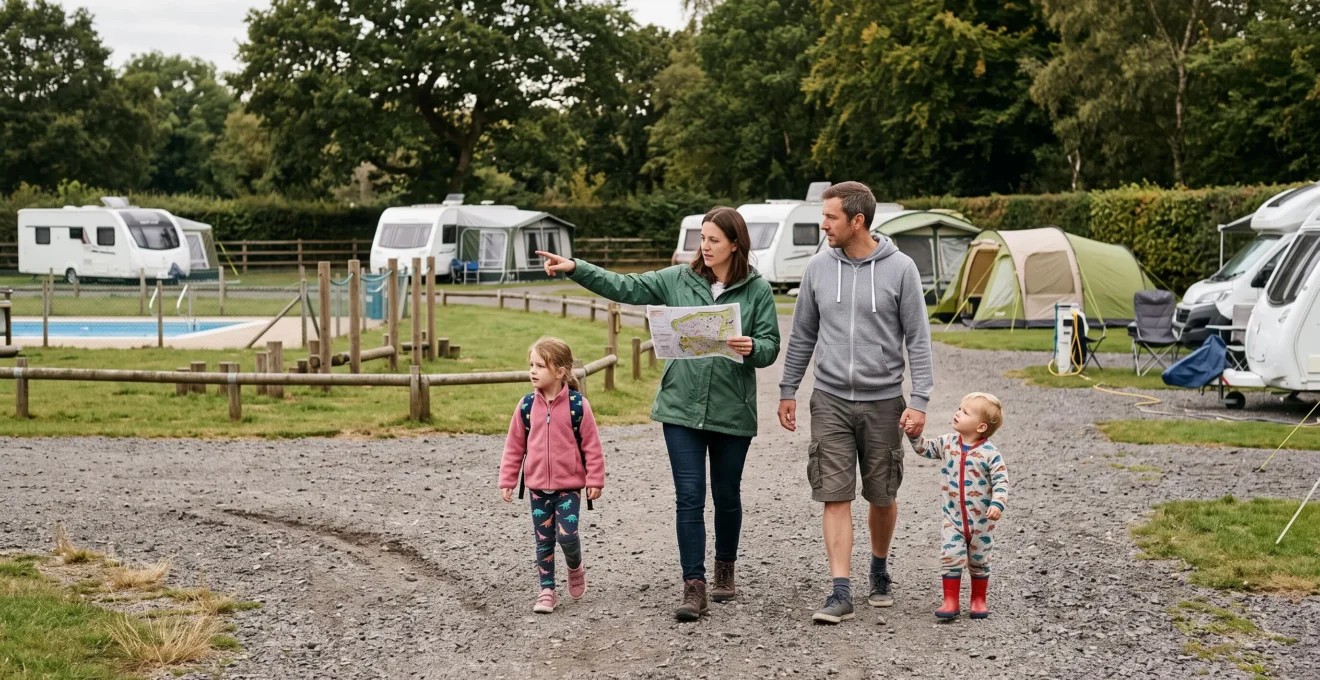
A campsite can advertise heated swimming pools, adventure playgrounds and family entertainment while leaving parents uncertain about the things that matter most: whether children can reach water unattended, who checks the play equipment and how quickly help arrives in an emergency.
For a first camping holiday with young children, the most suitable managed campsite is not necessarily the one with the longest facilities list. It is the one whose layout, physical barriers, maintenance procedures and staffing arrangements make everyday supervision manageable.
Start by requesting a detailed site map, the latest playground inspection information, pool access arrangements and the site’s emergency procedures. Check whether these provisions will operate during your actual travel dates, rather than relying on photographs taken during peak season.
The following assessment methods help families distinguish verifiable safety infrastructure from reassuring marketing language, while recognising that no campsite facility replaces attentive parental supervision.
What matters most when choosing a child-safe campsite
- Verify physical safeguards: look for inspected playgrounds, controlled pool access, separated vehicle routes and facilities appropriate to each child’s age.
- Check actual supervision: confirm lifeguard schedules, staff responsibilities and emergency arrangements for your travel dates.
- Assess the whole stay: pitch location, nighttime noise, medical access and nearby swimming conditions affect how comfortably parents can supervise children.
- How to Check if a Campsite Playground Meets UK Safety Standards?
- Campsite Pool or Natural Lake: Which Is Safer for Children Under Eight?
- The Campsite Feature That Sabotages Your Child’s Sleep Routine
- Why « Family-Friendly » Doesn’t Guarantee the Facilities You Actually Need?
- How to Assess a Campsite’s Emergency Medical Provision Before Arrival?
- How to Design a Campsite Stay That Keeps Toddlers Safe Yet Gives Teens Space?
- Blue Flag Beach or Wild Swimming Spot: Which for Families With Under-10s?
- How to Assess Natural Water Bodies for Safe Family Swimming?
How to Check if a Campsite Playground Meets UK Safety Standards?
To assess a UK campsite playground, request its latest independent inspection report, check the inspection date and recorded defects, and ask whether recommended repairs have been completed. Then examine the equipment and surrounding surfaces yourself on arrival. An inspection provides evidence of equipment assessment, but it does not guarantee that the playground remains defect-free or that children are supervised.
UK playground assessments commonly refer to BS EN 1176 for playground equipment and BS EN 1177 for impact-attenuating surfacing. These standards provide a useful technical framework, but parents do not need to interpret detailed engineering measurements to identify obvious warning signs.
According to RoSPA Play Safety‘s annual playground inspection guidance, annual inspections examine equipment, surfacing, site design and potential defects. Reports identify risks and recommended corrective actions.
Ask the operator for the actual report rather than accepting a statement that equipment is checked regularly. A credible response should identify when the inspection occurred, who performed it and what happened to any significant findings. Annual independent assessment and routine operational checks serve different purposes.
During a brief walk around the playground, look for:
- Impact-absorbing surfaces: suitable protective surfacing beneath climbing frames and other equipment where falls are foreseeable, without obvious damage or displacement.
- Potential entrapment points: openings, gaps and moving components that could trap a child’s head, neck or clothing. Leave technical compliance assessment to a qualified inspector.
- Equipment deterioration: splintered timber, exposed sharp edges, loose components and heavily corroded fixings.
- Age-appropriate zones: clear separation or sensible positioning of toddler equipment and larger structures used by older children.
- Surrounding hazards: nearby vehicle routes, open water or exits that a small child could reach without an adult noticing.
A further distinction matters: inspected equipment is not supervised play. Ask whether staff monitor the playground during busy school-holiday periods and whether supervision is explicitly the parents’ responsibility. A member of staff working nearby should not be assumed to be supervising children.
Small independent campsites may use second-hand or locally built equipment. Such equipment is not automatically unsafe, but a lack of independent assessment, maintenance records or clear responsibility makes its condition harder to verify. If the operator cannot explain how safety is assessed, consider that uncertainty when choosing between sites.
A well-maintained playground is valuable, but the next major question is whether the site’s water facilities offer equally manageable access and supervision.
Campsite Pool or Natural Lake: Which Is Safer for Children Under Eight?
For children under eight, a campsite pool with controlled access, clear visibility and appropriate supervision is generally easier for parents to manage than an unfamiliar natural lake. However, an unfenced, unsupervised pool may present greater practical difficulties than a designated lake swimming area with lifeguards, marked boundaries and controlled entry. The safer choice depends on the actual facilities and your ability to supervise every child continuously.
Pools offer relatively predictable boundaries and may provide marked depths, shallow areas and barriers. Lakes introduce less predictable underwater terrain, vegetation, changing water conditions and potential visibility problems.
The CDC drowning-prevention recommendations emphasise continuous adult supervision, suitable barriers and controlled pool access. Its guidance recommends four-sided pool fencing at least four feet (approximately 1.22 metres) high, with self-closing, self-latching gates. This is US public-health guidance, not a universal legal requirement for campsites in other countries.
Use the following comparison when reviewing a campsite’s facilities.
| Assessment factor | Managed campsite pool | Natural campsite lake |
|---|---|---|
| Depth | Often marked and easier to establish | May change abruptly or be difficult to judge |
| Visibility | Clear water may improve observation, although glare and crowds interfere | Turbidity, reflections and vegetation can obscure hazards |
| Access control | Fencing and self-closing gates may restrict entry | Shorelines may have multiple uncontrolled access points |
| Supervision | May have lifeguards during specified hours | May have designated, lifeguarded swimming zones |
| Changing conditions | Weather, crowding and visibility remain relevant | Weather, temperature, water quality and currents may change conditions |
Supervision capacity should determine the decision. If one adult is watching several children with different swimming abilities, a clearly bounded swimming environment is especially valuable. However, even a well-designed facility does not make it safe for one adult to divide attention between swimming children and other tasks.
For example, imagine one parent helping a toddler change while another watches two children in the pool. If the supervising adult must leave, the children need to leave the water too, unless another responsible adult explicitly takes over.
Before booking, ask whether the pool has a complete enclosure, functioning self-closing gates and lifeguards during your exact holiday dates. Confirm whether any lake swimming area has marked limits, designated entry points and published supervision hours.
Also consider the journey from your pitch. A pool that looks secure in photographs may still be easily accessible to an unsupervised toddler if the accommodation opens directly onto the pool area. Conversely, a distant swimming area may encourage rushed supervision arrangements when families are tired.
The best water facility is the one your family can use consistently under safe, realistic supervision arrangements. Its location within the campsite also matters when planning quieter accommodation.
The Campsite Feature That Sabotages Your Child’s Sleep Routine
Evening entertainment areas are a frequently overlooked threat to children’s sleep on managed campsites. Music stages, busy communal facilities and nearby touring pitches can generate noise after young children need to settle. Before booking, examine the campsite map, check entertainment finishing times and request accommodation away from evening activity routes. Published quiet hours are useful only when the operator enforces them.
A family campsite may promote evening shows as a major attraction, yet the same programme can make a pitch beside the entertainment venue unsuitable for a toddler accustomed to an early bedtime.
Noise is not confined to music. Shared toilet blocks attract foot traffic, vehicle-access roads can remain active late into the evening, and early-morning deliveries may disturb families sleeping near service areas.
Ask the operator to identify the following locations on a detailed site map:
- Entertainment stages, bars and outdoor seating areas.
- Swimming pools and evening recreation facilities.
- Main pedestrian routes between accommodation and sanitary blocks.
- Touring pitches with frequent arrivals or departures.
- Delivery entrances, waste collection points and service roads.
Request a quieter end-row or boundary pitch, but do not assume the perimeter is always peaceful. A boundary beside a public road, delivery entrance or neighbouring venue may be noisier than a central pitch.
Accommodation type changes the noise experience. Tent fabric provides limited sound insulation and light control. Caravans and mobile homes may offer more substantial walls, blinds and separate sleeping areas, although open windows, thin partitions and close neighbouring units can still transmit noise.
Ask about spacing between pitches, bedroom blackout arrangements and whether entertainment sound is audible inside the accommodation. A site operator familiar with the layout should be able to suggest suitable locations for families with early bedtimes.
Sleep planning also supports safer family routines. A child who has slept poorly may be harder to settle or supervise during the following day’s activities, while tired adults may find sustained attention more demanding. This is a practical reason to prioritise rest, not a claim that a particular campsite noise level causes accidents.
Once sleeping arrangements are satisfactory, assess whether the campsite’s broader family-friendly claims describe facilities that genuinely match your children’s needs.
Why « Family-Friendly » Doesn’t Guarantee the Facilities You Actually Need?
« Family-friendly » is a marketing description, not a standardised guarantee of playground inspections, pool barriers, traffic separation or childcare supervision. A campsite may use the label because it offers entertainment and children’s activities, while lacking the infrastructure cautious first-time parents consider essential. Translate every promotional claim into a specific facility question and request evidence before booking.
For experienced camping families, a large activity programme may be the main attraction. First-time parents with young children may instead value an enclosed toddler playground, short pedestrian routes to toilets and clearly controlled access to swimming facilities.
The difference becomes clearer when promotional language is replaced with observable features.
| Marketing description | What parents should verify |
|---|---|
| Family paradise | Age-separated play areas, safe pedestrian routes and practical access to toilets |
| Child-safe pool | Complete barriers, gate operation, depth information and lifeguard arrangements |
| Secure campsite | Vehicle entrance controls, perimeter boundaries and pedestrian access points |
| Supervised activities | Staff responsibilities, age eligibility, operating hours and parent handover rules |
| Peaceful family accommodation | Pitch position, entertainment schedule and enforced quiet hours |
Pay particular attention to traffic management. A campsite can have excellent play equipment while requiring children to cross vehicle routes to reach it. Ask whether accommodation areas are pedestrian-only, whether vehicle access is restricted at certain times and how children reach the playground from your proposed pitch.
Online reviews can help identify questions worth investigating, but overall ratings often reflect enjoyment, cleanliness and entertainment rather than specific safety arrangements.
Search reviews for terms such as « gate », « fence », « traffic », « lifeguard », « playground », « noise » and « supervision ». Read critical reviews for recurring, specific observations rather than treating a single complaint as proof of an ongoing defect.
Five checks to complete before booking a family campsite
- Request the latest playground inspection information. Save the report or written explanation of inspection arrangements and outstanding repairs.
- Verify pool and water access controls. Obtain written confirmation of fencing, gates and supervision hours for your stay.
- Review the campsite layout. Save an annotated map showing your proposed pitch, vehicle routes, playground, water facilities and toilets.
- Confirm quiet accommodation. Keep the operator’s written response identifying a suitable pitch area and applicable quiet hours.
- Check emergency arrangements. Record the on-site emergency contact, first-aid arrangements and nearest appropriate medical services.
These five records create a practical booking comparison. If an operator cannot answer a safety-critical question, mark that feature as unverified rather than assuming it meets your expectations.
Facilities that can be verified in advance provide more useful reassurance than promotional labels. Emergency medical readiness deserves the same evidence-based approach.
How to Assess a Campsite’s Emergency Medical Provision Before Arrival?
Assess campsite medical provision by identifying who can provide immediate first aid, how emergency services reach the site and which medical facilities operate nearby. Do not assume that a managed campsite has a permanent nurse, doctor or medical centre. Request details of trained staff, emergency equipment, access routes and local treatment options before committing to a remote location.
A campsite’s medical response usually involves several separate stages: immediate assistance from people nearby, contact with trained staff, emergency service notification and access to appropriate healthcare.
The operator should be able to explain what happens when a child is injured or becomes seriously unwell, including outside reception hours.
Ask these questions directly:
- Which staff members hold current first-aid qualifications, and is a trained person available during evenings and overnight?
- Where are first-aid supplies kept, and how can families access them when reception is closed?
- Is an automated external defibrillator available, clearly signed and accessible when needed?
- How are emergency services given the correct site entrance, accommodation location and pitch number?
- Are access gates or internal roads likely to complicate emergency vehicle entry?
Do not confuse first-aid availability with clinical treatment. A trained first-aider may provide immediate assistance, but serious injuries and illnesses require assessment by appropriate medical professionals.
Independently check the nearest emergency department, minor injuries service, pharmacy and out-of-hours medical service. In the UK, distinguish an A&E department from a minor injuries unit, as their capabilities and operating hours differ. In other English-speaking destinations, use the corresponding local healthcare categories.
Distance alone is insufficient. Road conditions, opening hours and rural emergency service coverage affect practical access. A hypothetical campsite 40 minutes from an appropriate treatment facility requires a different contingency plan from one 10 minutes away, but neither distance predicts actual ambulance response time.
Before departure, prepare a concise family emergency information sheet containing relevant allergies, medications, emergency contacts and any medical details responders may need. Store it securely but accessibly.
Teach children who are old enough how to identify campsite staff and seek help. Younger children should remain with a responsible adult rather than being expected to manage emergencies independently.
Finally, establish the correct local emergency number. In the UK, 999 and 112 can be used for emergencies; other countries have different arrangements.
Medical readiness becomes especially important when families include children with widely different levels of independence, because their daily supervision needs may pull adults in different directions.
How to Design a Campsite Stay That Keeps Toddlers Safe Yet Gives Teens Space?
Choose a campsite with enclosed toddler facilities and a clearly bounded area where teenagers can reach approved activities independently. The most workable layout separates age-specific recreation while keeping routes predictable, vehicle access controlled and family accommodation centrally positioned. This allows parents to maintain close supervision of younger children while granting older children independence appropriate to their maturity.
A site that suits a teenager may not suit a toddler. Sports courts, social areas and extensive grounds appeal to older children, but a sprawling layout with open vehicle routes can make daily supervision difficult for parents of younger siblings.
Evaluate the campsite as two overlapping zones.
- Toddler zone: enclosed or easily supervised play areas, age-appropriate equipment, convenient toilets and effective separation from vehicles and water.
- Teen zone: sports courts, communal areas, suitable Wi-Fi access and agreed routes between accommodation and approved activities.
Rather than relying only on rules such as « stay nearby », establish geographical boundaries that teenagers can understand. Identify the facilities they may visit, the routes they should use and the locations that remain off-limits without an adult.
For example, on a hypothetical campsite with one controlled vehicle entrance and a central pedestrian recreation area, parents might allow a teenager to travel independently between the sports court and accommodation while requiring an adult for pool visits or excursions beyond the site.
The specific arrangements should reflect the teenager’s age, judgment, communication abilities and the site’s actual risks.
Look for controlled vehicle entry, understandable perimeter boundaries and paths that avoid unnecessary crossings. A perimeter fence alone does not guarantee that every exit is secure or that staff know where individual children are.
Shared facilities also create predictable friction. A toddler playground beside a teenage sports area may expose younger children to fast-moving games, while a pitch near evening social spaces may be unsuitable for early bedtimes.
Ask whether the campsite has separate play zones, designated sports areas and age-related activity schedules. Positioning the family pitch within easy reach of toddler facilities, but away from evening gathering areas, can reduce competing demands.
A workable site design reduces daily negotiation without replacing parental judgment. The same attention to boundaries is essential when choosing beaches and natural swimming locations.
Blue Flag Beach or Wild Swimming Spot: Which for Families With Under-10s?
For families with children under ten, a beach with active lifeguard patrols, designated swimming areas and suitable conditions is generally a more manageable choice than an unfamiliar wild swimming spot. Blue Flag recognition provides useful information about environmental management, bathing-water quality and safety arrangements, but it does not guarantee lifeguards at all times or safe conditions on the day of your visit.
The distinction between certification and real-time safety is important. The Blue Flag official beach certification criteria cover bathing-water quality, environmental management, safety and services. Depending on the applicable requirements and local circumstances, public rescue equipment may be accepted instead of lifeguards.
Therefore, parents should verify actual patrol availability rather than interpreting the Blue Flag symbol as a promise of permanent supervision.
For young swimmers, consider the following differences.
| Factor | Managed beach with active patrols | Wild swimming location |
|---|---|---|
| Safety information | May provide daily flags, warnings and designated areas | May rely on local signage and independent research |
| Rescue arrangements | Identifiable lifeguard patrols when operating | Often no on-site rescue personnel |
| Water conditions | Still subject to tides, currents and changing weather | May involve variable depths, submerged hazards and currents |
| Water quality | May have published bathing-water monitoring results | Monitoring may be absent or limited |
| Family supervision | Clearly marked areas may make boundaries easier to establish | Unmarked access points can complicate observation |
When assessing a wild swimming spot recommended online, establish whether swimming is permitted, whether it is a designated bathing-water location and whether reliable local information describes entry points, currents and submerged hazards.
Look for recent, location-specific observations from local authorities or established swimming organisations. Popularity among experienced open-water swimmers does not establish suitability for children.
Timing can change the assessment completely. A beach that operates lifeguard patrols during peak summer hours may have no patrol outside those hours or seasons. Check the precise dates and daily times, then read the beach flags and safety notices on arrival.
At UK lifeguarded beaches, the RNLI recommends swimming between red-and-yellow flags. Children still need close adult supervision even where professional lifeguards are present.
A managed beach offers useful infrastructure when its safeguards are operating. If your family is considering a lake, river or other natural water body, a separate location-specific assessment is essential.
Key takeaways before choosing natural water
- Assess the actual swimming location and current conditions, not its reputation or appearance in photographs.
- Choose a place where adults can maintain continuous observation and reach young children immediately.
- Treat uncertain depth, changing currents, poor water quality information or unclear emergency access as reasons to reconsider swimming.
How to Assess Natural Water Bodies for Safe Family Swimming?
Assess natural swimming water by checking whether swimming is permitted, reviewing current water-quality and weather information, identifying currents and underwater hazards, and confirming safe entry, exit and supervision arrangements. Calm-looking water is not necessarily safe: sudden depth changes, cold temperatures and submerged obstacles may be difficult to detect. If essential conditions cannot be established, choose a managed swimming facility instead.
Begin the assessment before travelling. Look for official designated bathing-water information, environmental regulator monitoring results and local authority warnings. A designated bathing-water classification provides useful evidence about monitored water quality, but it does not certify that the location is physically safe for children to swim.
Check recent rainfall and local notices. Heavy rain can affect water quality, particularly where runoff or wastewater contamination is possible. Visible algal blooms, discoloured water or warning signs should prompt families to avoid entering until reliable local advice confirms conditions are suitable.
At the water’s edge, examine the shoreline without entering. Look for steep banks, reeds, visible inflows, unusual water movement, submerged branches and abrupt changes in the lakebed. Clear water may help reveal hazards, but clarity alone cannot establish depth or safety. Never use a child’s entry into the water to test an unknown swimming area.
Cold-water shock is another important consideration. The RNLI’s July 2026 water-safety advice explains that sudden immersion in cold water can cause involuntary gasping, increased heart rate and panic, even during warm weather. Families should not assume that a sunny day means a lake or river has warmed sufficiently.
Before considering entry, establish whether the location has an officially recognised swimming area and reliable information about underwater conditions. Where available, consult local depth information and knowledgeable site staff rather than relying on visual estimates.
Supervision geometry matters as much as water conditions. Unlike a swimming pool, open water may have no clearly defined perimeter. Identify a single agreed entry area, a suitable exit and a fixed meeting point on land.
Keep toddlers and children who cannot swim within immediate adult reach in and around water. Assign one responsible adult to continuous observation without phone use or competing tasks. A second adult should manage towels, food and other children rather than assuming the same person can do everything simultaneously.
Appropriately fitted life jackets provide an additional protective measure for activities around natural water, but they do not make an unsuitable swimming location safe or replace supervision. Inflatable toys should never be treated as safety equipment.
Finally, confirm mobile reception, emergency access and the precise location details needed by responders. A beautiful, isolated swimming spot may be a poor family choice when communication or rescue access is uncertain.
Before booking, select two or three campsites and request written answers about playground inspections, water barriers, supervision, pitch location and emergency procedures. Compare the answers against your children’s ages and your family’s realistic supervision capacity. Choose the site whose safeguards can be verified and whose daily layout you can manage comfortably.
Should parents expect campsite staff to supervise children throughout the day?
No. A managed campsite may offer staffed activities, lifeguards or monitored facilities, but these services have defined responsibilities and operating hours. Parents should confirm which activities involve formal supervision, how children are checked in and out, and when direct parental supervision remains necessary.
Is a smaller campsite automatically safer for toddlers?
No. A compact layout may reduce walking distances, but safety depends on barriers, vehicle routes, equipment condition and access to hazards. A larger campsite with clearly separated pedestrian areas and controlled water access may be easier to supervise than a smaller site with open vehicle movement.
What should families do if a campsite refuses to share safety documentation?
Ask whether the operator can provide a recent inspection summary, the inspector’s details or written confirmation of maintenance arrangements. A refusal does not by itself prove a facility is unsafe, but unresolved uncertainty about significant hazards is a reasonable reason to select another campsite.
Can swimming lessons make a campsite pool safe without close adult supervision?
No. Swimming ability does not remove drowning risk. Children need appropriate adult supervision in and around pools and natural water, even where lifeguards are present. Barriers, swimming skills and rescue equipment provide additional layers of protection rather than substitutes for attentive supervision.
How far in advance should parents verify campsite safety facilities?
Request essential documentation and facility information before making a non-refundable booking. Reconfirm seasonal services, lifeguard availability and any facility closures shortly before departure. On arrival, check that the barriers, routes and equipment you intend to use match the operator’s description.