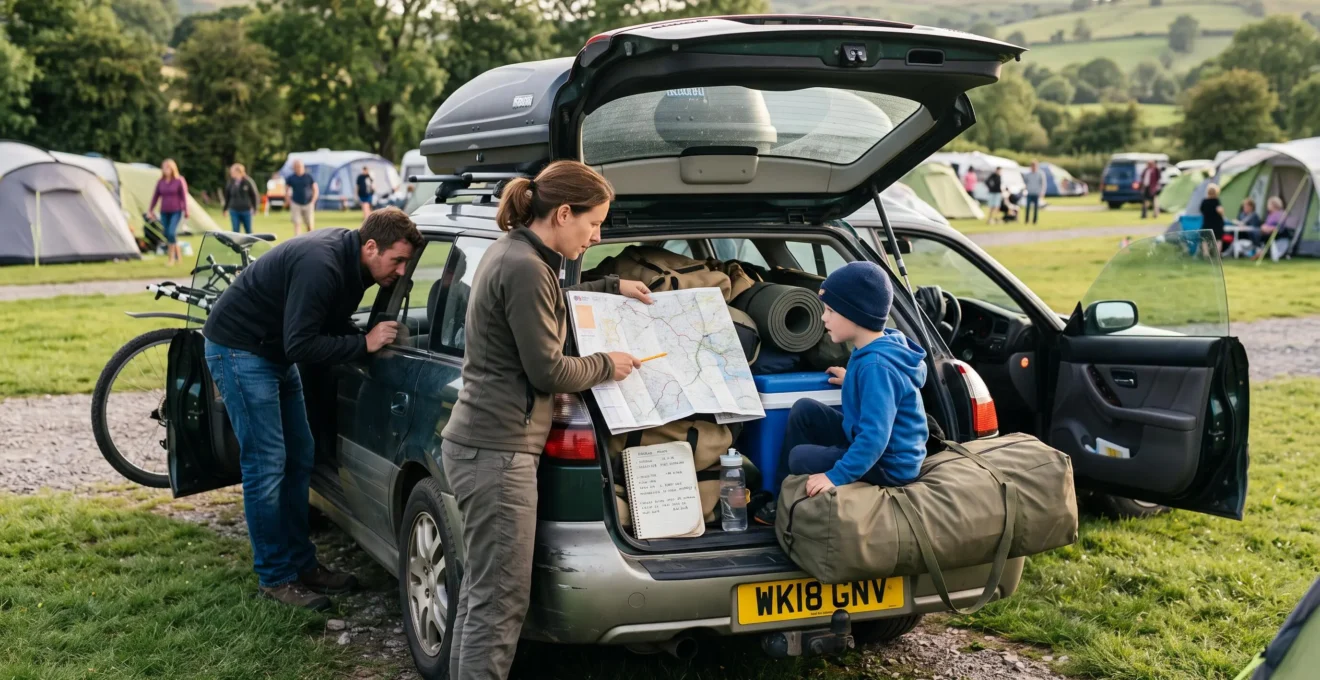
A cheaper camping road trip does not necessarily mean visiting fewer places. The biggest opportunity often lies in changing the order of destinations, selecting better-positioned campsites and avoiding unnecessary return journeys. A carefully chosen base can make several attractions accessible without repeatedly driving the same roads.
Fuel-efficient route planning requires more than choosing the shortest distance on a map. Motorway speeds, secondary-road conditions, petrol prices, roof-mounted equipment and the cost of extra camping nights all influence the final budget. A longer route may even cost less when it avoids congestion, steep gradients or expensive overnight stops.
The practical approach is to calculate the total cost of reaching and exploring each destination, rather than focusing exclusively on the drive between campsites. That means including daily excursions, shopping trips, refuelling diversions and the time spent travelling. The following methods help turn a fixed fuel allowance into a realistic itinerary while protecting the experiences that make the journey worthwhile.
Fuel-saving camping routes at a glance
- Group nearby attractions around well-positioned campsites, then compare excursion mileage against the cost of relocating.
- Use your vehicle’s actual fuel consumption to compare speeds, road types and petrol-station diversions.
- Include campsite fees, travel time, refuelling reserves and roof-load safety before choosing the cheapest overall route.
- How to Group Campsites Geographically to Cut Total Driving by 40%?
- Why Does Driving 10mph Slower Save £80 on Long Camping Road Trips?
- Motorway or A-Road: Which Route Costs Less Fuel for 200-Mile Camping Journeys?
- How to Find the Cheapest Petrol Stations Within 5 Miles of Your Camping Route?
- Should You Refuel at Half-Tank or Quarter-Tank During Camping Road Trips?
- How to Arrange Roof Cargo to Cut Wind Resistance by 30%?
- What Is the True Daily Cost of RV Camping Including All Hidden Expenses?
- How to Secure Roof-Mounted Gear Without Excessive Fuel Consumption?
How to Group Campsites Geographically to Cut Total Driving by 40%?
Grouping campsites geographically can reduce driving by replacing repeated long excursions with shorter trips from strategically positioned bases. A 40% reduction is a planning target, not a guaranteed result. The actual saving depends on attraction locations, road connections, campsite availability and whether moving camp eliminates more mileage than it adds.
Start by plotting every must-see destination before choosing accommodation. Identify attractions that sit within a manageable driving area, then look for campsites with convenient road access to several of them. This creates a cluster: a group of places that can be explored from one base without repeatedly crossing the wider region.
Cluster routing is particularly useful for families staying several nights in one area. Instead of driving between distant attractions and returning along overlapping roads, arrange compatible stops into circular excursions. When a day trip becomes too long, consider moving the campsite rather than extending the same return journey.
The US Department of Energy guidance on fuel-efficient driving recommends reducing unnecessary mileage, traffic stops and congestion exposure through better route planning. It does not establish a fixed percentage saving for campsite clustering, so the improvement should be calculated from the proposed itinerary.
To find the most economical daily excursion radius, compare the round-trip distance from your current campsite with the mileage needed to relocate to another base and explore from there. Use the same estimated fuel consumption initially, then adjust it if the road types differ substantially.
Hypothetical example: stay or move?
Suppose a family’s car consumes 7 litres per 100 km and petrol costs £1.50 per litre. Visiting an attraction 70 km away requires a 140 km return journey, costing approximately £14.70 in fuel.
Moving to another campsite 50 km away would consume approximately £5.25 in fuel for the relocation. If that new campsite also reduces the distance to the next day’s attractions, relocating may be cheaper. Any pitch-price difference and the inconvenience of moving must also be considered.
A rural campsite with a low nightly price is not automatically the best-value choice. If it saves £8 per night but adds £11 of driving each day, the apparent accommodation saving disappears. Compare total costs over the intended length of stay rather than treating pitch prices separately from petrol expenditure.
Finally, allow for unplanned travel. Shopping, forgotten equipment, changed weather and unexpected detours can add mileage to an otherwise efficient schedule. Keeping a contingency allowance in the distance estimate makes the fuel budget more resilient without requiring destinations to be removed.
Once the destination groups are established, driving speed becomes the next important variable: the same route can consume substantially different amounts of fuel depending on how the vehicle is driven.
Why Does Driving 10mph Slower Save £80 on Long Camping Road Trips?
Driving 10 mph slower can reduce fuel consumption on sustained high-speed journeys, but saving £80 requires enough mileage and a sufficiently large difference in fuel use. The figure is an illustrative possibility rather than a universal saving. Vehicle aerodynamics, load, fuel price and the speeds being compared determine the financial result.
Air resistance rises rapidly as a vehicle travels faster. Aerodynamic drag increases approximately with the square of speed under comparable conditions, while the power needed to overcome that drag increases even more sharply. A loaded estate car, campervan or vehicle carrying roof equipment can therefore consume noticeably more fuel during prolonged fast cruising.
According to the US Department of Energy road-trip fuel-saving advice, average petrol fuel economy generally declines rapidly above 50 mph. This observation does not mean 50 mph is the ideal speed for every vehicle or journey. Engine characteristics, gearing, gradients, traffic and local driving rules all affect the optimum.
The financial saving can be estimated using a simple calculation:
Fuel saving (£) = distance (miles) ÷ miles per gallon at faster speed × fuel price per gallon − distance (miles) ÷ miles per gallon at slower speed × fuel price per gallon.
Both consumption figures must use the same gallon definition. For UK drivers using litres per 100 km, an equivalent formula is: distance in km × (fast consumption − slow consumption) ÷ 100 × price per litre.
Hypothetical example: when could slower driving save £80?
Consider a 2,000-mile camping journey, equivalent to approximately 3,219 km. Assume the vehicle averages 9.5 L/100 km at the higher cruising speed and 7.5 L/100 km at a speed 10 mph lower. With petrol hypothetically priced at £1.25 per litre, the saving would be approximately £80.47.
These are illustrative consumption rates and a hypothetical fuel price, not measured results or a current market quotation. A shorter trip or smaller consumption difference would produce a lower saving.
Slower driving also requires a time-cost comparison. Covering 200 miles at a constant 70 mph takes approximately 2 hours 51 minutes, compared with 3 hours 20 minutes at 60 mph, before stops and delays. Across multiple travel days, those extra minutes can affect campsite arrival times.
If driving more slowly requires an additional paid night, compare that overnight cost with the fuel saved. The same applies to delayed attractions, fatigue and the practical limits of family travel schedules.
Always maintain a speed appropriate to local rules and conditions. Driving excessively slowly relative to surrounding traffic can create safety problems, and some roads impose minimum speeds or other restrictions. Similarly, forcing a vehicle to operate in an unsuitable gear may undermine the expected economy improvement.
After choosing a reasonable cruising speed, compare the roads themselves. A slower route may appear efficient but lose its advantage through additional distance, hills and repeated stops.
Motorway or A-Road: Which Route Costs Less Fuel for 200-Mile Camping Journeys?
Neither motorways nor A-roads are consistently cheaper for a 200-mile camping journey. Motorways often offer steadier traffic flow, while A-roads may permit lower speeds that reduce aerodynamic resistance. The better option depends on actual route length, gradients, congestion, junction frequency, tolls and your vehicle’s measured consumption on each road type.
A motorway route can deliver relatively consistent fuel use when traffic moves smoothly and the driver maintains a moderate speed. Its disadvantage is that sustained high-speed travel increases aerodynamic resistance, particularly for tall campers and vehicles fitted with roof boxes.
An A-road route may operate at more economical speeds, but that benefit can disappear when the journey involves roundabouts, steep climbs, traffic lights or frequent acceleration. Narrow roads can also increase driver fatigue or become unsuitable for larger camping vehicles.
To demonstrate the comparison, consider two hypothetical ways of reaching a destination approximately 200 miles away.
| Criterion | Motorway route | A-road route |
|---|---|---|
| Route length | 200 miles (322 km) | 190 miles (306 km) |
| Average fuel consumption | 8.5 L/100 km | 8.0 L/100 km |
| Estimated fuel used | 27.37 litres | 24.46 litres |
| Fuel cost at an assumed £1.50/L | £41.06 | £36.69 |
| Other considerations | Potential tolls; steadier cruising | More junctions; potentially longer travel time |
In this constructed example, the A-road saves approximately £4.37 in fuel. That advantage would change if slower roads increased consumption or if the motorway offered a shorter route. The figures illustrate the calculation method, not representative performance for every vehicle.
Terrain matters as much as road classification. An apparently direct route through hills may require repeated climbs, while a longer road following a valley may allow more consistent speeds. Descending does not necessarily recover all the energy consumed during climbing, particularly in a conventional petrol or diesel vehicle.
For a personalised comparison, record your average consumption on representative motorway and secondary-road journeys using the vehicle’s trip computer. Apply those values to each proposed route:
Estimated fuel cost = route distance in km × consumption in L/100 km ÷ 100 × fuel price per litre.
Add tolls and account for the difference in journey time. A route saving only a small amount of fuel may not be worthwhile if it causes significant fatigue, a missed campsite check-in or an additional overnight stay.
Navigation applications are useful for measuring alternative distances, but the quickest or shortest route is not necessarily the least expensive. Compare at least two realistic options before deciding.
Once the driving route is selected, strategically choosing where to buy petrol can reduce expenditure further, provided the search for a lower price does not introduce expensive detours.
How to Find the Cheapest Petrol Stations Within 5 Miles of Your Camping Route?
To find cheaper petrol within five miles of a camping route, compare stations along the planned journey rather than searching only around your current location. Check their actual road access, displayed prices, opening hours and distance from the route. A lower pump price is worthwhile only when the resulting saving exceeds the cost of reaching that station.
Begin with a route map and identify likely refuelling areas before departure. Look for stations near motorway exits, towns crossed by the journey and the final population centres before remote camping destinations. A five-mile search radius is a useful screening rule, but it does not guarantee a short diversion.
In the United Kingdom, the UK government’s Fuel Finder data service supplies retail fuel-price information for third-party applications and websites. Its documentation includes station locations, fuel types, prices, opening hours and update information. Prices are published within 30 minutes of changes, while the downloadable CSV dataset is updated twice daily.
Fuel Finder is a data service rather than a dedicated camping-route application. Travellers should use a suitable consumer comparison service that incorporates its information, where available. Drivers in the United States, Canada, Australia and other English-speaking destinations should check locally available price-comparison tools and their data coverage.
The key calculation is the break-even diversion distance. Multiply the price difference per litre by the number of litres purchased. Then compare that saving against the fuel consumed by the complete detour, including the return to the original route.
Hypothetical example: is a cheaper pump worth the detour?
A driver needs 45 litres. One station charges a hypothetical £1.55 per litre, while another charges £1.49. The cheaper option saves £2.70 at the pump.
If reaching that station and returning to the route adds eight miles (approximately 12.9 km), and the vehicle consumes 8 L/100 km, the detour uses about 1.03 litres. At £1.49 per litre, that represents approximately £1.54, leaving a net fuel-cost benefit of £1.16.
Additional time, traffic and uncertainty could make the detour less attractive despite the small saving.
Fuel-price patterns should be investigated rather than assumed. Motorway services, urban stations and rural forecourts may differ, but local competition, regional taxes and supply conditions can change which area is cheapest. A traveller crossing several regions should compare available stops along the entire route instead of relying on a universal urban-versus-rural price rule.
Remote destinations introduce another risk: the cheapest listed station might be closed, inaccessible or temporarily unable to supply the required fuel. Confirm opening information shortly before arrival and identify a backup stop.
Choosing the right station is only part of refuelling efficiency. The remaining decision is how much reserve to maintain so that an attractive price does not become a risky gamble on the next available pump.
Should You Refuel at Half-Tank or Quarter-Tank During Camping Road Trips?
Refuelling at half-tank is generally the more flexible strategy for remote camping journeys, while waiting until quarter-tank can be practical on routes with frequent reliable stations. Neither level is universally optimal. The choice should reflect the vehicle’s real range, expected road conditions, fuel availability and the distance to a dependable alternative station.
A half-full tank provides more freedom to bypass an expensive forecourt, change the itinerary or continue through a region with limited services. It is particularly valuable where mountain roads, rural campsites and uncertain opening hours make the next fuel opportunity difficult to predict.
Waiting until quarter-tank can reduce the number of unnecessary refuelling stops when travelling through densely populated areas. However, quarter-tank is a fraction of tank capacity, not a fixed distance allowance. Two vehicles showing the same gauge level may have very different remaining ranges.
Compare the strategies using three practical criteria:
| Decision factor | Refuel near half-tank | Refuel near quarter-tank |
|---|---|---|
| Price flexibility | More opportunities to skip expensive stations | Fewer remaining alternatives |
| Remote-route resilience | Greater fuel reserve | Requires more reliable station planning |
| Fuel weight | Carries more fuel mass | Carries less fuel mass |
| Best practical setting | Remote, mountainous or uncertain routes | Well-serviced roads with predictable supply |
The most useful technique is identifying a refuelling point of no return. Before entering a long stretch without reliable stations, mark the last dependable opportunity to fill up. Estimate fuel needed to reach the next confirmed stop, then retain an additional reserve for detours, congestion or changed conditions.
For example, if a vehicle typically uses 8 L/100 km and the next dependable station is 150 km away, the expected consumption is 12 litres before adding a safety margin. The driver should compare that requirement with the usable fuel remaining, rather than relying solely on a dashboard range prediction.
A fuller tank does increase vehicle mass, but the fuel-economy effect is usually modest compared with the consequences of running short. For a heavily loaded motorhome, predictable fuel availability and safe margins generally matter more than minor weight-related savings from carrying less petrol or diesel.
Where possible, record station locations on an offline map. Mobile coverage can be unreliable in remote camping areas, and advance planning avoids making urgent purchasing decisions at the only available forecourt.
With route selection and fuel stops planned, vehicle configuration deserves attention. A poorly arranged roof load can increase consumption even when the itinerary itself is efficient.
How to Arrange Roof Cargo to Cut Wind Resistance by 30%?
Roof cargo should be kept low, compact and securely contained to limit additional aerodynamic drag. A 30% reduction in wind resistance is not an established general result: it depends on the load’s original shape, the rearranged configuration and driving speed. The practical goal is to reduce unnecessary frontal exposure without exceeding roof-load limits or compromising safety.
Roof-mounted equipment changes the airflow around a vehicle. Tall stacks, widely separated items and loose covers can increase turbulence, particularly at motorway speeds. Streamlined equipment generally creates less aerodynamic disruption than bulky arrangements with exposed edges, although the actual effect varies with vehicle design.
Start by deciding what genuinely needs to travel on the roof. Heavy, rigid or awkward equipment may be better carried inside the vehicle when suitable space and safe restraint are available. Interior packing must not obstruct visibility, interfere with occupants or exceed vehicle loading limits.
For equipment that must be roof-mounted, use a compatible carrier designed for its dimensions and weight. Long camping items can sometimes be arranged in a lower profile, but the manufacturer’s instructions determine the correct position, permissible projections and securing method.
A fitted aerodynamic roof box or appropriate cargo system may offer a more controlled arrangement than separate exposed bags. A loose fabric cover, however, is not a substitute for secure containment: material that flaps or shifts can create both drag and safety risks.
A particularly useful improvement is removing accessories that are no longer required. Empty roof boxes, unused crossbars and other external carriers can continue affecting airflow even when no camping equipment is being transported.
The same principle applies to bicycle carriers and additional roof-mounted equipment. Removing compatible detachable accessories between journeys can reduce unnecessary aerodynamic exposure, provided removal and reinstallation follow the manufacturer’s instructions.
The impact of these choices increases in importance during sustained high-speed driving. However, reduced drag should not be confused with an identical percentage reduction in total fuel use: tyres, drivetrain losses, engine efficiency and other factors also contribute to consumption.
Better packing can make the journey more efficient, but meaningful savings should ultimately be assessed against the full holiday budget, particularly when comparing different types of camping vehicles.
What Is the True Daily Cost of RV Camping Including All Hidden Expenses?
The true daily cost of RV camping includes much more than campsite fees and fuel. It can also include cooking gas, water services, waste disposal, electricity, tolls, insurance, parking and vehicle-related expenses. To obtain a useful daily figure, calculate the total expected trip expenditure and divide it by the number of travel days.
A motorhome may provide sleeping, cooking and storage facilities in one vehicle, potentially reducing spending on separate accommodation and certain meals. Its size, weight and fuel consumption can nevertheless make long-distance driving more expensive than travelling in a smaller car with a tent.
The correct comparison is therefore between complete travel arrangements, not just litres consumed per kilometre or the price of a campsite pitch.
Begin with direct daily expenses: fuel actually used, pitch charges, paid electricity connections and cooking fuel. Then include intermittent expenses such as fresh-water services, waste disposal, tolls and parking charges. Finally, allocate relevant trip-related insurance, maintenance and vehicle hire or ownership costs across the planned travel period.
Some campsites and serviced RV parks apply additional charges for facilities or resort services. Pricing may also vary between peak and quieter periods. These costs should be checked against booking conditions rather than assumed to be included in the headline nightly rate.
The following hypothetical example shows how small expenses combine.
| Expense | Estimated daily allocation |
|---|---|
| Fuel | £24 |
| Campsite pitch | £30 |
| Electricity supplement | £5 |
| Cooking gas | £3 |
| Water and waste services | £4 |
| Tolls and parking | £6 |
| Trip-related insurance and maintenance allocation | £8 |
| Illustrative daily total | £80 |
These amounts are constructed solely to demonstrate budgeting. They are not observed market averages and do not include vehicle hire or purchase costs, food, attractions or other discretionary expenses. An actual budget should use confirmed bookings and vehicle-specific estimates.
The economic balance between an RV and a smaller vehicle changes with trip duration, the number of travellers and the proportion of days spent driving. A longer stay at one location may reduce the relative importance of motorhome fuel consumption, while a multi-region road trip can amplify it.
It is also important to count unproductive mileage: moving an RV between distant attractions, making shopping runs or travelling to disposal facilities may increase fuel expenditure without adding another destination.
Build a verifiable camping fuel-and-cost plan
- Map every essential attraction and possible campsite, producing a marked route with separate geographic clusters.
- Calculate planned driving mileage, including excursions and practical detours, and record a total with a contingency allowance.
- Estimate fuel consumption using your vehicle’s measured figures for each major road type, producing a fuel-cost worksheet.
- Identify practical refuelling stops and compare their prices, opening information and round-trip diversion distances on the route map.
- Add campsite fees, equipment expenses, road charges and vehicle-related costs to produce a complete daily and trip-total budget.
The resulting worksheet makes trade-offs visible. An economical driving speed, a more conveniently located campsite or fewer unnecessary relocations can reduce the daily total without removing the attractions that motivated the holiday.
After the main cost decisions are made, the remaining task is ensuring the packed vehicle stays safe and efficient throughout the journey, including after equipment has been repeatedly loaded and unloaded.
Key decisions before securing the final route
- Keep the most important destinations, but remove repeated journeys that contribute little to the travel experience.
- Compare fuel savings against the whole holiday cost, including overnight fees and the extra time required by alternative routes.
- Treat secure roof loading as a non-negotiable safety requirement; aerodynamic improvements must work within that limit.
How to Secure Roof-Mounted Gear Without Excessive Fuel Consumption?
Roof-mounted camping equipment should be secured with a compatible rack, approved restraints and the correct manufacturer-specified attachment points. Fuel efficiency improves when the load remains compact and stable, but safety comes first. Loose straps, shifting equipment and unsuitable carriers can create hazards that outweigh any potential aerodynamic advantage.
Different securing systems serve different purposes. Suitable ratchet straps or dedicated clamps can restrain equipment effectively when used according to their specifications. Fitted roof boxes and purpose-designed carriers may provide integrated containment, whereas cargo nets and covers have limitations that depend on the actual system.
The UK’s DVSA guidance on securing loads to vehicle roof racks emphasises manufacturer’s weight limits, appropriate straps and effective clamping. It also warns against using rope, bungee cords or other elastic cords as substitutes for effective primary restraint.
Roof-load capacity includes the relevant weight of the equipment being carried and must be assessed against the vehicle and rack manufacturers’ specifications. A secure-looking installation is not sufficient if it exceeds those limits.
Aerodynamic improvements should focus on arrangements that are already safe. Keep suitable equipment within the carrier’s intended dimensions, prevent loose fabric from flapping and avoid protruding straps where they could become a hazard. Never compromise restraint tension merely to create a smoother-looking profile.
For unconventional equipment, such as kayaks, bicycles or boards, use carriers designed for that particular load. There is no universally correct orientation for every model: the relevant manufacturer instructions and vehicle limitations determine whether a given installation is appropriate. Long loads may also require additional front or rear restraint arrangements.
Before departure, inspect the rack, attachment points and locking systems. Confirm that each item is restrained and that the installation does not interfere with vehicle controls, visibility, lights or access to essential components.
After beginning the journey, stop in a safe place to inspect the load again in accordance with the equipment instructions. Recheck after overnight stops, equipment handling or exposure to conditions that could affect restraints. Temperature changes, vibration and movement can alter the fit of some installations.
Unexpected whistling, flapping or movement may signal a loading problem. These are reasons to stop safely and investigate, not merely indications of possible extra fuel consumption.
The safest economical arrangement is often the simplest: carry only necessary equipment, keep the load compatible with its mounting system and remove unused external carriers when practical. This protects the vehicle’s efficiency without turning fuel savings into a reason for unsafe modifications.
Before booking, create one final itinerary showing campsite locations, daily driving distances, expected fuel expenditure, refuelling opportunities and the attractions allocated to each day. Use it to eliminate unnecessary mileage while preserving the experiences that matter most to the travellers.
How much extra mileage should a camping road-trip fuel budget allow?
There is no universal contingency percentage suitable for every route. Start with mapped transfers and excursions, then add likely journeys for shopping, water services, weather-related changes and other practical needs. Increase the allowance where campsite access is uncertain or attractions are spread across remote areas. The result should be a clearly labelled planning estimate rather than a guaranteed distance.
Is one campsite always cheaper than moving between several?
No. Staying in one place avoids repeated packing and relocation costs, but it can generate expensive daily return trips. Moving may be cheaper when it substantially shortens access to several attractions. Compare the fuel cost of remaining at the first campsite against relocation mileage, new excursion distances and differences in pitch fees.
Should camping route planners optimise for distance or journey time?
Neither measure is sufficient alone. The shortest route may involve hills and frequent stops, while the fastest may require sustained high-speed travel. Compare predicted distance, realistic fuel consumption, journey time, road charges and campsite arrival constraints. The best-value route is the one with the lowest acceptable total cost while remaining practical and safe.
How can families compare fuel costs across different countries?
Use a common measurement system, such as litres per 100 km and kilometres, for every route. Convert local fuel prices into the same currency using an appropriate exchange rate, and distinguish petrol from diesel prices. Include local tolls and other road charges separately. Recheck prices close to departure because fuel costs and exchange rates can change.
Can removing a roof box save more fuel than choosing a shorter route?
It depends on the journey. Removing an unnecessary roof box may improve efficiency across every remaining mile, while a shorter route produces a direct mileage reduction. Compare measured fuel consumption with and without the equipment, where safe and practical, against the distance saved by alternative routes. Roof equipment should only be removed or installed according to manufacturer instructions.