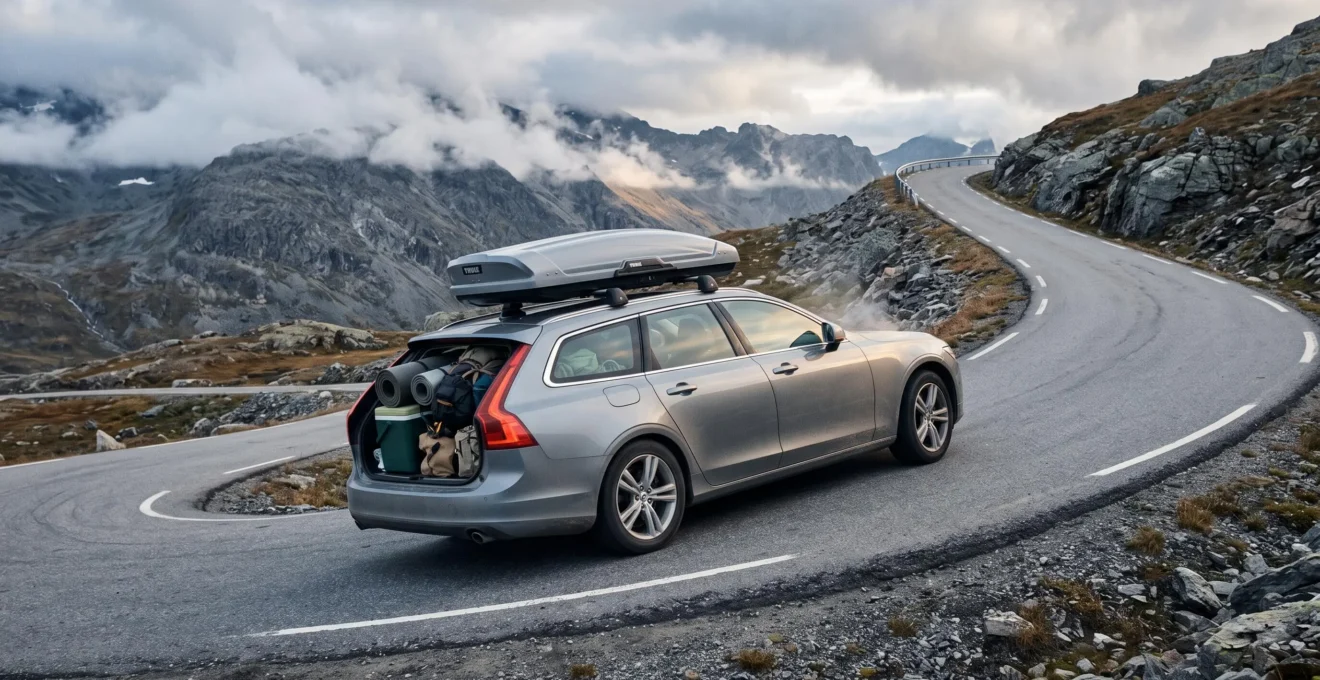
Driving above 1,000 metres changes the demands placed on a vehicle, even when the road is paved and the weather looks favourable. Thinner air can reduce engine output, steep gradients increase the load on the cooling and braking systems, and mountain temperatures may differ sharply from those at the departure point. For a family carrying camping equipment, these effects become especially relevant.
Human responses to altitude follow a different pattern. Crossing a pass at 1,000 or 2,000 metres does not automatically require acclimatisation, but rapidly reaching higher elevations and staying overnight can increase the risk of altitude illness. The important distinction is between the highest point reached during the drive and the elevation where passengers will sleep.
Safe preparation therefore involves two parallel assessments: whether the loaded vehicle can climb and descend reliably, and whether its occupants can tolerate the planned altitude exposure. Checking both before departure is more useful than relying on a single elevation threshold or assuming that a familiar lowland driving technique will work in the mountains.
Mountain pass driving: the essentials
- Expect reduced power from naturally aspirated engines as elevation increases, especially when carrying passengers, luggage or camping equipment.
- Base altitude-illness precautions primarily on sleeping elevation, ascent speed and symptoms rather than treating 1,000 metres as a medical danger threshold.
- Check cold tyre pressures, mountain forecasts and vehicle condition before climbing, then use an appropriate lower gear to control speed on descents.
- Why Does Your Car Struggle on Mountain Climbs Even With a Full Tank?
- At What Altitude Should You Stop Driving and Acclimatise for Safety?
- Turbocharged or Naturally Aspirated Engine: Which Performs Better on 2,000-Metre Passes?
- Should You Increase or Decrease Tyre Pressure Before Climbing Mountain Passes?
- When Should You Turn Back From a Mountain Pass Due to Altitude Conditions?
- How to Use Engine Braking to Descend Mountains Without Touching the Brake Pedal?
- How to Predict Summit Temperature From Lowland Starting Conditions?
- How to Descend Steep Mountain Roads Without Brake Fade or Failure?
Why Does Your Car Struggle on Mountain Climbs Even With a Full Tank?
A car can feel noticeably weaker on mountain climbs because increasing altitude reduces the density of the air entering its engine. A naturally aspirated engine receives less oxygen per intake cycle, limiting the fuel it can burn efficiently and therefore the power it can produce. A full fuel tank cannot compensate for reduced oxygen availability, while steep gradients and additional vehicle weight increase the power required.
This process is related to density altitude, which reflects how atmospheric pressure and temperature affect air density. The FAA guidance on density altitude and engine performance explains how thinner air and higher temperatures can reduce engine horsepower. Its technical discussion concerns aircraft, however, and does not establish a precise power-loss percentage for road vehicles.
As a car climbs, the engine must overcome both the gradient and ordinary driving resistance. A fully loaded estate car carrying several passengers, a roof box and camping supplies may therefore accelerate more slowly than the same vehicle travelling unloaded on a flat road. A roof box can also increase aerodynamic resistance, although its effect depends on vehicle speed and configuration.
The following observations help distinguish expected climbing behaviour from signs requiring mechanical attention:
- Sluggish acceleration: a gradual reduction in responsiveness during a climb can be consistent with thinner air and increased load.
- Rising engine temperature: a temperature warning or continuing abnormal increase is not something to dismiss as routine altitude-related power loss.
- Increased fuel consumption per kilometre: sustained climbing and heavy loading can increase the energy required to complete the route, even though reduced air density does not automatically increase fuel use under every driving condition.
- Unusual noises, misfiring or warning lights: these require investigation rather than an assumption that altitude alone is responsible.
Before committing to a remote climb, check the vehicle’s permitted gross weight and loading limits, including roof and axle limits where applicable. Compare the actual travelling load with those limits, then review the route’s gradients and the manufacturer’s operating guidance. Staying within a legal weight limit does not guarantee effortless climbing, but exceeding one is a clear reason to redistribute or reduce the load.
On a sustained uphill section, select a suitable gear, avoid forcing the engine at very low revolutions under heavy load, and monitor temperature. Colorado’s official mountain-driving recommendations advise watching for overheating on steep climbs, particularly in hot weather. If temperature rises abnormally, follow the vehicle manual and stop safely if the problem persists.
Once the vehicle’s limits have been assessed, the next question is whether the family can tolerate the elevation reached during the journey, especially if the itinerary includes overnight stays.
At What Altitude Should You Stop Driving and Acclimatise for Safety?
There is no single altitude at which every driver must stop and acclimatise. Crossing a pass at 1,000 metres is generally different from sleeping at considerably higher elevations. Altitude-illness precautions become particularly important around 2,450 metres and above, although susceptibility varies. Starting elevation, rate of ascent, intended sleeping altitude and the appearance of symptoms should determine whether to pause, descend or change the itinerary.
The CDC Yellow Book chapter on high-altitude travel and altitude illness identifies altitude illness as a possibility for travellers sleeping at approximately 2,450 metres or higher, sometimes at lower elevations. It also distinguishes daytime visits to high places from overnight exposure.
For a family beginning at low elevation, these reference points help structure an itinerary without pretending that altitude affects everyone identically.
| Elevation or situation | Practical interpretation | Recommended planning response |
|---|---|---|
| Pass crossing around 1,000 metres | Not an established threshold requiring routine medical acclimatisation. | Focus on driving conditions, individual symptoms and vehicle readiness. |
| Sleeping around 2,450 metres or above | Altitude illness becomes a recognised possibility, with individual variation. | Consider previous altitude exposure, gradual ascent and symptom monitoring. |
| Direct ascent from low elevation to sleep at 2,750 metres or above | A rapid sleeping-altitude gain that CDC guidance recommends avoiding in a single day. | Plan an intermediate overnight stay or an acclimatisation period. |
| Sleeping above 3,000 metres | The CDC recommends limiting further sleeping-altitude increases to approximately 500 metres per night. | Include additional acclimatisation nights, approximately one per 1,000 metres of sleeping-altitude gain. |
| New or worsening symptoms at any elevation | The person’s clinical condition matters more than an arbitrary numerical threshold. | Stop further ascent, assess the situation and descend when symptoms worsen or serious illness is suspected. |
Headache, nausea, dizziness and unusual fatigue can signal acute mountain sickness after ascent. In younger children, loss of appetite, irritability or unusual pallor may be easier to notice than a clear description of headache. Children can be as susceptible as adults, while older travellers should not assume that age alone establishes their risk. Certain respiratory and cardiovascular conditions require medical advice before high-altitude travel.
3–5 days
The initial acclimatisation process is particularly important during the first three to five days following ascent. This is a physiological adjustment period, not a required waiting time for every mountain-pass crossing.
CDC Yellow Book 2026, High-Altitude Travel and Altitude Illness.
A camping itinerary can use the principle of travelling high and sleeping lower. For example, a family might cross a high pass during daylight but book accommodation at a lower elevation rather than immediately camping near the summit. For higher-altitude trips, overnight stops and buffer days provide flexibility when symptoms or weather interfere with the original schedule.
Hydration and adequate rest support general wellbeing but do not replace acclimatisation. Drinking extra water cannot reliably prevent altitude illness, and persistent symptoms should not be treated as a reason simply to wait longer while continuing upward. Worsening symptoms, breathing difficulty at rest, confusion or impaired coordination require urgent action and appropriate medical assistance. Descent is essential when altitude illness deteriorates; oxygen and medical treatment may also be necessary.
With the overnight exposure understood, vehicle selection becomes the next practical concern: different engine designs can respond very differently to the reduced air density encountered on higher passes.
Turbocharged or Naturally Aspirated Engine: Which Performs Better on 2,000-Metre Passes?
A turbocharged engine generally maintains its available power better than a comparable naturally aspirated engine as altitude increases, because its compressor can compensate for some of the reduction in intake-air density. A naturally aspirated engine relies more directly on atmospheric pressure. At 2,000 metres, however, the practical difference depends on engine calibration, cooling capacity, vehicle loading and the manufacturer’s operating limits.
The distinction begins with how air reaches the combustion chamber. A naturally aspirated engine draws air in without a compressor increasing its intake pressure. As ambient air becomes thinner, the oxygen available for combustion tends to decrease. A turbocharger uses exhaust-driven machinery to compress incoming air, allowing some engines to preserve more of their lowland output at elevation.
This does not mean that a turbocharged vehicle has unlimited mountain performance. Turbocharger operation generates heat, and sustained high-load climbing places demands on cooling systems. The driver must still respect engine-temperature warnings, recommended operating ranges and vehicle weight limits.
Turbo response may also influence low-speed manoeuvres. On a tight hairpin bend, the engine’s available torque and response to accelerator input depend on its design, gearing and operating speed. Turbo lag is possible in some configurations, but its severity cannot be determined simply from the presence of a turbocharger.
| Consideration | Naturally aspirated engine | Turbocharged engine |
|---|---|---|
| Response to thinner air | Available power generally falls as air density decreases. | Boost can partly compensate, within the engine’s operating limits. |
| Sustained uphill load | Performance depends on available power, gearing and cooling. | Performance also depends on boost management and sustained-load cooling capacity. |
| Low-speed bends | Response depends on torque delivery and selected gear. | Response additionally depends on turbocharger behaviour and calibration. |
| Loaded camping travel | Weight and gradient remain critical constraints. | Better power retention does not remove weight or cooling constraints. |
Diesel and petrol engines add another distinction. Many modern diesel-powered camping vehicles use turbochargers and provide substantial torque at relatively low engine speeds. That can be useful on gradients, but torque figures alone do not establish whether a vehicle can safely carry its planned load or maintain suitable speed control downhill.
When choosing a rental car, campervan or motorhome, evaluate engine performance alongside transmission control and gross vehicle weight. A vehicle with adequate engine output but limited downhill gear-selection options may be less convenient on steep routes than its horsepower figure suggests.
A useful rental enquiry covers the engine type, permitted loaded weight, transmission modes, cooling-system condition and any mountain-driving guidance from the manufacturer or hire company. The source material supports the general air-density mechanism, not an exact percentage advantage for a particular automotive engine at 2,000 metres.
Engine choice can improve climbing comfort, but it cannot compensate for poor tyre preparation. Tyres must carry the same load through long climbs, changing temperatures and demanding descents.
Should You Increase or Decrease Tyre Pressure Before Climbing Mountain Passes?
Do not deliberately increase or decrease tyre pressure solely because a route climbs above 1,000 or 2,000 metres. Check the tyres while cold and inflate them to the vehicle manufacturer’s recommended pressures for the actual load, including any specified fully loaded settings. Temperature and atmospheric-pressure changes can affect measured pressure, but an improvised altitude correction is less reliable than following the approved vehicle specification.
The NHTSA TireWise information on tyre pressure and maintenance explains that recommended pressures are found on the vehicle’s tyre and loading information label or in its owner’s manual. It defines a cold tyre as one on a vehicle that has not been driven for at least three hours.
Tyre pressure measured with a conventional gauge is relative to surrounding atmospheric pressure. When a vehicle climbs, that surrounding pressure decreases. At the same time, colder mountain air can reduce tyre temperature, whereas driving, flexing and sustained loading can increase it. These influences interact, so an altitude-based pressure adjustment cannot be determined reliably from elevation alone.
For everyday preparation, the central rule is to use the approved cold pressure and avoid releasing air merely because a tyre reads higher after driving. Removing air from a warm tyre may leave it underinflated when cold.
The pre-ascent inspection should go beyond inflation. Check tread condition, visible sidewall damage and any abnormal wear. Confirm that the spare tyre, if supplied, is serviceable and accessible even when the luggage compartment is packed with camping equipment. A tyre-pressure monitoring system is useful, but it does not replace a manual condition and pressure check.
Caravans and trailers need a separate assessment. Their tyres must be inflated and loaded according to their own approved specifications, rather than automatically using the towing vehicle’s settings. Additional trailer weight also changes the demands placed on the towing vehicle during climbing and braking.
Five checks to complete before the mountain ascent
- Locate the vehicle’s tyre-pressure label and record the recommended pressures for its intended load.
- Measure and adjust every road tyre while cold, recording the readings after adjustment.
- Inspect tread and sidewalls, noting any damage that requires professional attention before departure.
- Check the spare tyre or available puncture equipment and confirm it can be reached without unloading everything onto the road.
- For a caravan or trailer, verify its separate tyre and loading specifications and confirm the actual load is within permitted limits.
A puncture on a narrow mountain road requires a different response from one on a wide motorway shoulder. Do not attempt a wheel change in an exposed traffic lane or on an unstable verge. Stop somewhere safe if possible, activate appropriate warnings and request roadside assistance when the location does not permit a safe repair.
Correctly prepared tyres support the journey, but changing weather, mechanical warnings and passenger symptoms can still make continuing unsafe. These conditions should be evaluated before reaching a point where turning around becomes difficult.
When Should You Turn Back From a Mountain Pass Due to Altitude Conditions?
Turn back from a mountain pass when worsening weather, unsafe road conditions, vehicle abnormalities or passenger illness make continued ascent unjustifiable. The decision should follow criteria agreed before departure, not the distance remaining to the summit. A safe turning point, adequate fuel reserve and an alternative route should be identified in advance, particularly when travelling with children or towing a caravan.
A mountain route can deteriorate even when the journey begins under clear skies. Fog may reduce visibility, precipitation can change road traction, and shaded sections may retain ice despite mild conditions lower down. The appropriate response depends on road restrictions, weather forecasts, vehicle capabilities and the driver’s experience.
Use a simple go/no-go assessment before entering a remote or exposed section:
| Warning category | Observable problem | Practical decision |
|---|---|---|
| Weather and visibility | Rapidly closing fog, deteriorating precipitation or insufficient visibility for safe progress. | Do not enter the exposed section; return to a safe location if conditions already prevent safe continuation. |
| Road surface | Snow, ice or a road restriction incompatible with the vehicle’s equipment. | Use an authorised alternative or postpone the crossing. |
| Vehicle condition | Abnormal engine temperature, braking behaviour or critical warning indications. | Stop safely and assess or obtain assistance rather than proceeding toward the summit. |
| Passenger wellbeing | New altitude-related symptoms or symptoms that are worsening. | Stop further ascent and arrange descent and medical assessment as appropriate. |
| Fuel and route logistics | Insufficient reserve for the intended route and a safe alternative. | Refuel before entering the remote section or revise the journey. |
Family travel introduces pressure to continue even when the warning signs are evident. A campsite booking, a child hoping to reach the summit or several hours already spent driving can make retreat feel wasteful. None of these considerations improves road traction, repairs brakes or reverses altitude illness.
Agree beforehand that serious symptoms, unsafe road restrictions or major vehicle warnings take priority over the itinerary. This reduces the likelihood of turning an urgent safety decision into a prolonged roadside debate.
The turn-back itself needs planning. Identify official lay-bys, junctions or other safe places to change direction before starting a narrow pass. Never attempt a blind U-turn on a hairpin bend, and do not reverse along an exposed road simply because the summit is close. If there is no safe manoeuvring area, stop where permitted and seek appropriate assistance or road-authority guidance.
Be particularly cautious about a braking anomaly identified during the climb. Descending a steep road places substantial demands on the braking system, so a vehicle with an unresolved brake problem should not be driven down a dangerous gradient as a routine response.
A safe decision to descend must then be matched by an appropriate driving technique. The next priority is controlling downhill speed without allowing the service brakes to accumulate excessive heat.
How to Use Engine Braking to Descend Mountains Without Touching the Brake Pedal?
Engine braking helps control a vehicle’s speed on long mountain descents by selecting a lower gear before the downhill gradient begins. The drivetrain then provides resistance that reduces reliance on the service brakes. It does not guarantee that the brake pedal can remain untouched: drivers must still use the brakes when necessary for speed control, corners, hazards and safe stopping.
In a conventional combustion-engine vehicle, releasing the accelerator while remaining in gear allows the moving vehicle to drive the engine. Internal pumping losses, friction and other engine-related resistance can slow the vehicle. The amount of retardation depends on engine and transmission design, gear ratio and operating conditions.
The traditional advice to descend in approximately the same gear needed for climbing provides a useful starting point, but it is not a universal rule. Gradient, vehicle loading, traffic conditions and manufacturer guidance determine the final choice.
A practical descent method follows four steps:
- Approach the downhill section at a controlled speed and identify an appropriate lower gear before the gradient steepens.
- Select that gear using the transmission controls recommended by the manufacturer, without exceeding engine-speed limits.
- Release the accelerator and observe whether the vehicle maintains a suitable speed without continuously accelerating.
- If speed builds, use the service brakes appropriately to reduce speed, then select a permitted lower gear if further engine braking is needed.
Automatic transmissions may provide manual, low-range or dedicated descent modes. Their behaviour is not identical across vehicles: some hold a selected ratio while others change gear to protect mechanical components. Verify the selected mode on a modest slope before relying on it for a demanding mountain descent.
A heavily loaded car requires more downhill energy management than an equivalent lightly loaded vehicle on the same route. A caravan or trailer adds further demands, potentially including its own braking system and manufacturer-specific towing instructions. The driver must account for the combined vehicle configuration rather than assuming a familiar gear will behave identically.
Electric and hybrid vehicles require particular care because regenerative braking can provide deceleration without traditional combustion-engine braking. Regeneration may vary with battery state, system temperature or operating mode. Follow the vehicle’s instructions and retain the service brakes as an essential part of speed control.
Never select neutral to coast down a long mountain gradient. Doing so removes useful drivetrain braking and may increase dependence on the wheel brakes. Appropriate gear selection is intended to share the deceleration workload, not eliminate the braking system from the journey.
Gear choice is only one element of downhill preparation. Temperature forecasts also affect braking conditions, available traction and whether a shaded mountain road may remain icy even when the valley is warm.
How to Predict Summit Temperature From Lowland Starting Conditions?
Estimate summit temperature by comparing the pass elevation with the departure elevation and applying a reasonable atmospheric temperature-decrease range. Air generally becomes cooler with height, but humidity, weather systems and temperature inversions can change or reverse that pattern. Treat the calculation as an initial planning estimate, then check an elevation-specific forecast, road reports and available webcams before departure.
The essential inputs are the forecast temperature at the starting elevation, the elevation difference and an assumed lapse rate. A lapse rate describes how air temperature changes with altitude. It should not be confused with a guaranteed temperature difference between two locations or with a reliable forecast for a particular mountain road.
For a purely hypothetical illustration, suppose a family starts at an elevation of 500 metres and expects to cross a pass at 2,000 metres. The elevation gain is 1,500 metres. Applying an illustrative lapse rate of 6°C per 1,000 metres would produce an estimated temperature decrease of 9°C. If the starting temperature were 20°C, the corresponding simplified estimate would be 11°C at the pass.
Hypothetical summit-temperature calculation
Starting elevation: 500 metres. Pass elevation: 2,000 metres. Starting temperature: 20°C. Illustrative assumed lapse rate: 6°C per 1,000 metres.
Elevation difference: 1,500 metres. Estimated temperature change: 9°C cooler. Simplified summit estimate: 11°C. These values are assumptions for demonstrating the calculation, not observed conditions or a validated local forecast.
The limitation is crucial. Temperature inversions can leave valleys colder than nearby higher terrain. Incoming weather fronts can cause conditions to change independently of the calculated elevation difference. Moisture, cloud cover and local terrain also influence actual temperatures.
Wind chill is another distinction. Wind can make exposed skin lose heat more rapidly, but it does not mean the ambient air temperature itself has fallen by the same amount. Packing warm layers and blankets is sensible for an unexpected stop; estimating road icing requires actual road and weather information rather than wind chill alone.
Check the forecast at or near the pass elevation, compare available roadside observations, and look for changes in precipitation, freezing conditions and road status. A temperature estimate from the departure town is not sufficient evidence that the entire route will be free of ice.
Shaded bends, exposed bridges and sections receiving little direct sunlight warrant particular caution when temperatures approach freezing. Road-surface conditions may differ from the reported air temperature, making local warnings more important than a simple calculation.
Once forecast temperatures, possible icing and vehicle load have been assessed, the final safety challenge is managing braking heat throughout the descent rather than discovering the limits of the brakes halfway down.
Key takeaways before the descent
- Select a suitable downhill gear before speed increases; do not wait for repeated braking to become necessary.
- Allow for greater braking demands when carrying passengers, camping equipment or a trailer, and respond promptly to abnormal pedal behaviour or braking performance.
- Plan a safe stopping opportunity and an alternative route before committing to a long, steep descent, particularly when temperatures or road conditions are uncertain.
How to Descend Steep Mountain Roads Without Brake Fade or Failure?
Descending steep mountain roads safely requires controlling speed before it builds, using the appropriate drivetrain braking mode and applying the service brakes when needed without continuously riding them. Brake fade develops when excessive heat reduces stopping effectiveness. A lower gear, conservative speed and timely response to warning signs are more dependable than relying on repeated heavy braking after the vehicle has accelerated.
Braking converts the vehicle’s motion into heat through friction. On a long descent, the vehicle continuously loses gravitational potential energy, and the braking system may have to dissipate a substantial portion of that energy. Additional passengers, luggage and towing weight increase the demands on speed control.
When braking components become excessively hot, pad friction can decrease. In severe cases, brake-fluid overheating may contribute to vapour formation and a loss of hydraulic effectiveness. These mechanisms can produce different symptoms, but either can seriously compromise vehicle control.
The Colorado Department of Transportation mountain-driving recommendations advise using lower gears on steep descents and avoiding continuous brake application. This guidance supports a preventative approach to brake fade rather than relying on recovery after substantial overheating.
Approach each sustained downhill section with a suitable gear already selected. Keep the vehicle at a speed appropriate for the gradient, visibility, road surface and traffic. Use the service brakes as necessary, with controlled applications rather than maintaining unnecessary constant pressure. The safest technique must remain compatible with the vehicle’s braking systems, including ABS, stability control and any manufacturer-specific descent functions.
The warning signs of brake trouble require immediate attention. A burning smell, decreasing deceleration for a familiar pedal input or an unusually long or soft pedal travel may indicate overheating or another braking fault. A pedal that becomes unusually hard can also signal a different serious problem. None should be dismissed as normal mountain-driving behaviour.
If braking performance deteriorates, remain focused on steering and maintaining control. Reduce speed using an appropriate lower gear or available vehicle braking mode without over-revving the engine, use the remaining service braking capability as necessary, and look for a safe stopping location. Where an emergency escape ramp is provided and needed, follow its signs. Do not continue descending with suspected brake failure merely to reach a campsite or the valley.
Once stopped safely, secure the vehicle and seek assistance as necessary. Brake components may be extremely hot; avoid touching them or attempting improvised cooling procedures. If the pedal or braking performance remains abnormal, arrange professional inspection or recovery before continuing.
Even after an apparently uneventful descent, brake temperatures may remain elevated. Avoid unnecessary hard braking and consider a safe pause after prolonged demanding downhill driving. If the vehicle is parked, follow its manufacturer’s instructions for securing it on a slope and any relevant guidance concerning overheated brakes. No universal cooling-stop duration can guarantee that the brakes have returned to a safe temperature.
Brake fade prevention matters more than attempting to manage a failure once the road has become steep or exposed. A controlled approach also avoids overstating the risk: the available evidence supports precautions for mountain descents but does not establish a universal statistical claim that every descent is more dangerous than the corresponding climb.
Before the next mountain journey, review the vehicle manual, verify its loaded condition and braking system, check the latest route and weather information, and choose overnight elevations appropriate for the family. The objective is not simply to reach the summit but to complete the entire crossing with enough mechanical and physiological safety margin for the descent and onward travel.
Can a healthy person experience altitude sickness without hiking or exercising?
Yes. Altitude illness is associated with exposure to reduced oxygen availability at elevation, not exclusively with physical exertion. Someone who drives rapidly from low elevation to a high-altitude campsite can develop symptoms even without strenuous activity. Sleeping altitude, rate of ascent and individual susceptibility are important factors.
Does a car use more fuel simply because it is driving at altitude?
Not necessarily. Fuel consumption depends on engine design, driving conditions, load, gradients and speed. Climbing a steep mountain road can increase fuel use per kilometre because the vehicle must gain elevation, but the effect cannot be attributed to thin air alone. Plan fuel reserves using the actual route and vehicle rather than a universal altitude surcharge.
Should air conditioning be switched off during a mountain climb?
Not automatically. However, if engine temperature begins rising abnormally on a sustained climb, switching off air conditioning may reduce engine load in vehicles with engine-driven compressors. Colorado’s mountain-driving guidance also describes using cabin heating to help shed engine heat. Follow the vehicle manufacturer’s instructions, stop safely if overheating persists, and do not open a hot cooling system.
Can a high-altitude pass be safe to cross during the day but unsuitable for camping overnight?
Yes. Brief daytime exposure to a high elevation is generally less physiologically demanding than remaining there overnight. For travellers planning to sleep at approximately 2,450 metres or higher, acclimatisation becomes an important consideration. Driving over a pass and descending to a lower campsite may therefore be preferable to sleeping at the pass elevation, depending on individual circumstances.
Is engine braking sufficient when descending with a caravan?
Engine braking can help reduce the load on the towing vehicle’s service brakes, but it is not a complete substitute for safe braking and trailer-specific controls. The combined load, trailer braking system, transmission limitations and permissible towing specifications all matter. Drivers should follow the towing vehicle and trailer manufacturers’ downhill-driving instructions and avoid attempting gradients beyond the combination’s capabilities.