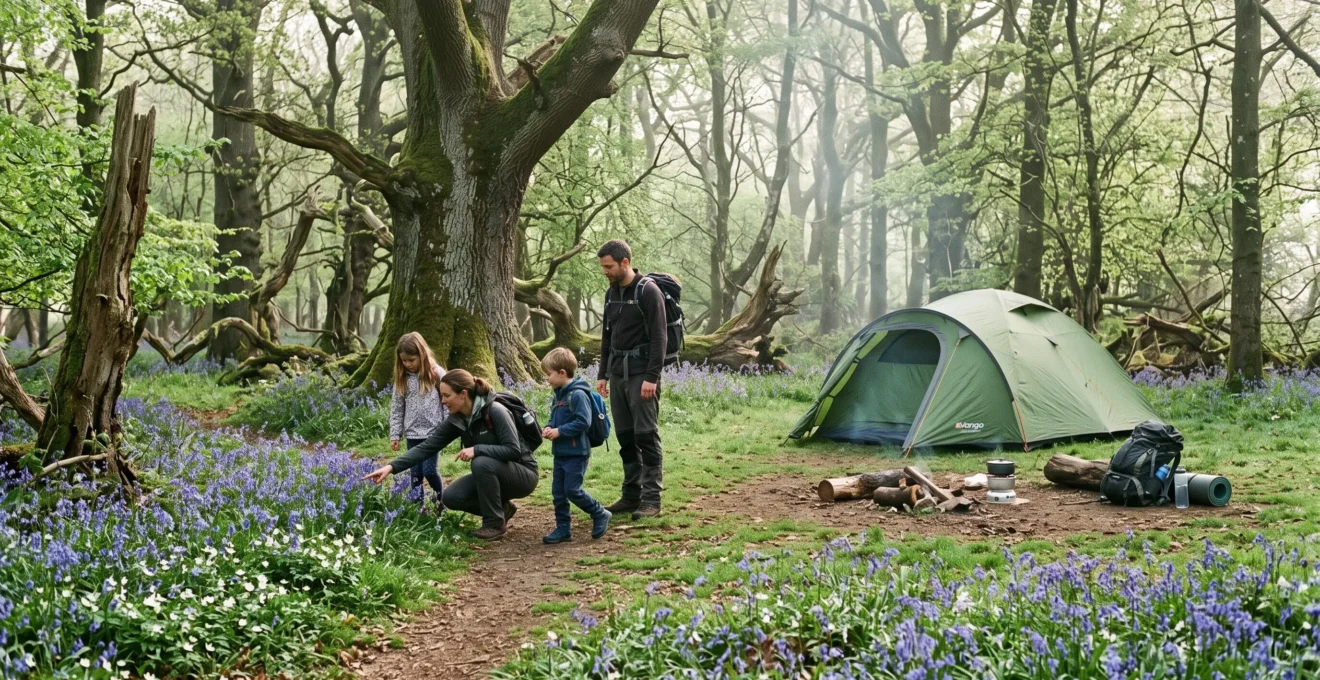
An ancient woodland can feel remarkably timeless: broad trunks rising above mossy banks, spring flowers spreading beneath the canopy, and fallen timber slowly returning to the soil. Yet the qualities that make these places extraordinary are also easily disturbed. A shortcut through bluebells, a tent placed over tree roots or a powerful lantern left shining after dusk can affect habitats that have developed over centuries.
Respectful ancient woodland visits begin with choosing where to walk, where not to camp and when to leave wildlife undisturbed. For campers, this usually means using an authorised campsite outside sensitive woodland habitat, exploring on established paths, observing plants without collecting them and keeping artificial light to a minimum.
The following guidance draws primarily on British woodland conservation practice. Ancient woodland has particular historical and policy definitions in the United Kingdom; elsewhere in the English-speaking world, comparable old-growth or long-established forests may be classified and managed differently. Whatever the terminology, the central principle remains valuable: experience the woodland without treating its ecological history as replaceable.
Respectful Ancient Woodland Visits at a Glance
- Recognise ancient woodland through a combination of indicator plants, historical features and woodland inventory records, rather than tree size alone.
- Keep tents, equipment and footsteps away from sensitive ground vegetation, exposed roots and veteran tree canopies; check camping permission before arrival.
- Protect woodland wildlife by remaining on established paths, controlling dogs, avoiding unnecessary lighting and planning exploration around daylight.
- How to Recognise Ancient Woodland From Plant Species During Spring Visits?
- The Treading Mistake That Damages 200-Year-Old Tree Roots in Ancient Woodlands?
- Why Can’t We Just Replant Ancient Woodlands Once They’re Destroyed?
- How to Capture Ancient Woodland Atmosphere Without Disrupting Nocturnal Species?
- Should You Visit Ancient Woodlands in Spring Bluebell Season or Quiet Autumn?
- The Walking Error That Destroys Protected Ground Habitats in 70% of Wild Areas?
- How to Expose Correctly for Dark Tree Trunks and Bright Canopy Gaps Simultaneously?
- How to Explore Surrounding Wilderness Safely While Camping?
How to Recognise Ancient Woodland From Plant Species During Spring Visits?
Ancient woodland can be recognised through a combination of characteristic woodland plants, historical landscape features and documentary evidence. Spring bluebells, wood anemones and other woodland flowers offer useful clues, but no single species proves that a site is ancient. Confirming its history requires checking woodland inventories, old maps and surviving features such as boundary banks or coppice stools.
In England, ancient woodland means land that has been continuously wooded since at least AD 1600. This describes the history of the land, not the age of every tree growing there today. The definition appears in the Natural England and Forestry Commission guidance on ancient woodland, which also distinguishes ancient semi-natural woodland from plantations on ancient woodland sites.
The distinction matters during a camping holiday. A woodland filled with enormous trees might have developed relatively recently, while a stand of younger trees could occupy ground that has supported woodland for centuries.
Spring provides a particularly useful opportunity to observe woodland ground flora. Native bluebells, wood anemone, wild garlic and wood sorrel can contribute to a picture of long woodland continuity, although their value as indicators varies with region, habitat and local conditions. None should be treated as an independently reliable test.
The Woodland Trust advice on identifying ancient woodland recommends considering several lines of evidence together. Indicator plants become more persuasive when accompanied by historical woodland boundaries, large coppice stools, old pollarded trees or archival records.
A camper exploring a woodland in spring can use a straightforward observational method:
- Observe multiple indicator species. Look for combinations of woodland flowers rather than basing an identification on a single patch of bluebells.
- Examine historical features. Old banks, ditches, coppice stools and pollarded trees may point towards long-established woodland management.
- Check historical evidence. Consult the appropriate national ancient woodland inventory and historical maps before describing the site as ancient.
Finding two or three candidate indicator plants can justify investigating further, but it is not a validated identification threshold. Conversely, failing to find them does not rule out ancient woodland.
Plantations on ancient woodland sites, often abbreviated to PAWS, illustrate why caution is necessary. Such sites may contain planted trees and relatively sparse ground vegetation while retaining soils, fungi or other characteristics associated with their ancient woodland history. Inventories can also omit qualifying sites, particularly small woods.
Once the woodland’s historical value becomes apparent, protecting what lies beneath the trees is the next responsibility. The most serious visitor impacts are not necessarily those that leave an immediately visible mark.
The Treading Mistake That Damages 200-Year-Old Tree Roots in Ancient Woodlands?
The damaging mistake is repeatedly walking, resting or placing camping equipment over sensitive tree-root zones. Soil compaction reduces the pore space through which water and air move, potentially harming fine roots that support tree health. This risk is not confined to trees aged 200 years: species, soil conditions and repeated pressure matter more than a particular age threshold.
Large woodland trees may have extensive root systems, including fine absorbing roots close to the soil surface. In beech and oak woodlands, soil depth and local growing conditions influence how those roots are distributed. Roots do not stop neatly at the trunk or necessarily at the edge of the canopy.
Repeated footsteps, concentrated visitor traffic and the weight of camping equipment can compact vulnerable soils. Exposed roots may also suffer direct injury when visitors scramble across them, drag equipment or attempt to level an uneven campsite.
The difficulty is that damage can remain invisible. A tree may retain a healthy-looking crown while its soil environment deteriorates. Visible decline can take time to emerge, and the effects of compaction depend on its severity and persistence.
For this reason, neither a single tent nor a single season should be assumed to produce a predictable amount of damage. The more reliable precaution is to avoid occupying root-sensitive ground altogether.
At a campsite where pitching is explicitly permitted, select an existing durable camping surface such as maintained short turf or an established pitch, well away from veteran trees. Stay outside the canopy spread and any larger protected root area specified by the site manager. The dripline is a useful visual warning, not a scientifically complete boundary for roots.
Do not clear leaves, cut vegetation, move deadwood or flatten exposed roots to create a more convenient pitch. An apparently unused patch of woodland floor may still support sensitive plants, fungi and invertebrates.
Where a woodland itself does not permit camping, a suitable established campsite outside the protected area provides the better alternative. Woodland Trust visitor guidance specifically discourages camping in its woods because of the potential to damage delicate ground habitats.
Keeping away from veteran trees also reduces exposure to falling branches, especially during windy or unsettled conditions. The interests of personal safety and habitat protection often reinforce one another.
Protecting individual roots is only one part of the challenge. Ancient woodland also depends on relationships between soils, organisms and habitats that cannot simply be recreated if the site is destroyed.
Why Can’t We Just Replant Ancient Woodlands Once They’re Destroyed?
Planting new trees cannot immediately replace an ancient woodland because the habitat includes centuries of ecological development beneath and between those trees. Its soil structure, fungi, seed banks, deadwood habitats and communities of specialised organisms depend on long continuity. New woodland can become valuable habitat, but it cannot quickly recover the full characteristics of an ancient site.
A young plantation and an ancient woodland can contain similar tree species while functioning very differently as ecosystems. The difference becomes particularly apparent when looking beyond their canopies.
Ancient woodland soils may contain long-established communities of fungi, including mycorrhizal fungi associated with tree roots. Woodland plants can depend on particular light conditions, soil properties and historical patterns of land use. Fallen branches and standing deadwood create habitats for organisms associated with different stages of decay.
These ecological relationships are not supplied automatically by planting saplings. Restoration can improve degraded woodland and help recover some features, but it cannot guarantee replacement of an ecosystem shaped by centuries of continuity.
“Ancient woodland takes hundreds of years to establish and is defined as an irreplaceable habitat.”
That principle changes the meaning of responsible recreation. Removing litter after a visit is important, but it does not undo soil compaction, crushed flowers or disturbance to sensitive wildlife. Preventing avoidable damage is more reliable than relying on restoration afterwards.
Popular bluebell photographs illustrate the tension. A woodland may be promoted for its floral displays precisely when visitors are most tempted to leave paths for a better photograph. The problem is not that appreciation is inherently harmful; it is that repeated pressure on the same vulnerable places can concentrate damage.
Site access rules therefore matter. The Woodland Trust, Forestry England and other woodland managers may apply different visitor restrictions depending on ownership, habitat protection and local circumstances. Public access to a woodland does not automatically grant permission to camp, light fires or leave designated routes. Formal protected-site designations and visitor rules are also distinct matters.
The practical response is to check the particular site’s management arrangements, use authorised access routes and avoid treating seemingly minor disturbances as acceptable merely because the woodland looks resilient.
Such care does not prevent meaningful encounters with ancient woodland. It encourages quieter ways of observing its character, including photography that preserves the darkness and tranquillity on which wildlife depends.
How to Capture Ancient Woodland Atmosphere Without Disrupting Nocturnal Species?
Capture ancient woodland atmosphere primarily through available daylight, quiet observation and minimal artificial lighting. After dusk, avoid illuminating potential bat roosts, woodland corridors or wildlife activity areas. Shield any lighting genuinely needed for safe movement, keep it brief and low intensity, and avoid using flash or bright torches to attract, locate or photograph animals.
Darkness is an ecological resource. Bats use woodland edges, tree cover and other landscape features while moving between roosting and feeding areas. Artificial lighting can interfere with these behaviours, although the response varies between species.
The Bat Conservation Trust information on artificial lighting explains that illumination near roost entrances may delay emergence, while some species avoid lit commuting or feeding areas. Horseshoe bats and members of the Myotis group are among the light-sensitive bats discussed in its guidance.
Other bats may feed opportunistically around insects attracted to lights, but their presence does not demonstrate that lighting is harmless to the wider bat community.
For photographers, this means that a lantern illuminating a picturesque tree, a bright headlamp used repeatedly along a woodland path or a flash aimed towards a possible roost deserves greater scrutiny than ordinary daytime photography.
A practical low-disturbance lighting method has three layers:
- Use daylight first. Plan landscapes, bark studies and canopy photographs when natural light makes artificial illumination unnecessary.
- Reduce unavoidable light. For permitted after-dark movement, use the lowest practical brightness, point the beam downwards and shield nearby habitats from direct illumination.
- Reserve stronger lighting for safety. Use brighter light when needed to navigate an immediate hazard, rather than for atmosphere or convenience.
A dim red headlamp may help preserve a visitor’s night vision, but red light is not automatically wildlife-safe. Brightness, direction, duration and the species present all matter. Avoiding unnecessary light remains the stronger principle.
Noise and behaviour require similar restraint. Loud music, repeated calling, dogs moving freely and food left unattended can disturb animals or attract unwanted wildlife activity. These risks are not specific to darkness, although reduced visibility may make them harder for visitors to recognise.
Dawn can provide woodland soundscapes and soft natural illumination without requiring artificial lights. It is not universally disturbance-free, however: birds and other wildlife may be highly active then. Remaining on established paths and keeping an appropriate distance are still essential.
The choice of season also shapes the experience. A woodland carpeted with spring flowers invites a different kind of visit from the same woodland during a quiet autumn morning.
Should You Visit Ancient Woodlands in Spring Bluebell Season or Quiet Autumn?
Spring is the better choice for observing woodland wildflowers, while autumn often offers a quieter experience with fewer distractions from popular floral displays. Neither season is inherently harmless. The more respectful option depends on visitor concentration, path conditions, wildlife activity and whether the chosen site can accommodate visitors without damage to sensitive ground habitats.
In spring, bluebells and other woodland flowers can make ancient woodland history unusually visible. Their distribution across the woodland floor offers clues to habitat conditions and long continuity, especially when interpreted alongside historical evidence.
Yet spring also brings ecological constraints. Flowering ground vegetation is vulnerable to trampling, and many woodland birds begin nesting or breeding activities. On popular routes, repeated departures from the path can gradually widen damaged margins.
Autumn provides a different perspective. Fallen leaves reveal seasonal changes in the canopy, fungi become a prominent feature in suitable conditions, and seeds and fruits help visitors recognise woodland structure beyond its spring display.
The trade-offs are best considered together rather than assuming one season is always preferable.
| Consideration | Spring bluebell season | Autumn woodland visit |
|---|---|---|
| Main attraction | Spring flowers and fresh canopy growth | Fungi, seeds, leaf colour and woodland structure |
| Ground habitat concerns | Flowering vegetation and off-path photography pressure | Wet soil, leaf-covered hazards and sensitive fungi |
| Visitor pressure | Potentially high at well-publicised bluebell woods | Often quieter, depending on the destination |
| Wildlife considerations | Bird nesting and breeding activity | Seasonal feeding, sheltering and other wildlife activity |
| Practical approach | Choose managed routes and remain on paths | Use established paths and observe fungi without disturbance |
A well-managed spring destination with clear paths may be easier to visit responsibly than a lesser-known wood with informal trails and unclear access arrangements. Conversely, choosing a quieter autumn date at an authorised visitor site can reduce the temptation to compete for crowded viewpoints.
Visitor concentration is an important decision factor. At heavily promoted bluebell woods, even small individual departures from designated paths can contribute to cumulative pressure. Specific comparisons between spring and autumn damage, however, require local evidence rather than broad assumptions.
Dogs should remain under close control throughout the year, with additional attention to seasonal nesting wildlife and any local restrictions. Quiet autumn paths do not remove the obligation to protect habitats.
Before travelling, check the site manager’s access information, path closures and seasonal guidance. Let these conditions determine the visit rather than expecting the woodland to accommodate every planned activity.
Whichever season offers the most rewarding experience, the route taken through the woodland matters as much as the date. Even a careful visitor can cause damage by stepping aside for what appears to be an insignificant obstacle.
The Walking Error That Destroys Protected Ground Habitats in 70% of Wild Areas?
The common walking error is leaving an established path to avoid mud, bypass other walkers or reach a better viewpoint. Repeated detours gradually widen routes, crush neighbouring vegetation and create informal trails through sensitive habitat. The percentage in this question is not supported by the supplied evidence and should not be treated as an established measurement of damage across protected wild areas.
Path widening often begins with an apparently reasonable choice. A puddle occupies the middle of a trail, so one walker steps around it. Others follow the same line, exposing soil at the edge. Over time, repeated traffic can turn the detour into a visible secondary route.
These informal routes, sometimes called desire lines or social trails, may look legitimate once enough people have used them. Their appearance does not establish that they are designated or environmentally appropriate.
On woodland slopes, disturbed ground may also change how surface water flows. Vegetation loss and exposed soil can increase opportunities for erosion, although the extent depends on local drainage, gradient and soil characteristics.
The Woodland Trust’s Love your woods visitor code asks visitors to remain on paths, avoid disturbing plants and wildlife, keep dogs close and refrain from lighting fires or camping in its woods.
Staying on the intended route is especially important near bluebell colonies, damp woodland flushes and thin or erosion-prone soils. Recovery from trampling differs between habitats, making it unwise to assume a flattened patch will quickly regenerate.
A muddy stretch does not automatically justify walking around it. Where it is safe, waterproof footwear can allow visitors to remain on the established line. If the route is flooded, unstable or unsafe, turn back or choose an authorised alternative rather than forcing a passage through vulnerable vegetation.
Five Checks Before Following a Woodland Trail
- Identify the official route using the site map or waymarkers. Record the intended trail on your map.
- Inspect the first muddy or narrow section. Decide whether the existing path is safely passable without stepping onto vegetation.
- Agree to walk single-file through constrained sections. Establish a clear group rule against taking shortcuts.
- Identify apparent side trails and verify them against authorised route information. Mark any uncertain junction on your map rather than assuming it is a public path.
- Choose a turnaround point if conditions deteriorate. Record a safe alternative or return route that avoids creating a new track.
This method protects both the ground and the visitor. It replaces improvised detours with a deliberate choice between continuing safely on an existing path and returning by a known route.
Remaining on a path need not limit appreciation of the woodland’s beauty. Photographers can adapt their camera settings and compositions to the views available from established routes.
How to Expose Correctly for Dark Tree Trunks and Bright Canopy Gaps Simultaneously?
Expose for the brightest important canopy details, then preserve or recover darker trunk information using a RAW file where possible. When the contrast exceeds the camera’s usable dynamic range, bracket several exposures and blend them carefully. This allows woodland photographers to represent both illuminated foliage and shaded bark without moving into protected vegetation to find different lighting.
Ancient broadleaf woodland presents a classic high-contrast photography problem. Bright sky may appear through gaps in the canopy while tree trunks, exposed roots and the forest floor remain in deep shade.
If exposure is based mainly on the shaded trunks, the brightest gaps can lose detail. If the camera exposes mainly for the sky, darker areas may become too dark to reveal useful texture.
RAW capture generally provides greater flexibility for tonal adjustments than a finished JPEG, although the amount of recoverable detail depends on camera capability, exposure and noise. Completely clipped highlights cannot reliably be reconstructed from information that was never recorded.
A practical field method is to:
- Compose from an established path, using major trunks and canopy openings to establish the visual structure.
- Check the brightest parts of the scene with the histogram and highlight warnings, if available.
- Adjust exposure to retain important highlight detail while keeping shadows within a usable range.
- Capture in RAW where supported, then make restrained shadow adjustments during editing.
- Use exposure bracketing for stationary scenes with exceptionally high contrast, blending only when subject movement and camera stability permit.
Spot metering can help assess bright areas, but it must be interpreted alongside the camera’s metering behaviour. Exposing to the right means placing the recorded exposure as bright as practicable without sacrificing important highlights; it does not mean deliberately overexposing the sky.
Backlit leaves, luminous openings and darker trunks can also form an intentional composition. Instead of forcing all tones towards equal brightness, preserve some shadow to communicate the depth and atmosphere of an ancient woodland.
This approach has an ecological advantage. Better exposure technique reduces the motivation to climb over roots, enter flower-covered ground or install artificial lights simply to achieve a particular photograph.
For daylight landscapes, work with existing viewpoints and natural light. Wildlife photography requires additional restraint: never direct lighting towards suspected bat roosts or manipulate animals to create a scene.
Technical preparation supports respectful observation, but it is only one part of a successful camping trip. Navigation, weather awareness and realistic walking plans help prevent both personal emergencies and damaging shortcuts.
Key Takeaways Before Exploring Further
- Choose a permitted campsite and an authorised walking route before entering the woodland, rather than making access decisions after arrival.
- Build sufficient daylight and weather flexibility into the outing so changing conditions do not encourage shortcuts through sensitive ground.
- Carry independent navigation tools, agree a return plan and keep the group’s pace appropriate for its least experienced member.
How to Explore Surrounding Wilderness Safely While Camping?
Explore woodland and surrounding countryside safely by planning an authorised route, checking weather and daylight, carrying reliable navigation equipment and agreeing when to return. A well-prepared group is less likely to become disoriented, rush through unfamiliar terrain or cut across protected ground. Around ancient trees, safety also involves avoiding unstable branches and respecting sensitive root zones.
Ancient woodland can be surprisingly disorienting. Dense vegetation, similar-looking junctions and restricted views may make distances and directions harder to judge than on open hills or maintained campsite grounds.
A safe exploration plan therefore begins before leaving the campsite. Check the route’s length and difficulty, identify recognised entrances and exits, and review any closures or restrictions announced by the land manager.
Compare the intended route with the daylight available and the weather forecast. Conditions can make paths slippery, obscure landmarks or turn normally manageable sections into difficult ground.
Carry a suitable map and compass and know how to use them. A charged phone with offline mapping can provide useful support, but its battery, reception and positioning should not be the only means of finding the route. Tell a responsible person where the group intends to go and when it expects to return.
Safety considerations specific to woodland and its surroundings include:
- Veteran trees: Avoid stopping beneath large or visibly unstable branches, particularly in strong winds or following severe weather. Do not assume apparently healthy trees are entirely free of branch-failure risk.
- Ticks: Take precautions in grassy, scrubby and bracken-rich areas, check clothing and skin after the visit, and follow locally applicable public-health advice.
- Livestock: Observe local access instructions, give animals space and keep dogs under appropriate control, especially near young livestock.
- Unstable ground: Treat waterlogged paths, steep banks, exposed roots and slippery fallen timber as reasons to reassess the route rather than improvise shortcuts.
Families benefit from a simple shared procedure. Keep younger children within sight, establish a turnaround time and explain what to do if anyone becomes separated. Agree that a lost person should stop in a safe place rather than wander off in search of the rest of the group, while the response of accompanying adults follows the circumstances and local emergency guidance.
Plan distances around the youngest or least experienced walker. A route that looks modest on a map may be demanding when it includes muddy ground, repeated junctions and frequent stops for observation.
Safe exploration also depends on knowing when not to proceed. If weather deteriorates, the route becomes unclear or daylight is running short, returning along the established trail is preferable to pushing onward through sensitive woodland.
Choose an authorised campsite, select one suitable woodland trail and prepare to explore it without rushing. Bring binoculars, a field guide or a camera if useful, but leave flowers, deadwood and woodland soil undisturbed. The most rewarding encounter with ancient woodland is one that preserves the possibility of equally rewarding visits for those who come afterwards.
Can you camp legally inside ancient woodland in the UK?
Permission depends on the woodland’s location, ownership, access rights and site-specific restrictions. Ancient woodland status does not itself establish a universal camping rule throughout the UK. The Woodland Trust discourages camping in its woods because of habitat disturbance. Check the land manager’s rules and the applicable national access framework before making arrangements.
Can fallen branches and deadwood be collected for a campsite fire?
Do not assume fallen wood is available for collection. Deadwood provides valuable habitat for woodland organisms, and removing it may conflict with site rules. Fires and barbecues are prohibited or discouraged in many managed woodland settings, including Woodland Trust woods. Use only cooking arrangements explicitly permitted at an authorised campsite.
Is an ancient woodland inventory enough to confirm a woodland’s status?
An official inventory is an important starting point, but absence from an inventory does not necessarily prove a woodland is not ancient. Smaller qualifying sites may be missing. Historical maps, landscape features, ecological evidence and appropriate expert assessment can provide further information where status is uncertain.
How can visitors photograph bluebells without damaging them?
Remain on established paths and use camera positioning, focal length and composition to frame flowers from a distance. Do not stand among bluebells, flatten surrounding vegetation or move plants for a photograph. A well-chosen viewpoint from the path can reveal the woodland’s atmosphere without disturbing its flowering ground layer.
Do the same ancient woodland rules apply in every English-speaking country?
No. England’s historical definition of ancient woodland and its planning protections are not universal standards. Scotland, Wales and Northern Ireland have their own administrative frameworks, while countries such as Canada, Australia and the United States use different conservation classifications and access arrangements. Visitors should follow local land-management guidance while applying the same underlying precautions against trampling, root damage and wildlife disturbance.