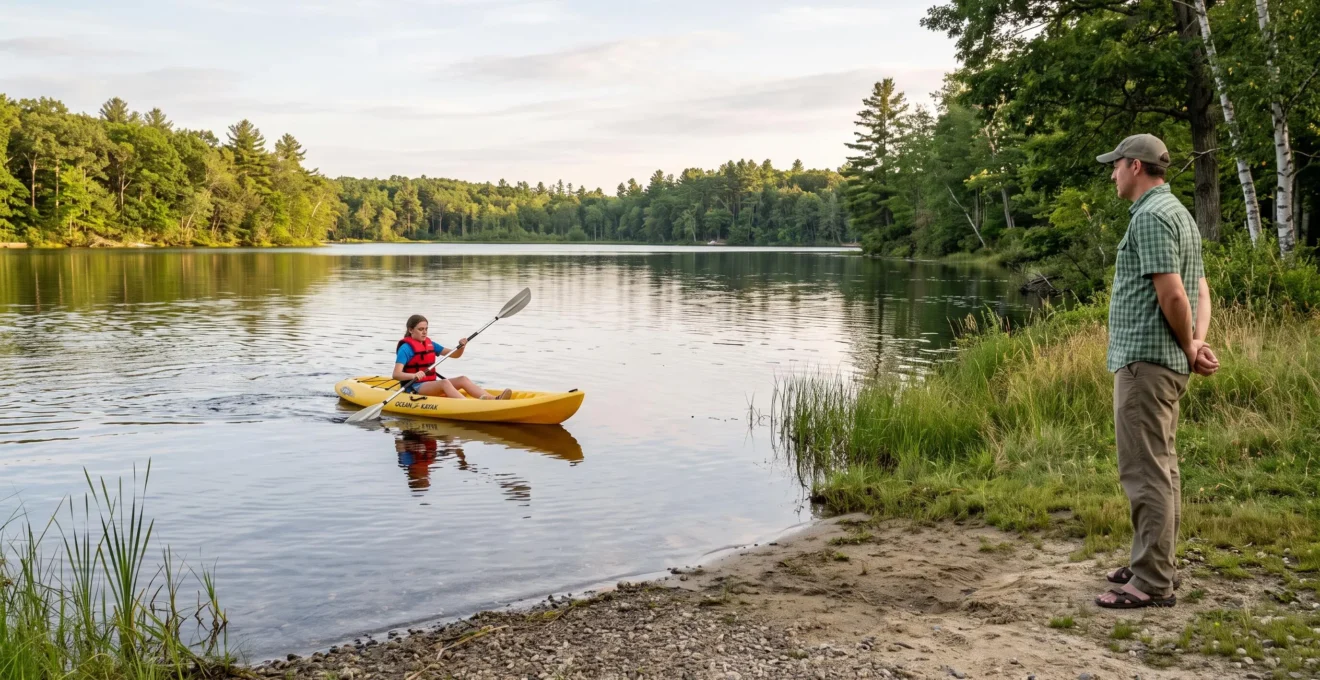
A lake can look perfectly calm from a campsite and still be unsuitable for someone learning to kayak. An exposed stretch of water can develop uncomfortable waves when the wind rises. A nearby marina can send powerboat wakes across an otherwise peaceful bay. Even a sheltered shoreline may conceal currents, underwater obstacles or difficult landing conditions.
The safest learning environment is not necessarily the smallest lake or the one with the clearest water. It is a sheltered area where beginners can launch comfortably, remain close to accessible shorelines, avoid significant boat traffic and return without fighting wind or current.
Before carrying a kayak to the water, examine the lake’s shape, prevailing wind, access points and nearby hazards. Then compare that information with the actual conditions at the launch. A suitable lake on one morning may be a poor choice that afternoon.
For a first outing, prioritize protected flatwater, a properly fitted personal flotation device (PFD), suitable clothing for the water temperature and an experienced companion or qualified instructor.
Choosing a beginner-friendly kayaking lake: the essentials
- Prioritize shelter over lake size: Short wind exposure, limited motorboat traffic and calm surface conditions matter more than total acreage.
- Plan exits before launching: Choose a gradual beach and identify other accessible landing places along a short shoreline route.
- Check hazards and recovery options: Avoid strong winds, dams, outlets and cold-water exposure beyond your preparation or rescue skills.
- How to Tell if a Lake Is Small Enough to Stay Calm in 15mph Winds?
- The Hidden Lake Hazard That Capsizes Novice Kayakers on Apparently Calm Water?
- Should Beginners Launch Kayaks From Shallow Beaches or Deep Dock Areas?
- How to Choose Lakes With Multiple Easy Exit Beaches for Nervous Paddlers?
- At What Wind Speed Should Beginners Avoid Kayaking Even on Small Lakes?
- How to Spot Hidden Currents From Surface Water Patterns Before Entering?
- How to Escape a Capsized Kayak Without Panicking Underwater?
- How to Recognise and Navigate Water Currents Safely While Kayaking?
How to Tell if a Lake Is Small Enough to Stay Calm in 15mph Winds?
A lake is not automatically calm enough for beginner kayaking simply because it is small. At 15 mph, wind can generate troublesome waves wherever it blows across an exposed stretch of water. Beginners should assess the distance of open water facing the wind, shoreline shelter, gusts and visible wave conditions rather than relying on lake width alone.
The important measurement is wind fetch: the distance over which wind travels across water while generating waves. The National Weather Service marine definitions explain this concept in the context of wind-generated waves.
Consider two hypothetical lakes experiencing the same 15 mph wind. One is approximately half a mile wide, surrounded by trees and sheltered from the prevailing wind. The other has five miles of uninterrupted water in the wind’s direction. The second offers much more room for waves to develop, although neither lake can be declared safe from these dimensions alone.
Wind direction matters as much as the shoreline-to-shoreline distance. A long, narrow lake may offer protected water when wind blows across its short axis but become considerably rougher when wind follows its length.
At the launch, look across the lake in the direction from which the wind is blowing. Identify the longest uninterrupted water corridor. A clearly visible opposite shore can help with orientation, while a barely distinguishable shore may suggest considerable exposure. Visibility alone, however, cannot establish wave conditions: haze, lighting and terrain all affect what can be seen.
Next, examine the surface. Darker streaks or patches of roughened water may indicate gusts crossing the lake. Compare these with the broader wave pattern, watching whether small ripples repeatedly develop into steeper waves. Sudden gusts can be particularly challenging because they alter the kayak’s handling without much warning.
Finally, compare the shoreline observations with the forecast. Weather stations may be located away from the lake, and sheltered launch areas can conceal stronger winds farther offshore.
Even when the wind exposure looks manageable, the next question is whether other water users can disturb an otherwise calm surface.
The Hidden Lake Hazard That Capsizes Novice Kayakers on Apparently Calm Water?
Motorboat wakes are an important hidden hazard for novice kayakers on apparently calm lakes. A passing powerboat can produce waves that reach a kayak after the boat has moved away. Beginners concentrating on paddling may be surprised by these waves, particularly when they arrive from the side or combine with reflected waves near shore.
A lake with mirror-flat water can be busy with motorboats, personal watercraft or recreational towing activities. Wakes may travel across open water and interact with shorelines, docks and other waves, creating unpredictable movement.
According to Parks Canada‘s Trent-Severn paddling guidance, paddlers should anticipate boat wakes and be prepared to turn into approaching waves or use a low brace to stabilize their craft.
Before launching, examine the lake map and shoreline for likely traffic concentrations:
- Marinas and public boat ramps: Boats frequently enter and leave these areas.
- Narrow channels: Motorboats and paddlers may share limited navigable space.
- Open mid-lake routes: Faster recreational boating may create wakes that travel considerable distances.
- Busy waterfront areas: Repeated wakes may arrive from several directions.
A kayak’s stability also changes as it tilts. Primary stability describes how steady the craft initially feels when upright. Secondary stability concerns its resistance and behavior as it heels farther over. A kayak that feels comfortable on flat water may still surprise a beginner when a wake causes it to roll.
Learning a low brace under supervision can help paddlers respond to moderate disturbances. However, bracing is not a substitute for avoiding traffic or conditions beyond their skill level.
Another hazard can be hidden just below the surface. Fallen branches, submerged stumps, rocks and shallow sandbars may stop or turn a kayak unexpectedly. They are particularly relevant around wooded shorelines and narrow passages. Staying reasonably close to shore can reduce exposure to boat traffic, but paddlers must maintain clearance from underwater obstacles and avoid obstructing navigation channels.
Once traffic and underwater hazards have been assessed, the safest starting location depends on how easily a novice can enter and leave the kayak.
Should Beginners Launch Kayaks From Shallow Beaches or Deep Dock Areas?
A gradual, sheltered beach is often the more manageable launch choice for a first-time kayaker because it allows entry in shallow water and offers an uncomplicated return to shore. A suitable low dock can also work, especially with an instructor or assistant. The better option depends on footing, kayak design, accessibility and available support.
Beach launches let learners position their kayak before sitting down, reducing the need to transfer their weight from an elevated platform onto a floating craft. Firm sand or fine gravel can provide stable footing, whereas mud, slippery rocks or steep drop-offs may make a beach unsuitable.
Dock launches introduce different challenges. If the dock is high above the water, a beginner must lower their body into a kayak that can move away or rotate. Trying to straddle a floating kayak while transferring weight can destabilize it. A low, purpose-built paddle dock with assistance may be much easier.
The American Canoe Association‘s Level 2 kayak touring overview recognizes docks, beaches and other shorelines as possible launch and landing locations. It does not establish that one method is universally safer.
For a suitable sit-on-top kayak at a shallow beach, a supervised launch can follow this general sequence:
- Choose firm, unobstructed footing and position the kayak where it floats without grounding heavily.
- Keep the paddle within reach and stabilize the kayak, with assistance if needed.
- Straddle the kayak in shallow water where conditions permit, then lower your weight centrally into the seat.
- Place both feet securely, settle into a balanced seated position and take hold of the paddle.
- Push gently into sufficient water depth while maintaining clearance beneath the hull.
This sequence should be adapted to the craft and the instructor’s guidance. Some sit-inside kayaks require a different entry method, and shallow-water techniques are unsuitable where underwater obstacles or unstable footing create additional risks.
| Selection criterion | Shallow beach | Dock area |
|---|---|---|
| Balance confidence | Often easier with a gradual, firm approach | Best with a low dock and assistance |
| Footing | Check sand, gravel, mud and underwater obstacles | Check surface grip, height and stability |
| After a capsize | May offer a straightforward shore landing | Re-entry can require assistance or a specialized platform |
| Heavier sit-on-top kayaks | Easy to position with sufficient help | May benefit from a purpose-built launch system |
| Mobility considerations | Uneven ground may be difficult | An accessible kayak-launch dock may be preferable |
For supervised lessons, rescue assistance can make either option workable. For unsupervised beginners, neither launch type compensates for missing capsize and recovery skills.
A comfortable launch is only the beginning: the rest of the shoreline must also offer realistic places to land if the paddler becomes tired or conditions change.
How to Choose Lakes With Multiple Easy Exit Beaches for Nervous Paddlers?
Choose lakes with several accessible, gently sloping landing areas along a short, sheltered route. For nervous beginners, these exits provide opportunities to rest, stop early or receive assistance without completing a full circuit. Check that each landing is physically usable, legally accessible and reachable under the wind conditions expected during the outing.
Landing opportunities are a practical safety margin. A beginner who becomes tired, uncomfortable or anxious should not have to paddle a long distance to return to the original launch.
Start by examining a satellite map. Look for small beaches, gradual shoreline clearings and sheltered coves along the intended route. Then compare the imagery with access maps, local rules and recent information about water levels.
A pale strip visible on satellite imagery may be a sandy beach, but it could also be exposed mud, private land or an inaccessible bank. Treat it as a possible landing until verified.
For each candidate exit, assess:
- Whether the shoreline is gradual enough to approach without striking rocks or obstacles.
- Whether landing is permitted and there are no protected-area restrictions.
- Whether the approach is sheltered from waves, boat traffic and current.
- Whether a supervising adult can reach the site on foot or by vehicle if assistance is needed.
- Whether the exit remains usable if the wind changes direction.
Windward and leeward shorelines require careful interpretation. A windward shore faces the incoming wind, while a leeward shore is sheltered from it. A downwind destination may be easier to drift toward, but waves can build against the receiving shore and make landing hazardous. Conversely, a sheltered cove may provide a safer landing even if reaching it requires a short controlled approach.
Do not assume that every downwind beach is a safe emergency exit. Favor protected landing places and routes that avoid forcing a tired paddler to travel upwind across exposed water.
For families camping beside a lake, a short out-and-back route between two accessible beaches may be more reassuring than a full shoreline loop. A supervising adult can remain at a visible landing point, although shore supervision alone does not replace an experienced companion on the water.
The American Canoe Association’s entry-level touring framework emphasizes regular access to landing areas. It does not specify a universal spacing between them, so the appropriate distance must reflect the learner’s stamina, conditions and available support.
After confirming suitable landings, examine the weather carefully: even a lake with excellent shore access may be inappropriate when the wind strengthens.
At What Wind Speed Should Beginners Avoid Kayaking Even on Small Lakes?
Beginners should favor calm or light-wind conditions, with winds below roughly 10 mph serving as a cautious planning starting point rather than a guaranteed safe limit. At 15 mph, a first-time paddler should generally postpone an independent outing. Gusts, lake exposure, kayak handling and the direction of the return journey can make even lower speeds unsuitable.
Wind limits cannot be determined from a single forecast number. Three practical variables influence how manageable the conditions will feel.
- Kayak and paddler combination: Hull shape, length, windage, load distribution and the paddler’s ability affect tracking and control. Weight relative to the manufacturer’s recommended capacity matters, but does not produce a universal wind limit.
- Kayak design: Sit-on-top and sit-inside kayaks vary considerably in stability, handling and wind sensitivity. Neither category is automatically safer in stronger wind.
- Available fetch: Wind acting across a longer exposed water surface has more opportunity to develop waves.
For a beginner, gusts may be more important than the reported sustained speed. A forecast with moderate average wind but much stronger gusts can produce abrupt changes in handling.
Wind direction creates another risk. Offshore wind blows away from the land toward open water. The launch may feel sheltered because nearby trees and terrain block the breeze, while conditions farther from shore are stronger. Paddling outward can feel easy until the learner attempts to return against the wind.
Whenever possible, plan a short route that tests the more difficult direction early, with a nearby exit available if progress becomes difficult. This principle does not justify launching into strong headwinds or paddling toward an unsafe shoreline.
Five checks for a beginner kayak go/no-go decision
- Check sustained wind and forecast gusts for the planned outing; record both figures and their expected direction.
- Mark the longest exposed water corridor on a lake map; identify the shoreline section most vulnerable to wind-generated waves.
- Observe flags, trees and water texture from the launch; write down whether gusts, steep chop or whitecaps are visible.
- Mark the intended outward and return directions, including sheltered alternative landing points; confirm the route does not require a difficult exposed return.
- Record a clear launch decision: proceed only within the group’s demonstrated abilities, otherwise postpone or choose a more sheltered location.
Whitecaps are a clear warning that waves are breaking under wind action. For a novice planning a protected flatwater session, their appearance is a strong reason not to launch. If conditions deteriorate during an outing, seek an appropriate nearby landing before control becomes difficult.
There is no need to test personal limits during a first kayaking experience. A sheltered lake with predictable conditions offers a better opportunity to develop technique.
Wind is not the only force capable of moving a kayak away from its intended route. Some lakes also contain currents that are difficult to recognize from a distance.
How to Spot Hidden Currents From Surface Water Patterns Before Entering?
Hidden lake currents can sometimes be recognized through moving debris, converging surface lines, localized ripples or water flowing differently from the surrounding lake. These clues are especially important near stream inlets, outlets, narrow channels and dams. Surface patterns are not definitive, however, so beginners should avoid suspicious areas rather than relying on visual interpretation alone.
Although lakes are often described as still water, several mechanisms can create movement. Streams carry water into or out of the lake. Wind can drive surface circulation. Narrow passages can concentrate flow, while dam operations may alter current strength unexpectedly.
Begin scouting from a safe position on shore. Observe the surface for several minutes, particularly where water enters or leaves the lake.
Possible indicators include:
- Debris or bubble lines: Floating material moving consistently in one direction may reveal a current pathway, although wind can also move surface debris.
- V-shaped surface patterns: Water passing around submerged rocks can create visible disturbances. Their orientation depends on flow and obstacle geometry, so a V alone cannot reliably establish current direction.
- Glassy patches: Smooth water beside rougher water may reflect shelter, depth changes or differences in flow. Smoothness is not proof of a safe channel.
- Standing ripples or wavelets: Persistent surface features may indicate moving water interacting with the lakebed or other currents.
- Converging surface lines: Distinct textures meeting along a boundary can indicate differences in current, wind or water properties.
Compare the movement of floating material with the wind direction. Debris moving steadily against the apparent surface wind may suggest another driving force, but this observation alone is not sufficient to calculate current speed or identify an underwater hazard.
Pay particular attention to narrows connecting two lake sections. Water movement can become concentrated there, especially where a river system passes through the lake.
Near a dam or outlet, the consequences of misjudging flow can be severe. Strong currents, intake structures and turbulent water may be difficult or impossible to escape. Do not approach these features to test current strength.
If a proposed launch is near an inlet, outlet or controlled water structure, choose another location unless reliable local information and qualified supervision establish that the area is appropriate. Attempting to paddle across an unfamiliar outflow is not a safe substitute for selecting a different launch.
Because surface observations cannot eliminate every hazard, beginners also need to prepare for the possibility of an unexpected capsize.
How to Escape a Capsized Kayak Without Panicking Underwater?
Escaping a capsized kayak safely begins with practiced wet-exit skills, a properly fitted PFD and an understanding of the kayak’s cockpit or seating system. Sit-on-top kayaks generally allow paddlers to separate from the craft more easily, while sit-inside kayaks may require deliberate cockpit and sprayskirt release techniques. These skills should be learned under qualified supervision before an independent outing.
Unexpected immersion can be disorienting. The kayak may rotate, visibility may decrease and a paddler may instinctively struggle to regain an upright position. Rehearsing a simple sequence under controlled conditions can reduce uncertainty.
For a capsize, remember three priorities: get clear and reach the surface, establish breathing and flotation, then recover equipment when safe. Staying with a floating kayak can aid rescue, but never delay escaping an overturned craft or surfacing to hold the boat or paddle.
For a sit-on-top kayak, the paddler will often separate from the seat as the craft overturns. Once at the surface, they can orient themselves, maintain flotation and follow a practiced recovery method.
For a sit-inside kayak, the cockpit may feel confining. If a sprayskirt is fitted, the paddler must know how to release it. Wet-exit instruction typically involves maintaining orientation, releasing the skirt where applicable, freeing the legs and pushing clear of the cockpit. Exact movements depend on equipment and must be practiced with an instructor rather than attempted for the first time underwater.
Re-entering a kayak is a separate skill. The American Canoe Association’s training framework includes assisted and unassisted re-entry, with scramble or cowboy methods and paddle-float techniques among the possible approaches.
A scramble recovery may involve climbing back aboard from the water. A paddle-float method uses additional flotation to assist with stabilizing the kayak during re-entry. Neither technique is exclusive to one kayak category, and both require practice appropriate to the specific craft.
Cold-water shock makes preparation particularly important. The National Weather Service cold-water safety information explains that sudden immersion can trigger involuntary gasping, rapid breathing and physiological stress. Such reactions may occur even when the air feels warm.
Cold water can also reduce muscle control, making it harder to swim, grip equipment or climb back into a kayak. Clothing should therefore be selected for the water temperature and realistic immersion risk, not simply the weather forecast.
For an introductory lesson, choose supervised, sheltered water with suitable depth and conditions for controlled capsize practice. Avoid deliberately overturning a kayak alone, in cold water without adequate protection, or near obstacles.
A properly fitted PFD supports flotation but does not prevent cold shock or guarantee rescue. Paddling with a capable companion, having a communication method and knowing how to reach shore remain important safeguards.
Once basic recovery skills are understood, the remaining environmental challenge is recognizing when moving water can carry a kayak away from its planned route.
Key takeaways before navigating lake currents
- Identify the source of water movement before deciding how to respond: wind-driven drift, natural inflow or outflow, and dam-related flows create different hazards.
- Keep enough control and shoreline access to end the outing early; an accessible landing is more useful than attempting to overpower unexpected flow.
- Never treat currents near dams, spillways or intake structures as suitable practice conditions for beginner kayakers.
How to Recognise and Navigate Water Currents Safely While Kayaking?
Beginner kayakers should recognize current through surface movement, local waterway information and the location of inlets, outlets and dams. In mild, predictable flow, trained paddlers can adjust their heading to compensate for drift. When the current exceeds their ability to maintain control, the safer response is to avoid the area or land at a suitable accessible shoreline.
Three sources of movement deserve separate consideration.
- Wind-driven drift: Wind pushes the kayak and can also generate surface circulation. Adjusting the route and staying in sheltered water may reduce exposure.
- Inflow and outflow: Streams and connected waterways can create directional currents, particularly around narrow channels. These may persist even when the wind drops.
- Dam-release flows: Water-control operations can create changing currents and hazardous turbulence. Beginners should remain outside restricted and potentially dangerous areas.
When a trained paddler crosses mild, predictable current, a technique often called a ferry angle can help compensate for sideways movement. Instead of pointing directly at the destination, the paddler angles the bow somewhat upstream and adjusts the heading to maintain the intended crossing line.
The correct angle depends on current strength, kayak speed and paddling ability. It is not a fixed setting, and a ferry angle does not make strong current safe for novices. Crossing-current skills should be developed with qualified instruction in suitable controlled conditions.
Broadside exposure can make some kayaks harder to control when current interacts with waves or obstacles. However, stability depends on hull design, wave characteristics and paddler technique; being beam-on to a current does not automatically cause a capsize.
Route planning should also account for drift. A kayak moving through water may still travel sideways relative to the shore when wind or current acts on it. Beginners can underestimate how much effort will be needed to return to the launch.
For a simple sheltered out-and-back trip, paddling the more demanding direction first can help preserve an easier return. This approach is appropriate only when the initial leg is comfortably within the paddler’s abilities and does not lead toward a hazard.
Imagine a hypothetical lake with a mild breeze blowing from the campsite toward the opposite shore. The outward journey may feel effortless, but the return could require sustained paddling against the wind. A better plan may be to stay along a sheltered shoreline, shorten the route or postpone the outing.
If a current becomes difficult to manage, prioritize maintaining control and reaching a genuinely safe landing. Do not attempt to fight directly against strong flow near an outlet or spillway. If the kayak is being carried toward a dangerous structure, immediate emergency assistance may be necessary; a shoreline landing should never be assumed possible.
Low-head dams are especially hazardous because their recirculating water can trap people and boats. Spillway turbulence, intake currents and other hydraulic structures should be avoided regardless of paddling confidence.
Before leaving the campsite, check local notices for navigation restrictions, dam operations, water levels and boating activity. Select a protected route with dependable exits and avoid any section where successful completion depends on overcoming unfamiliar currents.
Choose one short, accessible shoreline route, inspect it from land and arrange a supervised first session when the water is calm. Building confidence in predictable conditions is more useful than completing a longer or more challenging crossing.
Is a small lake always safer than a large lake for learning to kayak?
No. A small lake may have strong winds, motorboat traffic, steep shorelines or dangerous outlets. A larger lake may contain a sheltered bay with excellent access and very limited exposure. Compare the actual paddling area rather than relying on the lake’s overall size.
How far from shore should a beginner kayak?
There is no universally safe distance. Beginners should remain close enough to suitable landing areas for their abilities, water temperature and rescue arrangements. A short route along a protected shoreline is generally more appropriate than an open-water crossing, but shore proximity does not remove hazards such as rocks, fallen trees or boat traffic.
Can beginners kayak safely on a lake with motorboats?
Possibly, if a genuinely sheltered area separates beginners from busy traffic and wake exposure remains manageable. Look for designated paddling zones, protected coves and clear navigation arrangements. If wakes repeatedly disturb the learning area, choose another location or time.
Should beginners choose a sit-on-top or sit-inside kayak for a lake?
Both designs can be suitable for protected flatwater when appropriately selected and used. Sit-on-top kayaks commonly allow easier separation after a capsize, while sit-inside models provide a different seating arrangement and may offer additional protection from splashes. Consider stability, fit, water temperature, rescue skills and the instructor’s recommendations rather than assuming one design is always safer.
Can warm weather make cold lake water safe for first-time kayakers?
No. Lake water may remain cold despite warm air temperatures, especially in deeper areas or near cold inflows. Unexpected immersion can trigger gasping and breathing difficulties. Check water temperature, wear appropriate immersion protection and a properly fitted PFD, and choose conditions suitable for supervised learning.